
On-Page SEO Checklist: 20 Proven Ranking Tips
By the CoTasks IT Solutions SEO Team — Google & HubSpot Certified Digital Marketing Specialists
Most search journeys never make it past the first page. According to HubSpot's research on search behavior, 75% of Google users never scroll past page one — and a separate Ahrefs analysis of billions of clicks found that in August 2025, 96.98% of desktop clicks landed within the top 10 results, with mobile clicks concentrated even more tightly at the top. If your website isn't appearing in those top results, you're losing traffic, leads, and revenue every single day.
The good news: improving your rankings doesn't always require expensive ad campaigns or thousands of backlinks. Often, the biggest gains come from optimizing the pages you already have. That's where a well-planned on-page SEO checklist becomes essential.
On-page SEO is the practice of optimizing every element on your webpage — content, headings, images, URLs, page speed, and internal links — so search engines can better understand your content while giving visitors an excellent experience.
This guide covers 20 proven on-page SEO techniques to help bloggers, business owners, marketers, and SEO professionals improve rankings, grow organic traffic, and build content that Google — and increasingly, AI search tools — actually surfaces.
What Is On-Page SEO and Why Does It Matter?
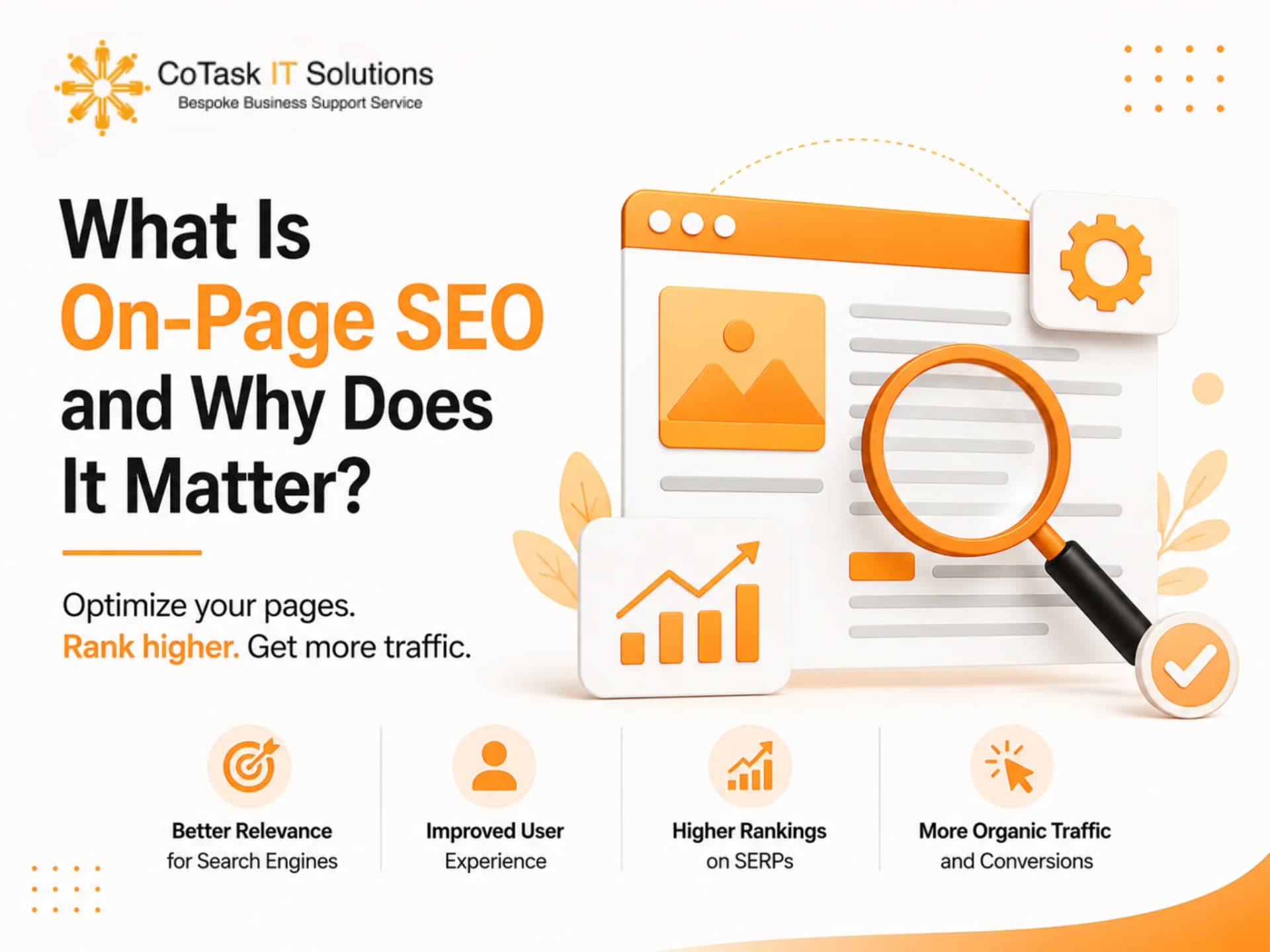
On-page SEO is the practice of optimizing individual web pages to improve visibility in search engines and deliver a better user experience. Unlike off-page SEO (backlinks, brand authority) or technical SEO (site infrastructure), on-page SEO focuses on everything you control directly on the page itself.
Google evaluates hundreds of on-page signals — content quality, keyword relevance, page speed, mobile usability, internal linking, structured data, and user engagement — to decide whether your content earns a top position.
Per Google's Search Central guidance on helpful content, creating people-first, genuinely useful content remains one of the strongest ranking signals. Strong on-page optimization isn't optional anymore — it's foundational to sustainable organic growth.
The Complete On-Page SEO Checklist: 20 Proven Ways to Improve Rankings
1. Conduct Thorough Keyword Research
Every SEO strategy starts with keyword research. Before writing, understand exactly what your audience is searching for — the wrong keywords mean low traffic even with excellent content.
Use tools like Google Keyword Planner, Ahrefs, SE Ranking, or SEMrush to assess search volume, competition, and intent.
Pro Tip: Prioritize long-tail keywords with clear buying or informational intent — they're easier to rank for and typically convert better.
2. Optimize Your Title Tag
Your title tag is often the first thing users see in results. A compelling title improves both rankings and click-through rate (CTR).
Keep titles under 60 characters and place your primary keyword near the beginning when it fits naturally.
Best Practice: Use numbers or power words — Ultimate, Complete, Proven — to boost clicks. Example: "On-Page SEO Checklist: 20 Proven Ranking Tips"
3. Write a Click-Worthy Meta Description
Meta descriptions aren't a direct ranking factor, but they strongly influence whether people click your result over a competitor's.
Write 150–160 characters, include your primary keyword naturally, and lead with a benefit.
Example CTA: "Get the complete On-Page SEO Checklist — 20 proven techniques to boost your Google rankings today."
4. Use the Primary Keyword in the First 100 Words
Google tries to understand your page quickly. Mentioning your primary keyword naturally in the opening paragraph reinforces topical relevance — but don't force it. Introduce it while explaining the article's purpose.
5. Optimize Your URL Structure
A good URL is short, descriptive, keyword-rich, and easy to read.
- Good: cotasks.com/blog/on-page-seo-checklist
- Avoid: cotasks.com/blog/post?id=98765
Pro Tip: Use hyphens, not underscores, to separate words.
6. Use Proper Header Tags (H1, H2, H3)
Headers organize content into logical sections for readers and crawlers alike. Every page should include one H1, several H2s, and supporting H3s where needed. Add keywords naturally in headings — never stuff them into every section.
7. Optimize Images with Alt Text
Alt text explains images to search engines and improves accessibility for visually impaired users.
File name: on-page-seo-checklist-guide.webp. Alt text: "On-page SEO checklist showing website optimization techniques for higher Google rankings."
Pro Tip: Compress images before uploading to protect page speed without sacrificing quality.
Related CoTasks services: SEO Services · Digital Marketing Services (SEO, PPC & Social) · Website Design Services
Further reading: Google Search Central · Ahrefs Blog · Moz Beginner's Guide to SEO
8. Improve Page Loading Speed
Page speed is one of the most important ranking and UX factors — even a one-second delay can raise bounce rates and hurt conversions. Google also factors in Core Web Vitals: Largest Contentful Paint (LCP), Interaction to Next Paint (INP), and Cumulative Layout Shift (CLS).
Use Google PageSpeed Insights and GTmetrix to diagnose issues.
Actionable Tip:
- Serve images in WebP format
- Minify CSS and JavaScript
- Enable browser caching
- Use a CDN
- Choose fast, reliable hosting
Read more: 15 Website Design Mistakes That Are Costing You Leads
9. Make Your Website Mobile-Friendly
Google's mobile-first indexing means it primarily evaluates your mobile experience. A responsive site adapts to any screen size so visitors can navigate and convert without pinching or zooming.
Actionable Tip: Regularly test pages with Google's Mobile-Friendly Test and fix small text, overlapping elements, or cramped tap targets.
10. Write High-Quality, Original Content
Google's algorithms prioritize content that demonstrates Experience, Expertise, Authoritativeness, and Trustworthiness (E-E-A-T). Thin, duplicated, or low-value AI-generated content underperforms over time.
Actionable Tip: Before publishing, ask: "Does this fully answer the reader's question better than the top-ranking pages?" If not, keep improving it.
11. Optimize Content Length
There's no universal ideal word count, but longer, well-structured content (roughly 1,500–2,500 words) tends to perform better for competitive keywords because it covers a topic more comprehensively. Quality still matters more than quantity — never pad for the sake of length.
Actionable Tip: Expand with FAQs, case studies, or step-by-step instructions rather than repeating existing points.
12. Use LSI Keywords and Semantic SEO
Google understands context, not just exact-match keywords. Related terms — on-page optimization, ranking factors, content optimization, internal links, technical SEO, search intent — help search engines fully grasp your topic.
Find semantic keywords via Google's "People Also Ask," Related Searches, or tools like Ahrefs and SE Ranking.
13. Add Internal Links Strategically
Internal links help users and search engines discover related content, distribute link equity, and improve crawlability. Use descriptive anchor text — never "click here."
Recommended internal links for this article:
- SEO Services
- Digital Marketing Services (SEO, PPC & Social)
- Local SEO Checklist: How to Rank Higher on Google Maps
- Google AI Overviews Explained
- Is SEO Dead? Why SEO Will Never Die in the Age of AI
- The Future of SEO: Why Ranking on Google Isn't Enough Anymore
- Google Ads vs SEO: Which Delivers Better ROI
- Website Design Services
Actionable Tip: Include 3–5 relevant internal links per post, and make sure each one genuinely helps the reader.
14. Add External Links to Authoritative Sources
Outbound links to trustworthy sources — Google Search Central, Moz, Ahrefs, Search Engine Journal — signal credibility and let readers verify facts. Don't overdo it; a handful of well-placed links is enough.
Actionable Tip: Set external links to open in a new tab so readers can explore without leaving your site.
15. Optimize for Featured Snippets
Featured snippets ("Position Zero") sit above the #1 organic result and can meaningfully boost visibility even without the top ranking. Google favors numbered lists, bullet points, tables, definitions, and short Q&A formats.
What is on-page SEO? On-page SEO is the process of optimizing individual web pages — content, keywords, headings, metadata, page speed, internal links, and user experience — to improve search rankings.
Actionable Tip: Answer key questions in 40–60 words directly under the heading, then expand below.
Quick SEO Checklist So Far
- Proper keyword research
- Optimized title tag
- Compelling meta description
- Primary keyword in the intro
- SEO-friendly URL
- Proper H1/H2/H3 hierarchy
- Optimized image alt text
- Fast loading speed
- Mobile-friendly design
- Helpful, original content
- Appropriate content length
- Semantic keywords
- Strategic internal linking
- Authoritative external links
- Featured snippet optimization
16. Add Schema Markup (Structured Data)
Schema markup isn't a direct ranking factor, but it enables rich results — FAQs, star ratings, breadcrumbs, article details — that improve click-through rate. Common types: Article, FAQ, Review, Product, Organization, and LocalBusiness schema.
Here's implementation-ready FAQ schema for this article's FAQ section below:
{
  "@context": "https://schema.org",
  "@type": "FAQPage",
  "mainEntity": [
    {
      "@type": "Question",
      "name": "What is an On-Page SEO Checklist?",
      "acceptedAnswer": {
        "@type": "Answer",
        "text": "An on-page SEO checklist is a list of optimization tasks that improve individual web pages for search engines and users, including keyword research, title tags, meta descriptions, content quality, page speed, internal linking, image optimization, schema markup, and user experience."
      }
    },
    {
      "@type": "Question",
      "name": "How often should I perform on-page SEO?",
      "acceptedAnswer": {
        "@type": "Answer",
        "text": "Review important pages every 3 to 6 months. Refresh outdated content, update statistics, improve internal links, and optimize titles or meta descriptions based on Google Search Console data."
      }
    },
    {
      "@type": "Question",
      "name": "Is on-page SEO more important than off-page SEO?",
      "acceptedAnswer": {
        "@type": "Answer",
        "text": "Both matter, but on-page SEO should come first. Without well-optimized content and site structure, backlinks alone are unlikely to produce lasting rankings."
      }
    },
    {
      "@type": "Question",
      "name": "What tools are best for on-page SEO?",
      "acceptedAnswer": {
        "@type": "Answer",
        "text": "Popular tools include Google Search Console, Google Analytics 4, Google Keyword Planner, Ahrefs, SE Ranking, Screaming Frog SEO Spider, GTmetrix, Google PageSpeed Insights, Rank Math, and Yoast SEO."
      }
    },
    {
      "@type": "Question",
      "name": "How long does it take to see on-page SEO results?",
      "acceptedAnswer": {
        "@type": "Answer",
        "text": "Most websites see measurable improvement within 4 to 12 weeks, depending on competition, website authority, content quality, and consistency of implementation."
      }
    }
  ]
}
Also add Article schema (not shown here) with headline, datePublished, dateModified, author, and publisher fields for E-E-A-T signals. Validate everything with Google's Rich Results Test.
17. Optimize for User Experience (UX)
Google rewards sites that are easy to read and navigate. Good UX means clean layouts, readable typography, logical navigation, clear CTAs, generous white space, short paragraphs, and scannable headings.
Actionable Tip: Break large text blocks into smaller sections with bullet points, images, and subheadings.
18. Use Engaging Multimedia (Videos, Infographics & Visuals)
Visual content increases dwell time and reduces bounce rate. An embedded explainer video or a summary infographic makes complex checklists easier to digest — and more shareable.
Actionable Tip: Place at least one engaging visual above the fold to capture attention early.
19. Update and Refresh Old Content Regularly
Search trends and algorithms change constantly. Refreshing an existing article often costs less effort than creating a new one and can meaningfully lift traffic.
Update: statistics, screenshots, examples, internal/external links, and recommendations in light of new algorithm changes.
Actionable Tip: Review top-performing pages every 6–12 months and add an "Updated [Month Year]" note to signal freshness.
20. Monitor and Analyze Your On-Page SEO Performance
Optimization doesn't end at publish. Track organic traffic, impressions, clicks, CTR, average position, bounce rate, time on page, and conversion rate using Google Search Console, GA4, Ahrefs, or SE Ranking.
Actionable Tip: Review performance monthly and improve titles/meta descriptions on pages with high impressions but low CTR.
Pro Tips to Maximize Your On-Page SEO Results
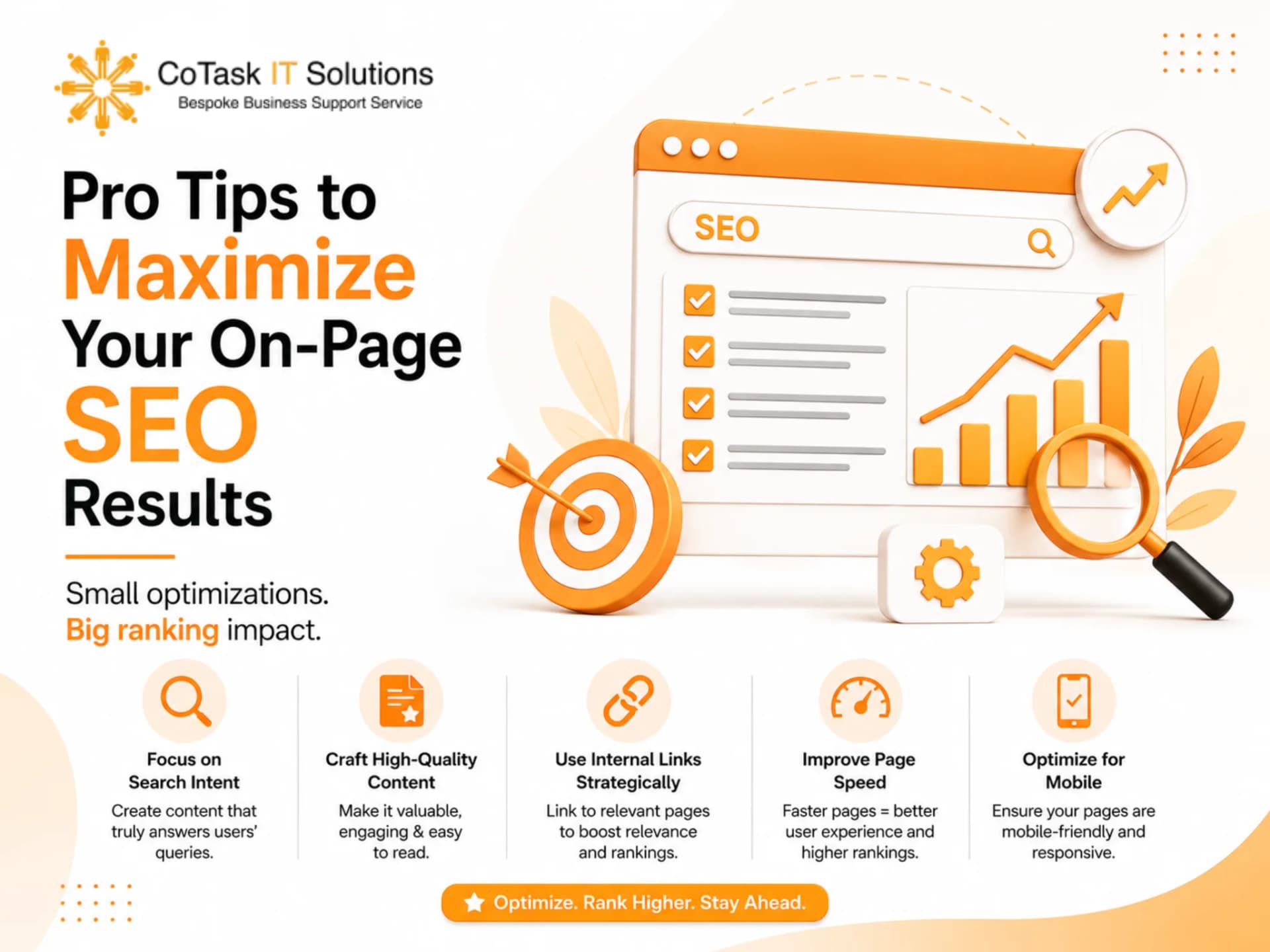
- Audit regularly. Run a full on-page SEO audit every few months to catch outdated content, broken links, and technical issues early.
- Lead with search intent. Understand why someone is searching — informational, comparison, or transactional — before you create the content.
- Use SEO plugins. On WordPress, Yoast SEO or Rank Math simplify managing titles, meta descriptions, schema, and readability.
- Improve what's already working. Small upgrades to pages already getting traffic often beat publishing something new from scratch.
Final Thoughts
A successful SEO strategy starts with the fundamentals. This checklist gives you 20 practical techniques to optimize every page on your site — from keyword research and content quality to page speed, schema, and UX.
SEO compounds. You won't see overnight results, but every optimized title, internal link, and content refresh builds toward stronger rankings and a better experience for your audience.
Start with one or two improvements on your most important pages, measure the impact, and keep iterating from there.
Ready to turn this checklist into results? Talk to CoTasks' SEO team for a free on-page SEO audit of your website — we'll show you exactly where you're losing rankings and how to fix it.