
Google Ads vs SEO: Which Marketing Strategy Delivers Better ROI?
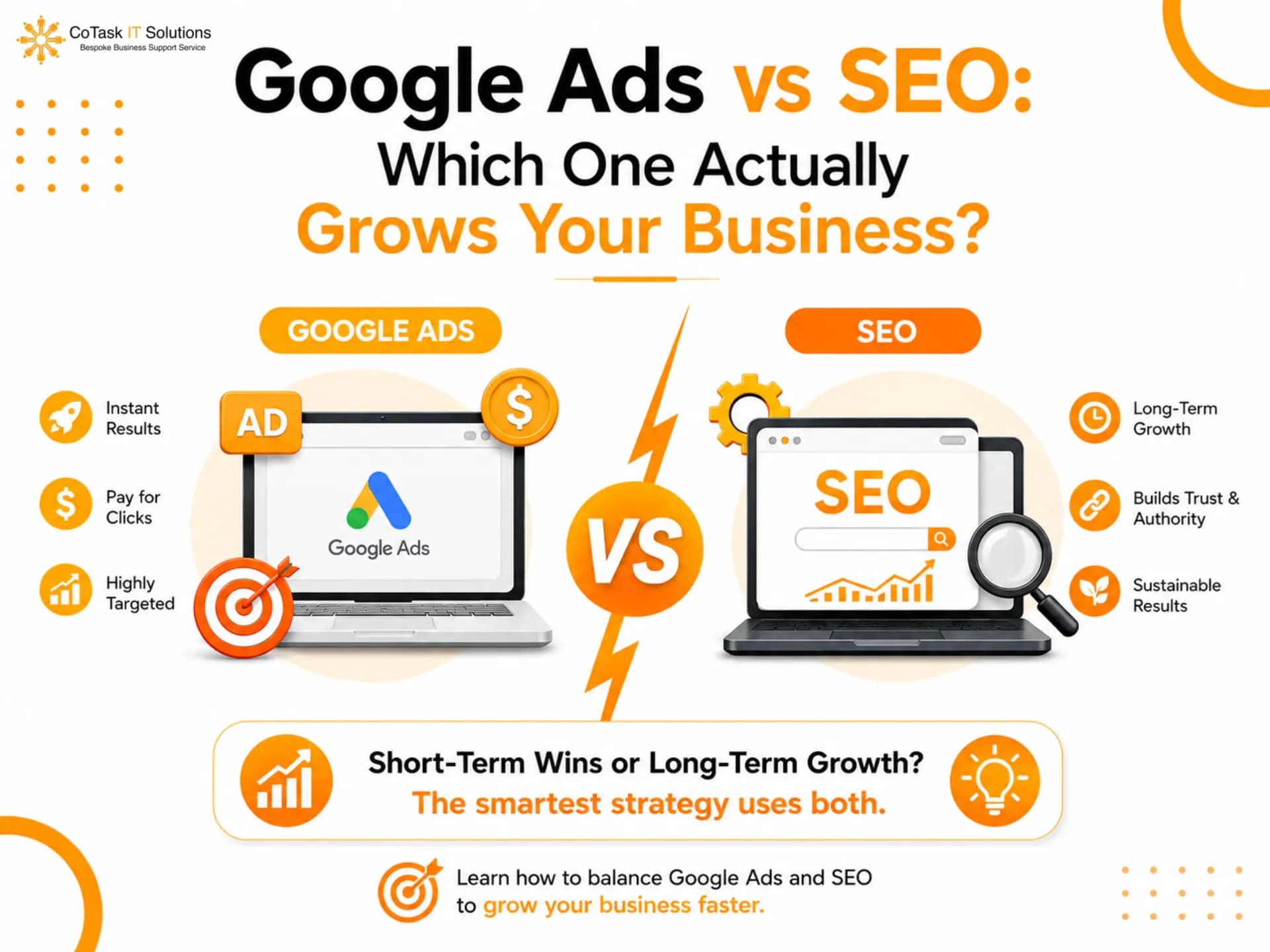
Every business owner asks this question eventually: should I pay for traffic, or earn it?
The honest answer is that it's rarely one or the other. But to make a smart call for your budget and timeline, you need to understand exactly how each one works, where each one breaks down, and when combining them beats picking a side.
At Cotasks, we run both — often for the same client, at the same time — across markets as different as Dubai, London, Riyadh, and Delhi. Here's what fifteen years of combined team experience across these markets has taught us.
What Is Google Ads?
Google Ads is a pay-per-click (PPC) system; you bid on keywords, and you pay only when someone clicks your ad. Run a campaign for "SEO services" or "web design company near me," and your ad can appear above organic results within hours of launch.
How the auction works: Google scores every ad on your maximum bid, Quality Score, ad relevance, landing page experience, and expected click-through rate. A stronger Quality Score doesn't just improve your position, it directly lowers your cost per click. This is the lever most businesses ignore, and it's usually the fastest way to cut wasted spend.
Where Google Ads Wins
- Speed — traffic starts within hours, not months, ideal for launches, seasonal pushes, and time-boxed offers
- Precision targeting — location, device, language, age, income bracket, time of day, and search intent are all controllable
- Hard numbers — every campaign reports clicks, CPC, conversion rate, cost per lead, and ROAS, nothing is a guess
- Budget flexibility — scale from $10/day to $10,000/day without restructuring anything
- High purchase intent — someone typing "hire SEO agency" is closer to buying than someone scrolling Instagram
Where It Breaks Down
- Traffic is rented, not owned — the moment budget stops, visibility stops with it
- Expensive categories — legal, finance, insurance, healthcare, and digital marketing itself often carry brutal CPCs
- Constant babysitting — negative keywords, bid adjustments, ad testing, and landing page tweaks are ongoing work, not a set-it-once task
- Traffic speed: Immediate
- Investment model: Pay per click
- Best for: Quick leads, launches
- ROI timeline: Short-term
- Scalability: High, budget-dependent
- Maintenance: Continuous
What Is SEO?
SEO is the process of earning visibility in organic search results — no per-click cost, just consistent investment in content, technical health, and authority. Google evaluates hundreds of signals to decide who ranks, but they collapse into three pillars:
1. On-Page SEO — title tags, meta descriptions, header structure, alt text, internal linking, keyword placement, URL structure. This is where search engines learn what your page is actually about.
2. Off-Page SEO — backlinks, digital PR, guest content, local citations, brand mentions. Each quality backlink functions as a vote of confidence from another site.
3. Technical SEO — sitemaps, robots.txt, Core Web Vitals, HTTPS, schema markup, canonical tags, page speed, mobile usability. This is the foundation everything else sits on, and it's the layer most agencies skip because it's invisible to clients until something breaks.
Where SEO Wins
- Compounding traffic — a well-ranked page can keep generating leads for years off one round of investment
- Higher trust — users consistently trust organic results more than paid placements, it reads as earned, not bought
- Falling cost per lead — the upfront lift is real, but cost per acquisition drops as rankings mature
- Ecosystem improvements — chasing rankings forces better site speed, UX, and mobile performance, gains that help every channel, not just search
Where It Breaks Down
- It's slow — meaningful movement typically takes 3–6 months, longer in competitive niches
- It's not "set and forget" — algorithm updates, content refreshes, and technical maintenance are ongoing
- Competitive keywords take real effort — not a paid budget increase, but sustained content and authority building
- Traffic speed: 3–6+ months
- Investment model: Content + optimization
- Best for: Sustainable growth
- ROI timeline: Long-term
- Scalability: Scales with content and authority
- Maintenance: Ongoing, but lighter than PPC
Read More: The Future of SEO — Why Ranking on Google Isn't Enough Anymore (https://cotasks.com/the-future-of-seo-why-ranking-on-google-isnt-enough-anymore)
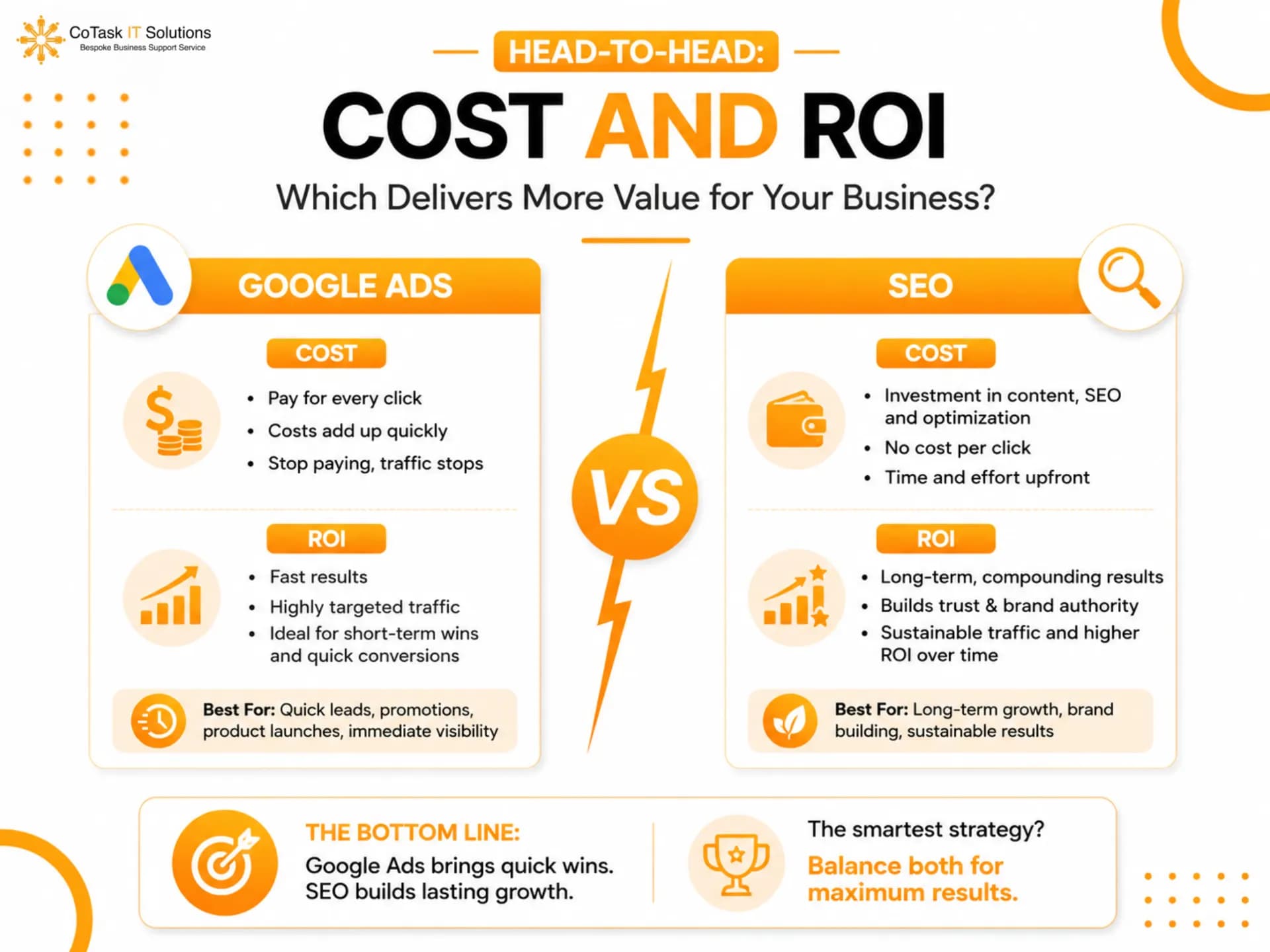
Head-to-Head: Cost and ROI
The clearest way to see the difference is to run the numbers.
If your average CPC is $8 and a campaign brings in 1,000 clicks, that's $8,000 spent — and $0 left over the moment the budget runs out. A well-ranked SEO page targeting the same demand can pull in thousands of monthly visitors without a per-click charge, though the upfront content and optimization cost is real.
The standard ROI formula applies to both channels equally: ROI = (Revenue − Marketing Cost) ÷ Marketing Cost × 100
Example: $2,000 invested, $10,000 generated → 400% ROI.
Don't stop at first-sale revenue when you run this. Factor in customer lifetime value, repeat purchases, and referral traffic — SEO in particular under-reports its own value if you only count the first transaction.
- Immediate leads → Google Ads
- Brand awareness → SEO + Google Ads
- Local business → Local SEO + Google Ads
- eCommerce → Both
- B2B services → SEO + remarketing ads
- Startup launch → Google Ads first, then SEO
- Limited budget → SEO
- Long-term growth → SEO
One stat worth knowing: ranking position isn't a vanity metric. Backlinko's analysis of roughly 4 million Google search results found the top three organic results capture more than half of all clicks combined — which is exactly why "page one" isn't the real goal; top-three is.
Read About: Website Design Mistakes Costing You Leads (https://cotasks.com/website-design-mistakes-costing-you-leads)
So, Which Should You Actually Choose?
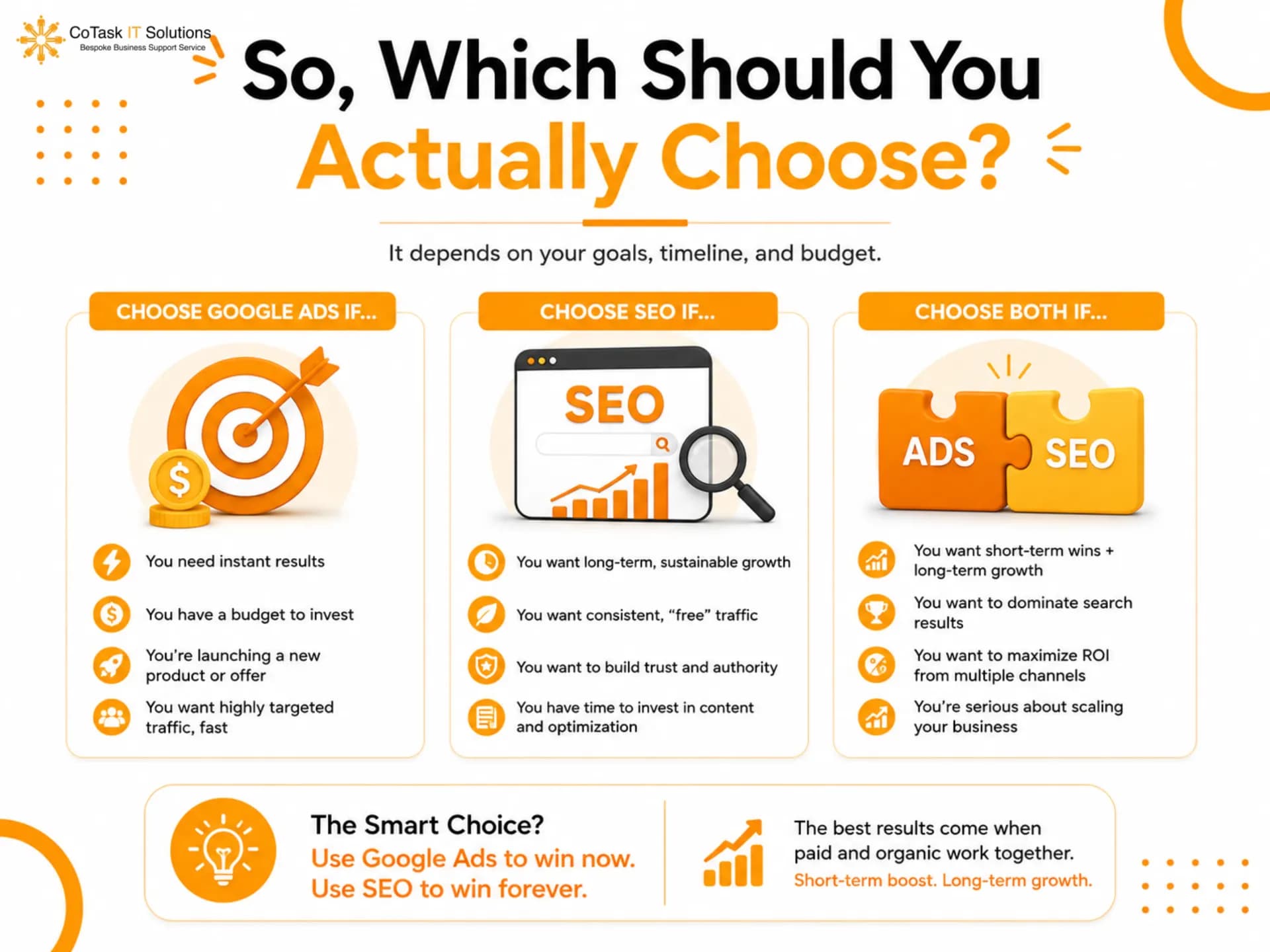
Pick Google Ads when: you need leads now, you're launching something new, your site has zero organic history yet, or you're testing keyword performance before committing SEO budget to it.
Pick SEO when: you're playing a longer game, your ad budget is limited, you're willing to invest in content consistently, and you want acquisition costs that fall over time instead of staying flat.
Pick both when: you can afford to. This isn't a hedge — it's the standard playbook for mature marketing teams. Ads generate the immediate data (which keywords actually convert, which landing pages hold attention) that makes your SEO content strategy sharper, while SEO steadily reduces how much you need to spend on ads to hit the same lead volume.
👉 Need help deciding which mix is right for your budget and timeline? Talk to the Cotasks team (https://cotasks.com/contact-us) — we'll audit where you stand and tell you honestly whether you need ads, SEO, or both right now.
Common Mistakes We See Constantly
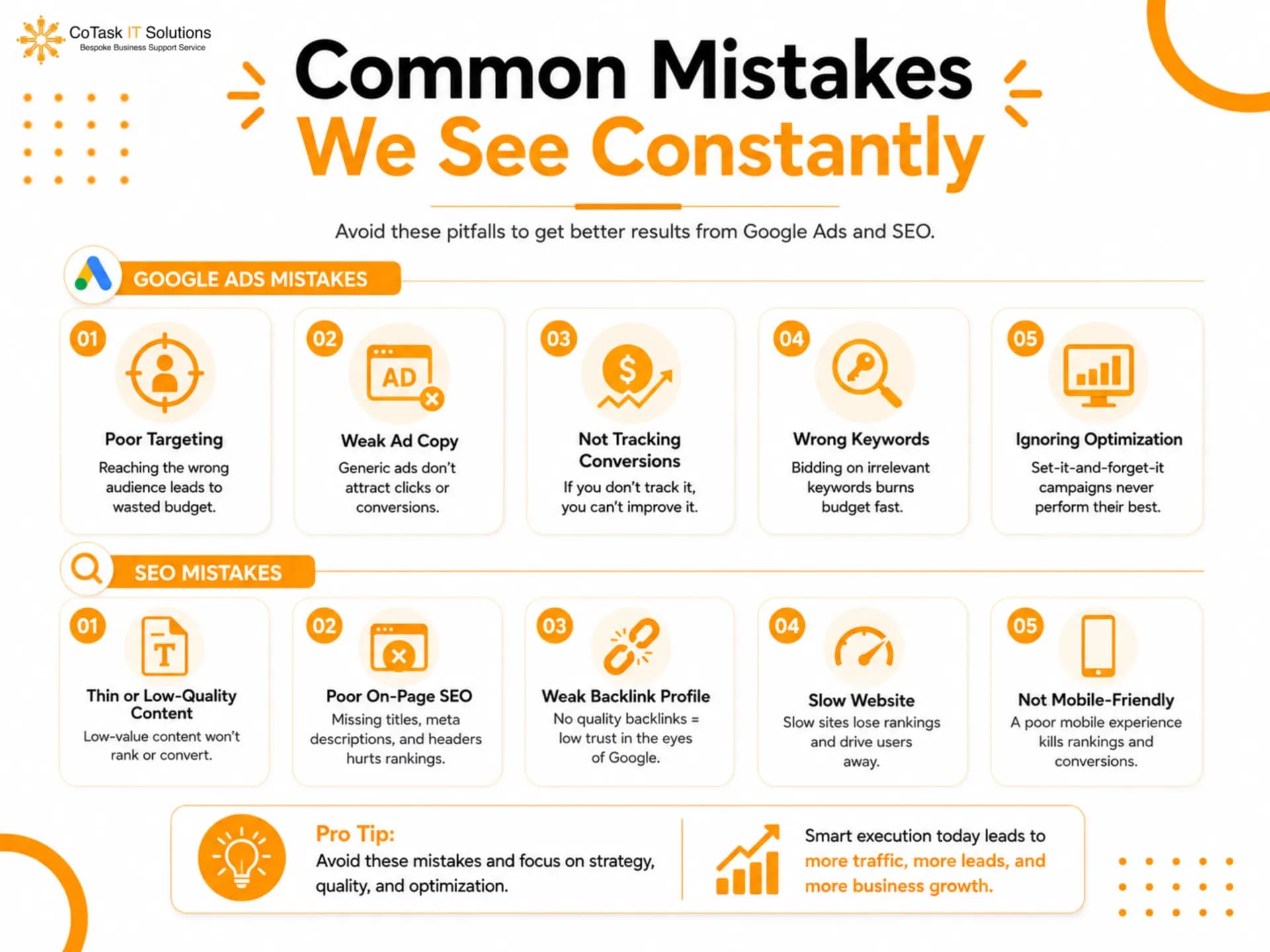
- Treating a Google Ads campaign as "set and forget" after launch
- Skipping landing page optimization while spending on traffic
- Expecting SEO results in weeks instead of months
- Chasing rankings while ignoring actual conversion rate
- Targeting broad keywords with no read on search intent
- Running paid traffic without conversion tracking in place
- Ignoring technical SEO until it quietly caps your growth ceiling
FAQs
The Bottom Line
Google Ads buys you speed. SEO builds you an asset. Most businesses that grow sustainably don't pick a side — they sequence the two so paid spend funds the short-term pipeline while organic search quietly takes over the acquisition cost curve.
Cotasks IT Solutions builds and runs both sides of this — SEO, technical audits, Google Ads management, and web development — for clients across the UAE, US, UK, Saudi Arabia, and India. If you want a straight read on where your budget is best spent right now, get in touch here for a free strategy breakdown.