
Google AI Overviews Explained: What Every Business Should Know
Google Search doesn't work the way it did even two years ago. Instead of a page full of blue links, many searches now open with an AI-written summary sitting right at the top of the results. That summary is Google AI Overviews, and it has quietly become one of the biggest shifts in search since Google introduced featured snippets.
For business owners, this changes the game. Ranking #1 no longer guarantees visibility, because the first thing a user sees might be an AI-generated answer that never sends them to your website at all. If your SEO strategy is still built entirely around keywords and backlinks, you're optimizing for half the picture. This guide breaks down what Google AI Overviews actually are, how they work, why they matter, and exactly what you can do to show up inside them.
What Are Google AI Overviews?
Google AI Overviews are AI-generated summaries that appear at the top of search results, built by Google's Gemini models to answer a user's query directly, using information pulled from multiple web sources.
Google launched AI Overviews to keep pace with how people actually search today. Users increasingly type full questions instead of short keyword fragments, and they expect a direct answer rather than a list of pages to sift through. Traditional search returns links; AI Overviews return a synthesized response, complete with citation links to the sources it drew from.
The underlying technology relies on natural language processing to understand not just the words in a query, but the intent behind it. That's a meaningful shift: instead of matching keywords to pages, Google is now matching meaning to concepts, then writing a response in plain language.
How Google AI Overviews Work
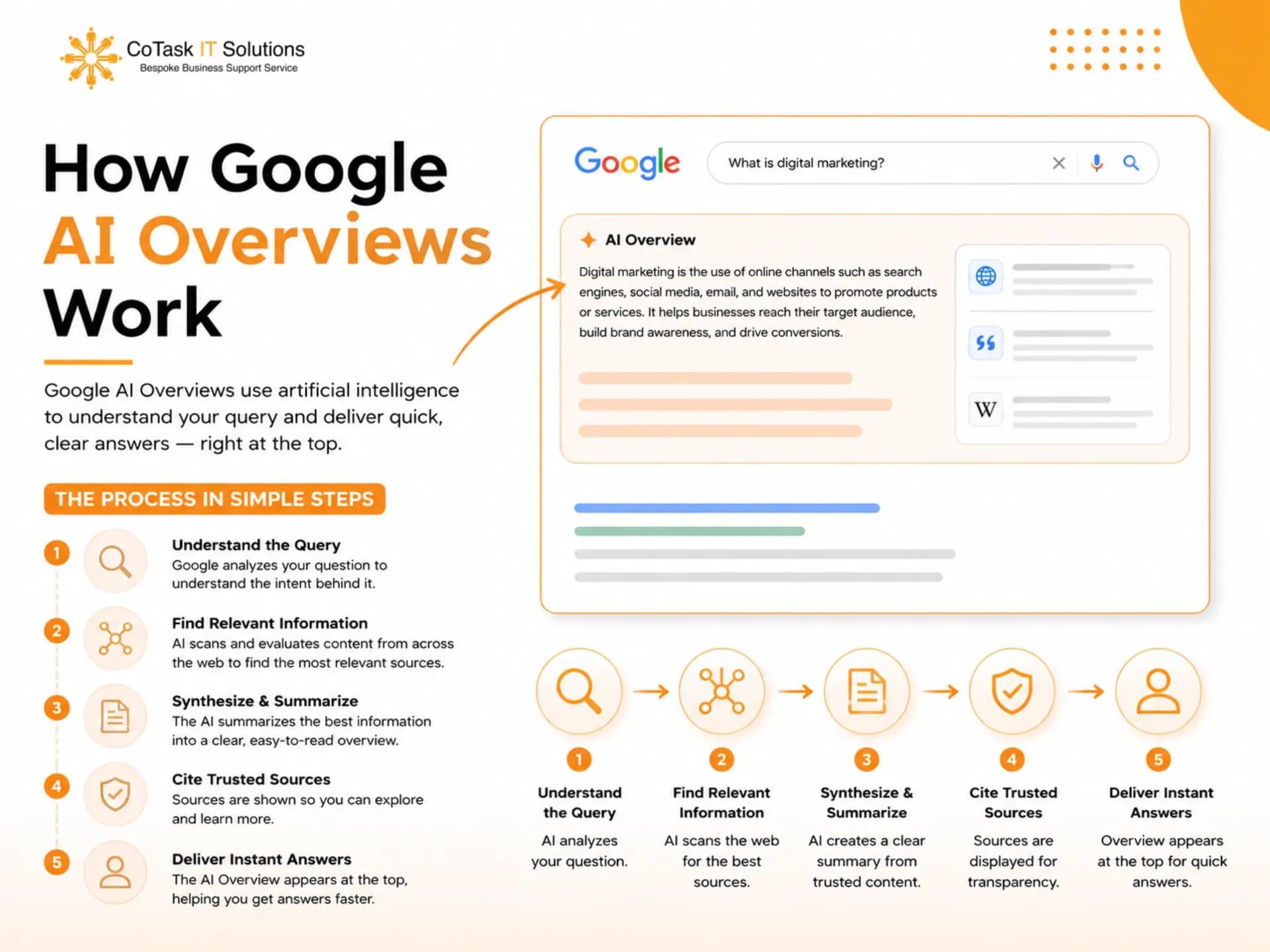
The process behind an AI Overview happens in a few clear stages:
- User query — someone types or speaks a search, often longer and more conversational than a typical keyword search
- Intent analysis — Google's systems interpret what the user actually wants, not just the literal words used
- AI processing — Gemini analyzes relevant web content to identify the most useful, accurate information available
- Information retrieval — the system pulls facts, data, and context from multiple trusted sources rather than a single page
- AI-generated response — a summary is written in natural language, combining information from several sources into one coherent answer
- Citation links — source websites are credited with clickable links, giving users a path to read further
- Continuous improvement — Google keeps refining the model and the sources it trusts, meaning the feature itself changes month to month
This matters for one simple reason: your content can be pulled into that summary, or it can be left out entirely. There's no in-between.
👉 Check Which Is Best For Your Business: Google Ads vs SEO
Why Google AI Overviews Matter for Businesses
The rise of AI Overviews touches nearly every part of the customer journey.
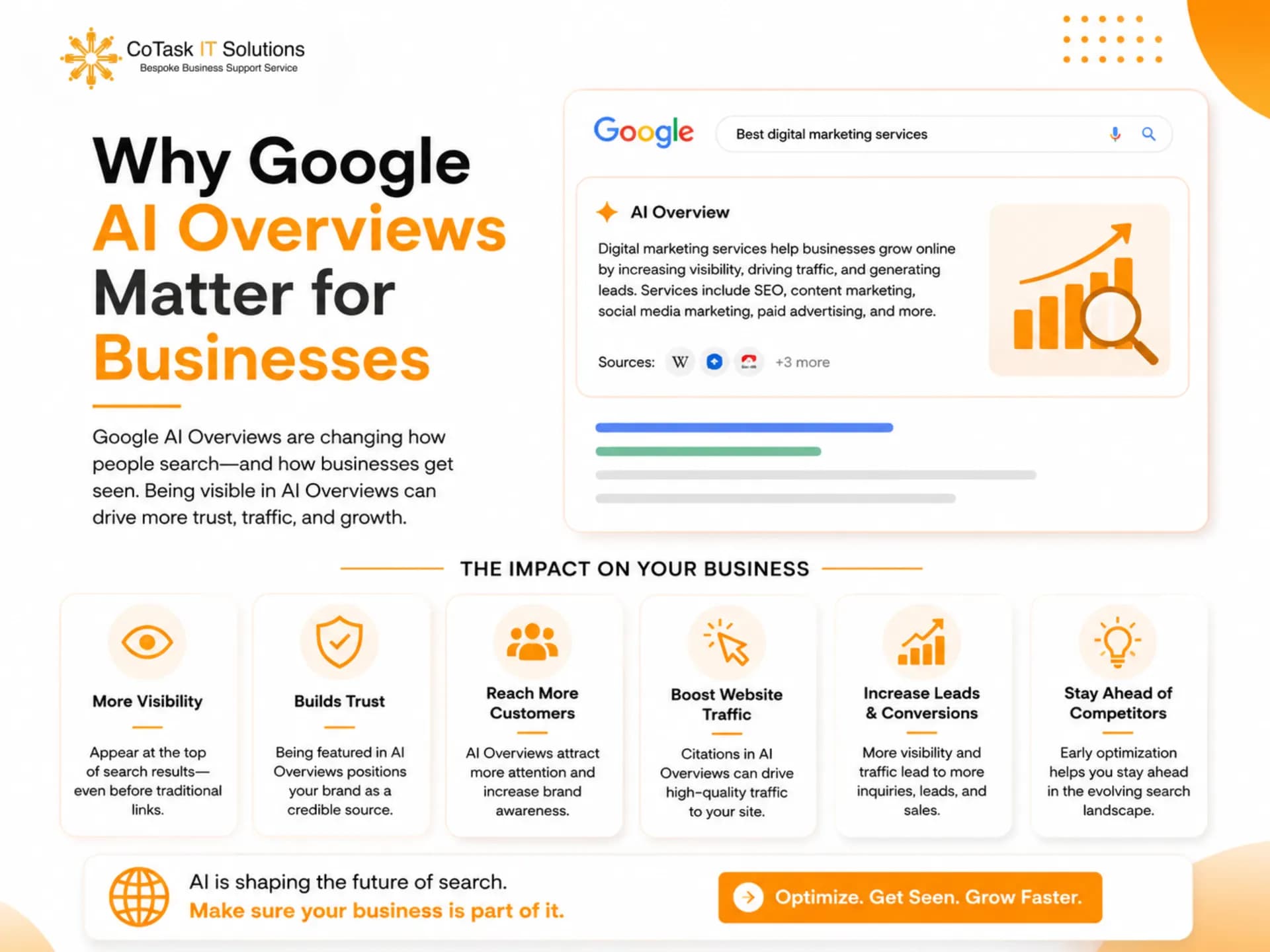
Search visibility now has two layers. You're competing for a position in classic search results and for a citation inside the AI summary — and the second one is increasingly where attention goes first.
Zero-click searches are growing. Many users get their answer directly from the AI Overview and never click through to a website. Industry tracking has put zero-click behavior at close to 60% of all searches in 2026, and organic click-through rates on AI Overview queries have dropped anywhere from roughly a third to over 60% depending on the study and query type.
Being cited builds trust fast. Appearing as a cited source inside an AI Overview signals authority to the user before they've even visited your site. Data from Seer Interactive's 2026 tracking of over 5 million queries found that brands cited in AI Overviews earn significantly more organic clicks per impression than uncited competitors on the same query — in some analyses, more than double.
Customer behavior is shifting toward AI-assisted research. Buyers are using AI summaries to compare products, understand services, and shortlist options before they ever reach a company's website.
There's a real competitive advantage available. Because most businesses still haven't adapted their content for AI Overviews, the brands that do it well right now have an outsized opportunity to dominate visibility in their niche.
Traditional SEO vs Google AI Overviews
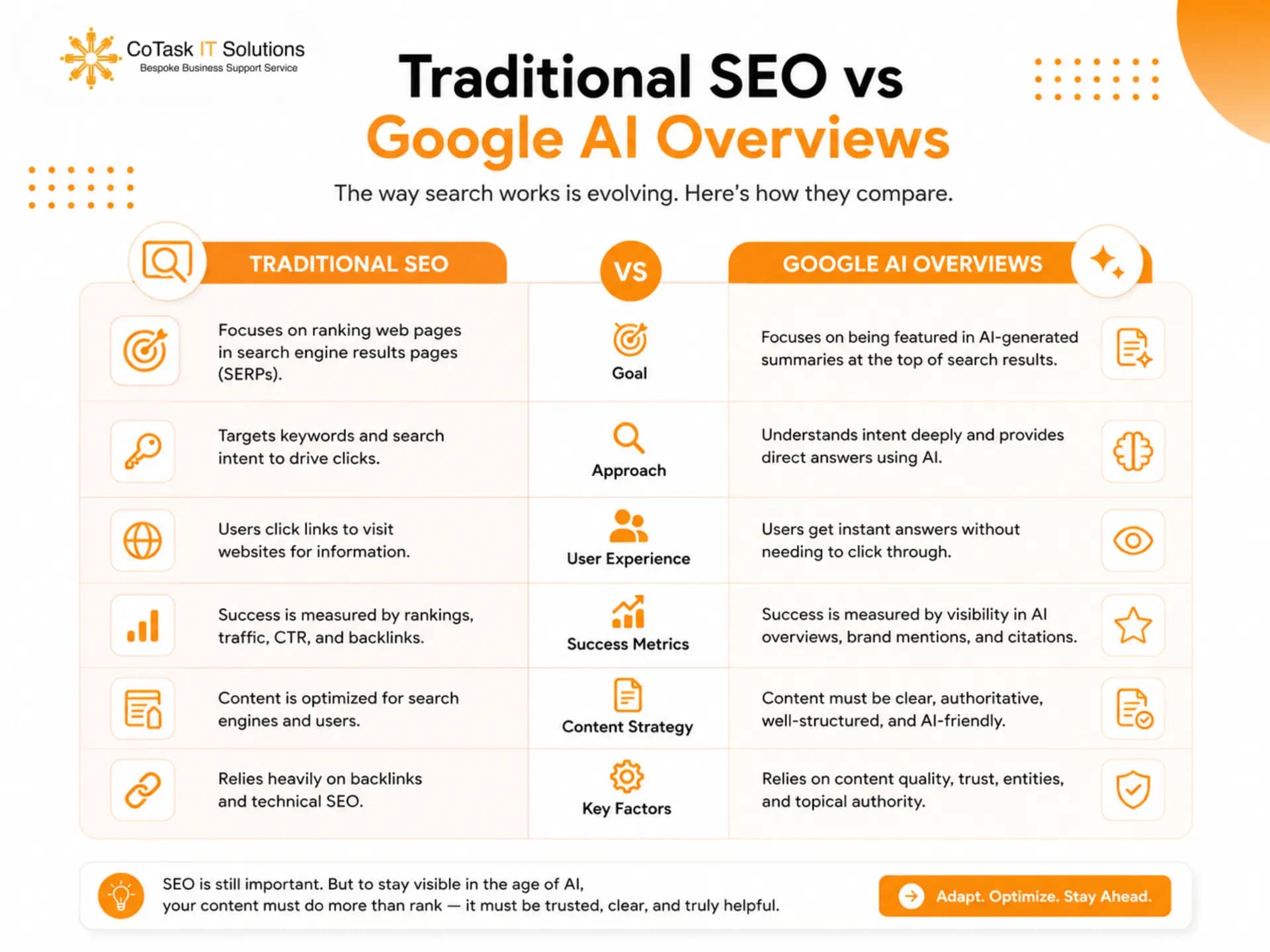
- Ranking — Traditional SEO: position on the results page / AI Overviews: selection as a cited source
- Visibility — Traditional SEO: blue link and meta description / AI Overviews: summarized text plus citation link
- User Experience — Traditional SEO: user scans and clicks results / AI Overviews: user reads a ready-made answer
- Search Intent — Traditional SEO: matched via keywords / AI Overviews: matched via deeper semantic understanding
- Content Style — Traditional SEO: keyword-focused, SEO copy / AI Overviews: clear, structured, directly answers questions
- Click Behavior — Traditional SEO: higher potential click-through / AI Overviews: often zero-click, fewer but higher-intent clicks
- AI Citations — Traditional SEO: not applicable / AI Overviews: directly determines inclusion
- Optimization — Traditional SEO: backlinks, on-page SEO, keywords / AI Overviews: E-E-A-T, topical authority, structured data
- Future Potential — Traditional SEO: still relevant, but shrinking share / AI Overviews: growing share of total search visibility
The smart move isn't to abandon traditional SEO — it's still what gets you crawled, indexed, and considered in the first place. The winning strategy is optimizing for both traditional rankings and AI citation at the same time.
Which Industries Are Most Affected?
AI Overview coverage varies a lot by industry. Informational, research-heavy categories tend to see the highest rates, with health and medical queries among the most frequently affected, alongside education. Other sectors seeing significant impact include:
- Healthcare — high-trust, informational queries
- Finance — comparison and advice-driven searches
- Education — explanatory, how-it-works content
- Travel — planning and comparison research
- Real Estate — local and process-driven questions
- Legal — informational queries before a consultation
- Ecommerce — product comparisons and buying guides
- Technology — how-to and troubleshooting content
- Digital Marketing — strategy and definition-style queries
- Local Businesses — service-area and "near me" searches, though local intent still triggers AI Overviews less often than broad informational queries
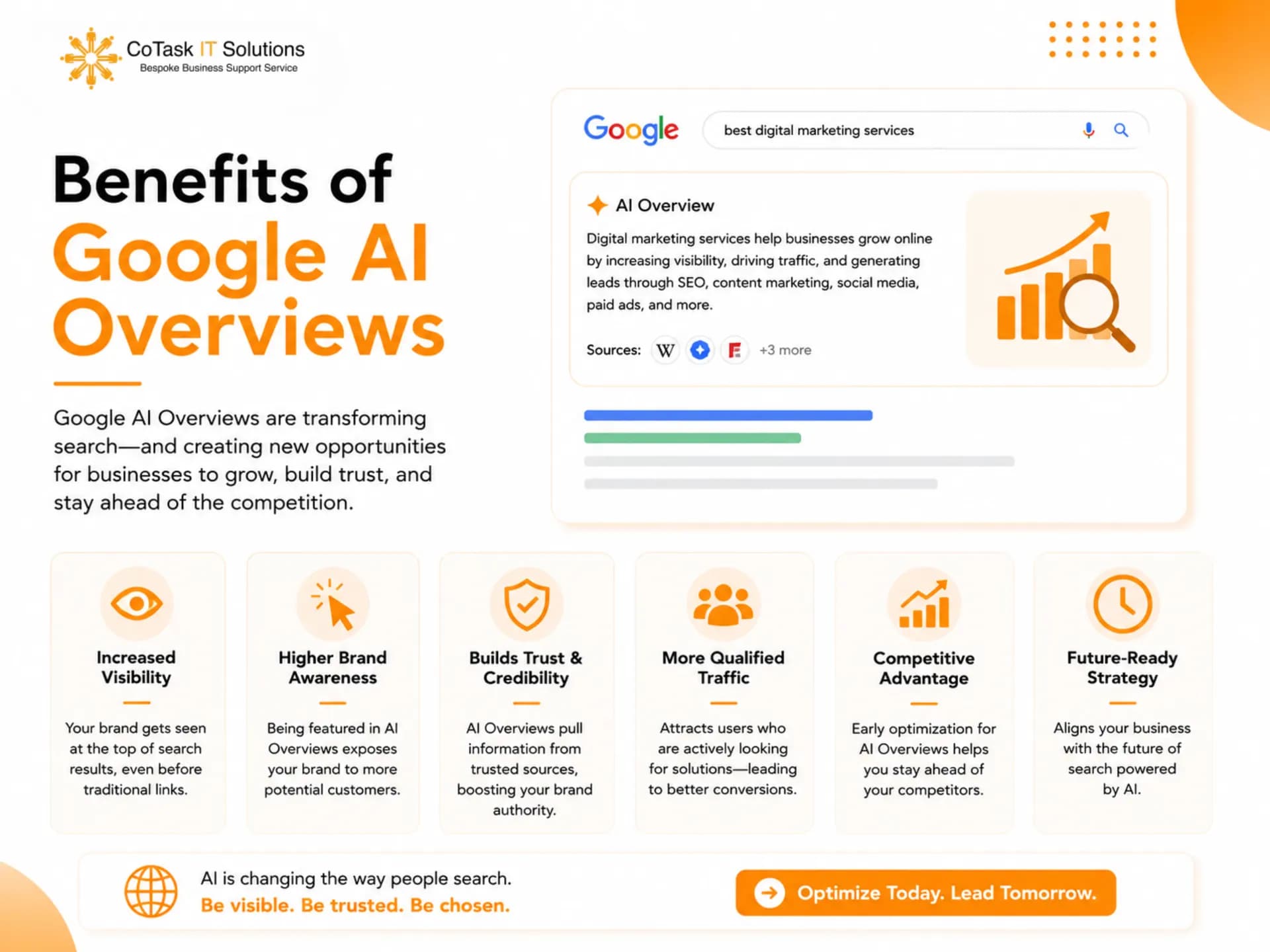
Benefits of Google AI Overviews
For users, the upside is real: faster answers, less time spent comparing pages, and a research experience that pulls together multiple perspectives in one place. That translates into a few practical benefits for businesses too:
- Users arrive better informed, often further along in their decision-making
- Citation acts as a trust signal before a single click happens
- Being featured across multiple sources in one summary opens visibility that a single search ranking never could
- Personalized, conversational search experiences increasingly favor content that explains things clearly rather than content built purely for keyword density
Challenges Businesses Should Know
It's not all upside. Several real challenges come with this shift:
- Lower click-through rates on queries where an AI Overview appears
- Rising zero-click search behavior, especially for purely informational queries
- Higher competition for citation, not just ranking position
- Elevated content quality expectations — thin or generic content rarely gets cited
- Stronger authority requirements, since Google increasingly favors sources it already trusts
- Frequent algorithm changes as Google continues refining which model powers the feature and which sources it prioritizes
- AI-generated competitor content flooding search results, making genuine expertise harder to stand out
👉 Read About: AI in Digital Marketing
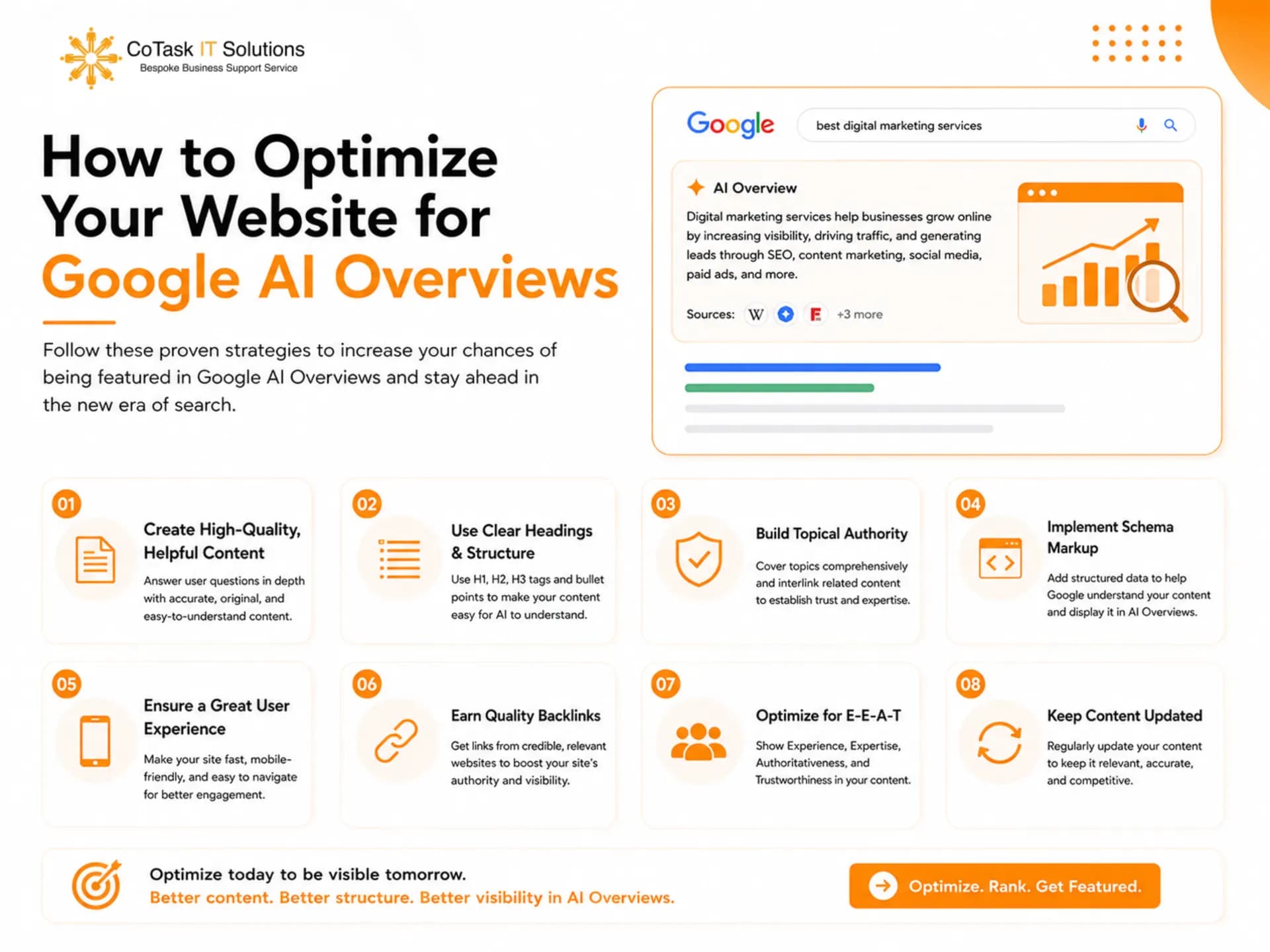
How to Optimize Your Website for Google AI Overviews
This is the part that actually moves the needle. Here's what deserves real focus:
- Create comprehensive content that fully answers a topic rather than skimming the surface
- Build topical authority by covering a subject area in depth across multiple connected pages, not just one post
- Understand search intent before writing — informational, commercial, or transactional
- Answer user questions directly, ideally within the first few sentences of a section
- Improve E-E-A-T (Experience, Expertise, Authoritativeness, Trustworthiness) throughout your content
- Add author profiles with real credentials and experience
- Publish original research or data wherever possible — Google increasingly rewards information it can't find anywhere else
- Include relevant statistics, sourced and dated
- Add real case studies that demonstrate practical results
- Use FAQ sections structured around actual questions people search for
- Optimize headings so each one clearly signals what the section answers
- Improve readability — short paragraphs, plain language, logical flow
- Use internal linking to connect related content and reinforce topical depth
- Reference external authoritative sources to support your claims
- Implement schema markup so search engines can understand your content structurally
- Focus on entity optimization — make it clear who you are, what you offer, and how concepts relate
- Apply semantic SEO by covering related terms and concepts naturally, not just the exact keyword
- Follow Google's Helpful Content principles — write for people first
- Keep your website fast — page speed still affects crawlability and user experience
- Prioritize mobile optimization, since mobile search continues to grow faster than desktop
- Improve overall page experience — clean design, no intrusive pop-ups, easy navigation
- Update content regularly — freshly updated pages are cited noticeably more often than stale ones
👉 Expert Tip: Structure your content the way you'd want an AI to quote it. Open each section with a direct, self-contained answer in one or two sentences, then expand with detail below. This single habit does more for AI Overview citation than almost anything else on this list.
Visit Us: CoTask IT Solutions
Best SEO Practices for Google AI Overviews in 2026
Looking ahead, the businesses that win will treat SEO, AEO, and GEO as one connected discipline rather than separate strategies. That means writing content that satisfies traditional ranking factors, answers questions the way a voice assistant would read them aloud, and demonstrates the kind of firsthand expertise that generative models are built to prioritize. Regularly auditing which of your pages get cited — and which competitors are winning citations instead — should become a standing part of your content process.
Common Mistakes Businesses Make
- Keyword stuffing instead of natural, useful writing
- Publishing thin content that doesn't fully answer the question
- Duplicate or repurposed content across pages
- Ignoring actual user intent behind a search term
- Skipping schema markup entirely
- Weak or missing internal linking
- Poor user experience and cluttered page design
- No real topical authority in the niche
- Publishing unedited AI-generated "spam" content
- Letting valuable content sit untouched for years without updates
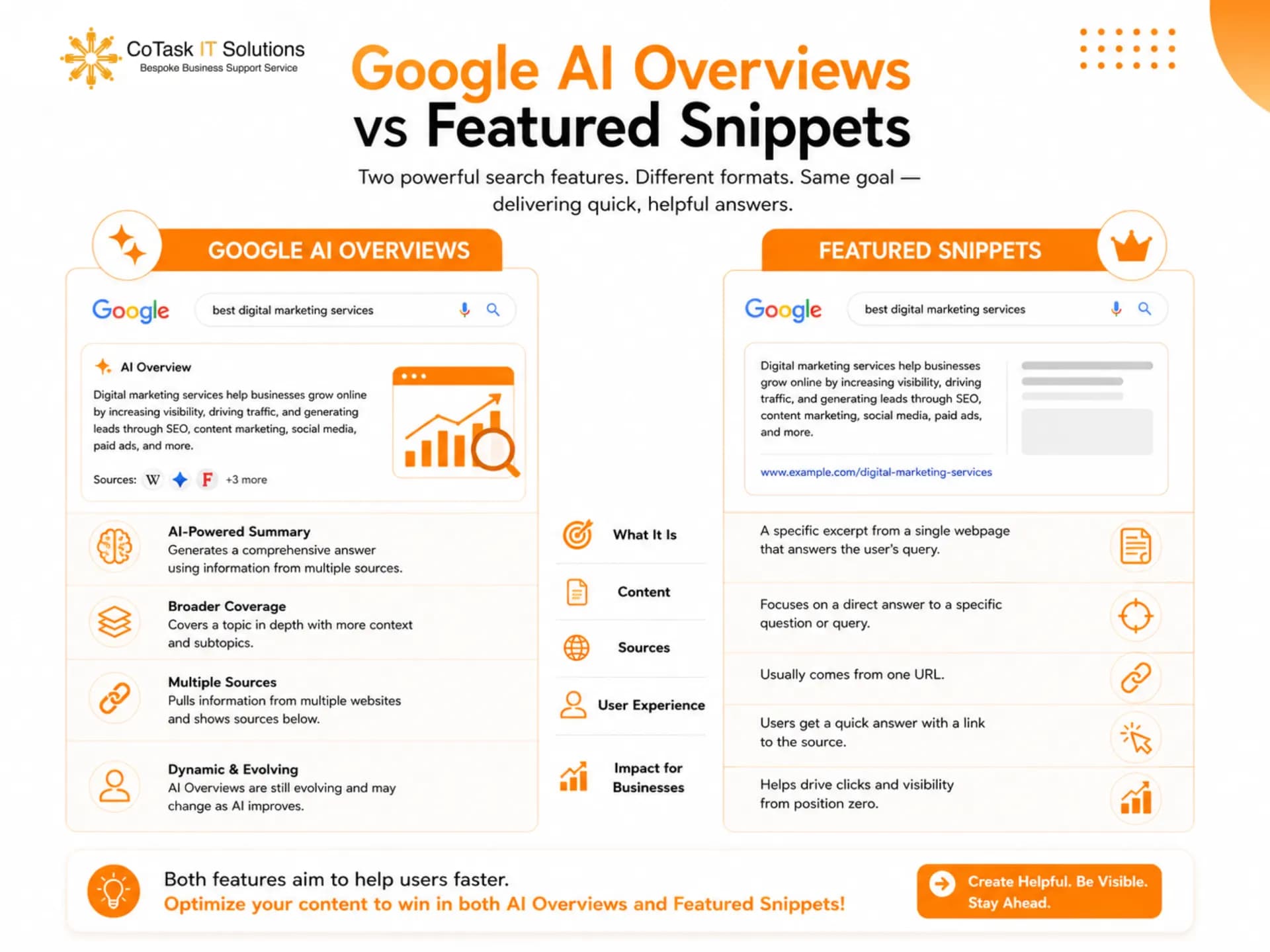
Google AI Overviews vs Featured Snippets
- Appearance — Featured Snippets: single highlighted box, one source / AI Overviews: multi-paragraph AI summary
- Ranking — Featured Snippets: pulled from one top-ranking page / AI Overviews: synthesized from multiple sources
- AI Generation — Featured Snippets: not AI-generated, extracted verbatim / AI Overviews: fully AI-generated response
- Source Citations — Featured Snippets: one source cited / AI Overviews: multiple sources cited
- Clicks — Featured Snippets: can drive strong click-through / AI Overviews: often reduces click-through
- Visibility — Featured Snippets: position zero for one query / AI Overviews: broader coverage across related queries
- Purpose — Featured Snippets: quick, direct factual answer / AI Overviews: comprehensive, conversational answer
Future of Google Search
Search is moving toward something closer to a conversation than a query box. Google's AI Mode has already crossed a billion monthly users, and query length inside Google's own results has grown substantially as people type fuller, more natural questions. Expect continued growth in conversational search, voice search, and multimodal search that blends text, images, and video into a single response. Personalization will deepen, agentic AI will start completing tasks on a user's behalf rather than just answering questions, and predictive search will anticipate needs before a query is even typed. For businesses, that means the line between SEO, AEO, and GEO will keep blurring — they're becoming one discipline, not three.
Expert Tips
- Write the direct answer first, supporting detail second
- Treat FAQ sections as citation bait — they map almost perfectly to how AI models pull answers
- Invest in original data or research; it's the single hardest thing for competitors to copy
- Keep author bios visible and specific about real experience
- Refresh your best-performing content every quarter, not just when it "feels old"
- Use schema markup on every page type it applies to, not just products
- Build content clusters around a topic instead of isolated one-off posts
- Don't chase every keyword — chase full topical coverage instead
- Monitor which pages get cited in AI Overviews and reverse-engineer why
- Never sacrifice clarity for keyword density — clarity is what gets quoted
Key Takeaways
- Google AI Overviews are AI-generated summaries that answer queries directly, citing multiple sources
- They now appear on a large and growing share of Google searches, with estimates ranging widely by industry and query type
- Zero-click searches are rising, but citation inside an AI Overview drives real trust and, in many cases, more clicks than being uncited
- Traditional SEO and AI Overview optimization aren't competing strategies — they work together
- E-E-A-T, topical authority, structured data, and genuinely helpful content are the core levers that drive citation
- Businesses that adapt now have a real head start, since most competitors haven't yet
Frequently Asked Questions
Conclusion
Google AI Overviews represent one of the most significant shifts in search since Google Search itself launched. Rankings still matter, but they're no longer the whole story — visibility now depends on whether your content is trusted enough, clear enough, and helpful enough to be cited directly inside an AI-generated answer. Businesses that treat SEO, AEO, and GEO as one connected strategy, and that consistently publish genuinely expert, well-structured content, are the ones positioned to win in this new search landscape.
Don't wait until your competitors have already claimed the citations. Start optimizing your content for Google AI Overviews today, and build the kind of authority Google's AI can't ignore.
Visit us for more details: cotasks.com