
The Future of SEO: Why Ranking on Google Isn't Enough Anymore
Imagine spending months ranking your website on the first page of Google—only to watch your organic traffic slowly decline.
Sounds impossible?
It's already happening.
Today, people don't just search on Google. They ask ChatGPT, Gemini, Perplexity, Copilot, voice assistants, and even social platforms for answers. Instead of clicking ten blue links, users increasingly expect instant, conversational responses.
That shift is redefining the future of SEO.
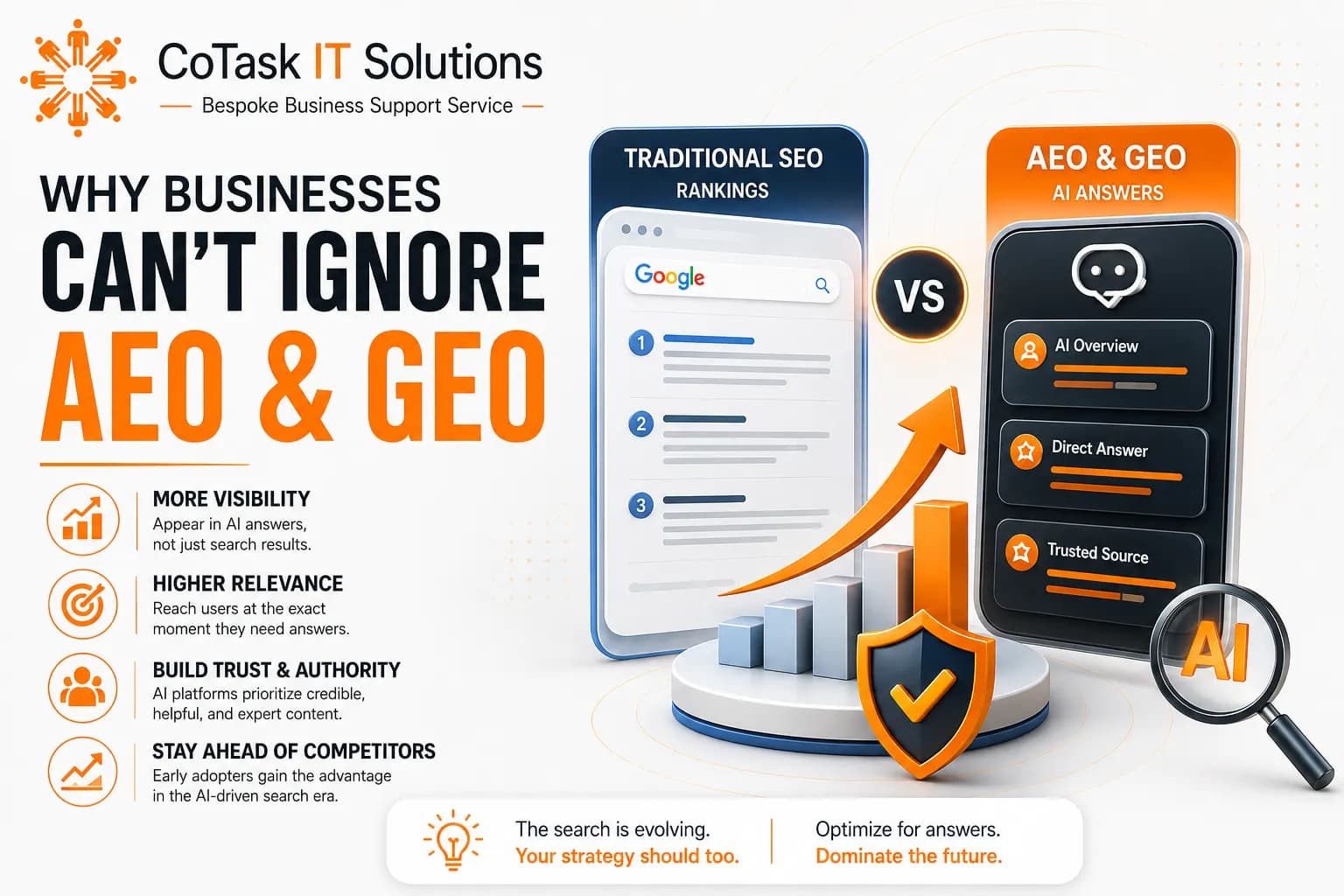
Traditional search engine optimization still matters, but it's no longer enough. To stay visible, businesses need to optimize not only for search engines but also for answer engines (AEO) and generative AI platforms (GEO).
The brands adapting today will be the ones dominating digital visibility tomorrow.
In this guide, you'll learn:
- Why SEO is evolving
- What AEO and GEO actually mean
- How AI is changing search behavior
- What businesses should do now to stay ahead
Let's dive in.
If you're looking to implement these strategies for your own business, explore our Digital Marketing Services covering SEO, PPC, and Social Media to build long-term online visibility: https://cotasks.com/digital-marketing-services-agency-seo-ppc-social-media
Table of Contents
- What Is the Future of SEO?
- Why Search Is Changing Faster Than Ever
- SEO vs AEO vs GEO: What's the Difference?
- Why AI Is Transforming Search
- The Biggest Risks of Ignoring This Shift
- How to Prepare for the Future
- Is SEO Dead?
- Final Thoughts
What Is the Future of SEO?
For nearly two decades, SEO followed a familiar formula:
- Research keywords
- Publish optimized content
- Build backlinks
- Improve rankings
- Earn more traffic
That strategy still works—but only as part of a much bigger picture.
Today, visibility isn't limited to Google's search results. Your audience might discover your business through:
- AI-generated answers
- Voice search
- Google's AI Overviews
- Chatbots
- Industry forums
- YouTube
- Knowledge panels
The future of SEO isn't about ranking on one platform.
It's about becoming the most trusted source of information wherever people search.
Think of SEO today as digital visibility optimization rather than just search engine optimization.
Search Has Changed—And So Have Users
People search differently than they did just a few years ago.
Instead of typing:
"best CRM software"
They now ask:
"What's the best CRM for a small business with fewer than 20 employees?"
Instead of browsing multiple websites, they expect one complete answer.
AI delivers that answer instantly.
That's changing everything.
Modern Search Looks Like This
- Then: Google Search → Now: Google + AI Assistants
- Then: Keywords → Now: Natural Questions
- Then: Multiple Website Visits → Now: One Instant Answer
- Then: Search Results → Now: AI Summaries
- Then: Links First → Now: Answers First
The biggest change isn't Google.
It's user behavior.
Why Search Is Changing Faster Than Ever
Several major trends are shaping the future of SEO.
Understanding them helps explain why traditional optimization alone isn't enough anymore.
1. AI Has Become the New Search Assistant
Millions of people now begin their research using AI tools instead of search engines.
Whether they're comparing products, learning a concept, or solving a problem, users increasingly prefer conversational answers over scrolling through dozens of web pages.
Instead of opening five browser tabs, they ask one question—and receive a summarized response.
For businesses, this means your content must be clear enough for AI to understand, trust, and reference.
2. Google's AI Overviews Are Reducing Clicks
Google's AI-generated summaries often answer questions directly on the search results page.
As a result:
- Users find answers faster.
- Fewer people click through to websites.
- Organic traffic patterns are changing.
Simply ranking #1 doesn't guarantee the same number of visitors it once did.
The new goal isn't just earning a ranking.
It's becoming part of Google's answer itself.
3. Voice Search Is Becoming More Conversational
Voice assistants continue to influence how people search.
Instead of typing:
"SEO future"
Users naturally ask:
"What is the future of SEO in 2026?"
Notice the difference?
Voice searches are:
- Longer
- More conversational
- Question-based
- Intent-driven
Content written in a natural, conversational style performs better because it mirrors how people actually speak.
4. Trust Matters More Than Ever
Search engines and AI models have become much better at identifying genuinely helpful content.
Publishing articles filled with repetitive keywords no longer delivers lasting results.
Instead, successful content demonstrates:
- First-hand expertise
- Clear explanations
- Original insights
- Helpful examples
- Credible sources
- Comprehensive coverage
The future belongs to brands that consistently earn trust—not those chasing algorithm shortcuts.
SEO vs AEO vs GEO: What's the Difference?
These three terms are often mentioned together, but they serve different purposes.
Understanding how they work together is essential for building a future-proof content strategy.
- SEO (Search Engine Optimization): Optimizes for Google rankings, focuses on keywords, drives website traffic, built for search engines.
- AEO (Answer Engine Optimization): Optimizes for direct answers, focuses on questions, wins featured snippets, built for search & voice assistants.
- GEO (Generative Engine Optimization): Optimizes for AI-generated responses, focuses on AI citations, builds AI visibility, built for ChatGPT, Gemini, Perplexity, Copilot.
The key takeaway?
These strategies complement one another.
They're not competitors.
What Is SEO?
SEO focuses on improving your website's visibility in traditional search engines.
It includes:
- Keyword research
- Technical SEO
- On-page optimization
- Internal linking
- Site speed
- Mobile usability
- Backlinks
- Content quality
SEO remains the foundation of online visibility.
Without it, the rest becomes much harder.
What Is AEO?
Answer Engine Optimization (AEO) is about helping search engines understand that your content provides the best direct answer to a user's question.
Rather than optimizing only for rankings, AEO optimizes for:
- Featured snippets
- AI summaries
- Voice assistants
- People Also Ask sections
- Instant answers
Well-structured content often includes:
- Short definitions
- Lists
- FAQs
- Tables
- Step-by-step explanations
The easier your content is to understand, the more likely it is to become the chosen answer.
What Is GEO?
Generative Engine Optimization (GEO) focuses on increasing your visibility inside AI-generated responses.
Instead of asking:
"How do I rank on Google?"
Businesses should also ask:
"How do I become a trusted source that AI references?"
Generative AI platforms evaluate content differently.
They value:
- Authority
- Accuracy
- Context
- Original research
- Strong brand signals
- Consistent mentions across the web
That's why GEO extends far beyond your website.
It includes your overall digital presence.
Why Businesses Can't Ignore AEO and GEO
Imagine two companies offering identical services.
Company A focuses only on traditional SEO.
Company B invests in SEO, AEO, and GEO.
When someone asks Google, ChatGPT, or Gemini:
"What's the best strategy for improving website visibility in 2026?"
Company B has multiple opportunities to appear:
- In Google's organic results
- Inside AI Overviews
- As a featured snippet
- Within AI-generated answers
- Through voice assistants
Company A competes for one opportunity.
Company B competes for five.
That's the difference.
Before diving into these practical steps, it's worth understanding how a complete digital marketing strategy combines SEO, PPC, and social media to maximize visibility. Learn more about our Digital Marketing Services here: https://cotasks.com/digital-marketing-services-agency-seo-ppc-social-media
How to Prepare for the Future of SEO
The good news?
You don't need to throw away everything you know about SEO.
Instead, you need to build on it.
Think of traditional SEO as the foundation. AEO and GEO are the layers that help your content reach people wherever they search—whether that's Google, ChatGPT, Gemini, Perplexity, or a voice assistant.
Here are the strategies that will keep your website competitive in 2026 and beyond.
1. Write for Humans First, Search Engines Second
This advice has been around for years, but it's more important than ever.
AI-powered search engines are designed to identify content that genuinely helps people. If your article feels like it was written only to rank for keywords, both readers and AI will notice.
Instead of asking:
"How many times should I use my keyword?"
Ask:
"Have I completely answered the reader's question?"
High-quality content should:
- Solve a real problem.
- Be easy to understand.
- Include practical examples.
- Offer unique insights.
- Leave readers with no unanswered questions.
When people find your content useful, search engines are more likely to reward it.
2. Build Topical Authority, Not Just Individual Pages
Publishing dozens of unrelated blog posts isn't enough anymore.
Search engines and AI platforms prefer websites that demonstrate deep expertise in a specific subject.
For example, if your primary topic is SEO, don't stop at one article.
Create a content ecosystem around it.
- Pillar Topic: Future of SEO → Supporting Article: What Is AEO?
- Pillar Topic: Future of SEO → Supporting Article: What Is GEO?
- Pillar Topic: Future of SEO → Supporting Article: AI SEO Tools
- Pillar Topic: Future of SEO → Supporting Article: Voice Search Optimization
- Pillar Topic: Future of SEO → Supporting Article: Google's AI Overviews Explained
- Pillar Topic: Future of SEO → Supporting Article: SEO Trends for 2026
- Pillar Topic: Future of SEO → Supporting Article: EEAT Best Practices
- Pillar Topic: Future of SEO → Supporting Article: Technical SEO Checklist
This approach helps search engines understand that your website is an authority on the topic—not just another blog with scattered content.
3. Structure Content for AI and Featured Snippets
AI systems don't read content the way humans do.
They look for clear, well-structured information that can be understood quickly.
To make your content easier to reference:
- Use descriptive headings.
- Answer questions immediately after the heading.
- Include bullet points where appropriate.
- Add comparison tables.
- Use numbered steps for processes.
- Keep important definitions concise.
For example:
What Is GEO?
Generative Engine Optimization (GEO) is the process of optimizing content so AI-powered search tools like ChatGPT, Gemini, and Perplexity can easily understand, reference, and recommend it.
That's the kind of clear answer AI systems love.
4. Optimize for Questions, Not Just Keywords
People no longer search using only short phrases.
They're asking complete questions.
Instead of optimizing for:
future of seo
Also target:
- What is the future of SEO?
- Is SEO changing because of AI?
- Will AI replace SEO?
- How does GEO work?
- What is Answer Engine Optimization?
- How do AI search engines rank content?
These conversational questions improve your chances of appearing in:
- Featured snippets
- AI Overviews
- Voice search
- "People Also Ask" sections
- AI-generated responses
5. Strengthen Your Brand Beyond Your Website
One major difference between traditional SEO and GEO is that AI looks beyond your website.
It evaluates your brand's presence across the web.
That means your business should aim to appear on trusted platforms such as:
- Industry blogs
- News websites
- Podcasts
- YouTube
- Quora
- Review websites
- Business directories
The more credible mentions your brand earns, the more trustworthy it appears to both search engines and AI models.
6. Don't Ignore Technical SEO
AI may be changing search, but technical SEO still matters.
A slow, poorly structured website creates a bad user experience—and search engines notice.
Regularly check your site for:
- Fast page speed
- Mobile responsiveness
- HTTPS security
- Clean URL structure
- Proper internal linking
- XML sitemap
- Schema markup
- Crawl errors
- Broken links
Technical SEO is still the backbone of long-term organic growth.
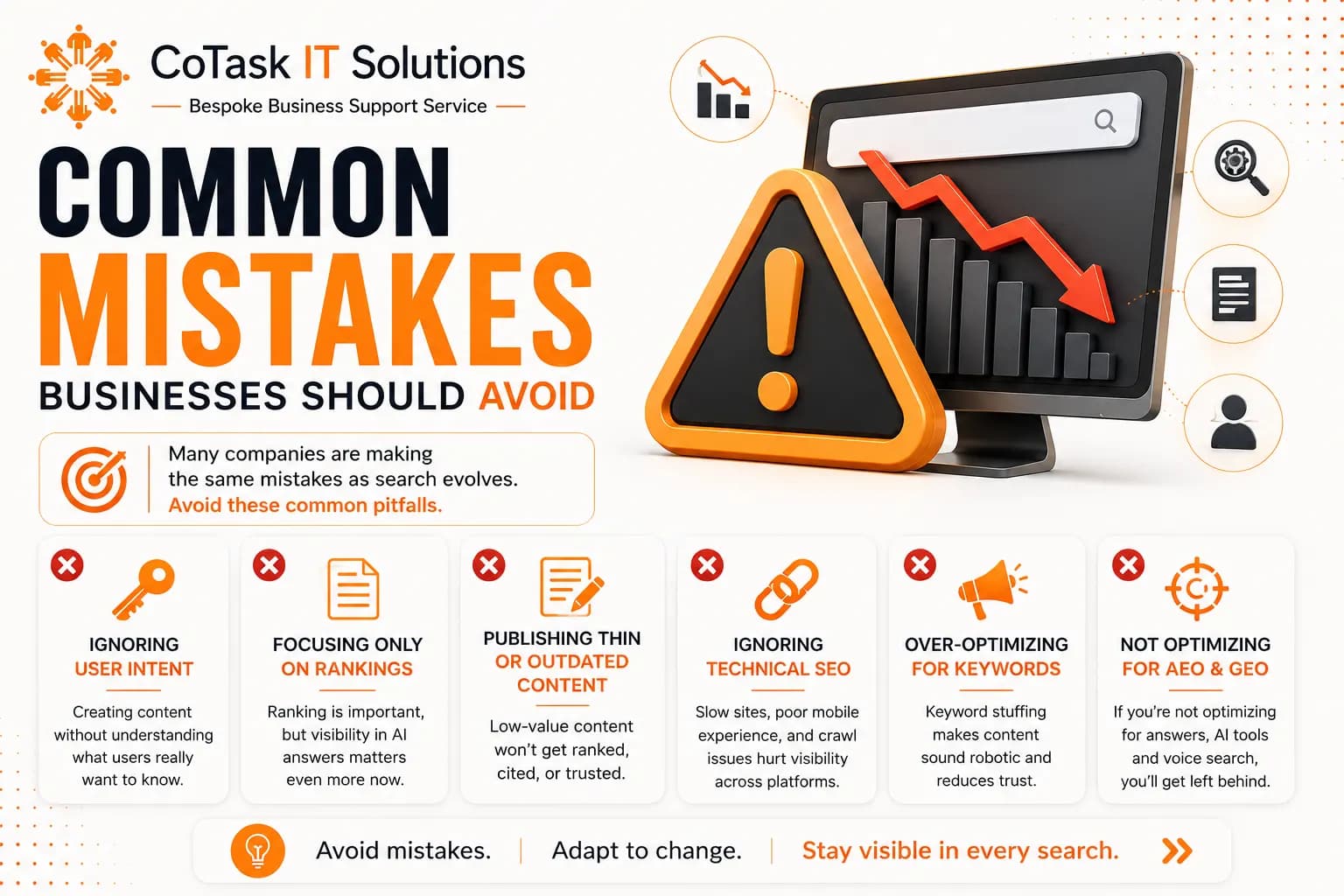
Common Mistakes Businesses Should Avoid
Many companies are making the same mistakes as search evolves.
Avoid these common pitfalls.
❌ Focusing Only on Rankings
Ranking first is valuable, but visibility now extends beyond search results.
Think bigger than Google.
❌ Publishing Thin Content
Short, repetitive articles rarely perform well.
Instead, create comprehensive resources that answer every important question on the topic.
❌ Writing for Algorithms Instead of People
Keyword stuffing, awkward phrasing, and robotic writing hurt both user experience and SEO.
Always write naturally.
❌ Ignoring AI Search Platforms
If your strategy only considers Google, you're missing a growing audience using AI-powered tools.
Diversify your visibility.
❌ Chasing Every Trend
Not every SEO trend lasts.
Focus on timeless fundamentals:
- Helpful content
- Strong expertise
- Great user experience
- Technical excellence
- Brand credibility
These principles won't go out of style.
Is SEO Dead?
This question seems to resurface every few years.
The answer remains the same.
No—SEO is not dead. It's evolving.
Search has changed before.
It adapted when:
- Mobile search became dominant.
- Voice search emerged.
- Featured snippets appeared.
- Mobile-first indexing launched.
- AI Overviews rolled out.
Each time, successful businesses adapted instead of resisting change.
The same applies today.
SEO is no longer just about ranking.
It's about being discoverable wherever people seek information.
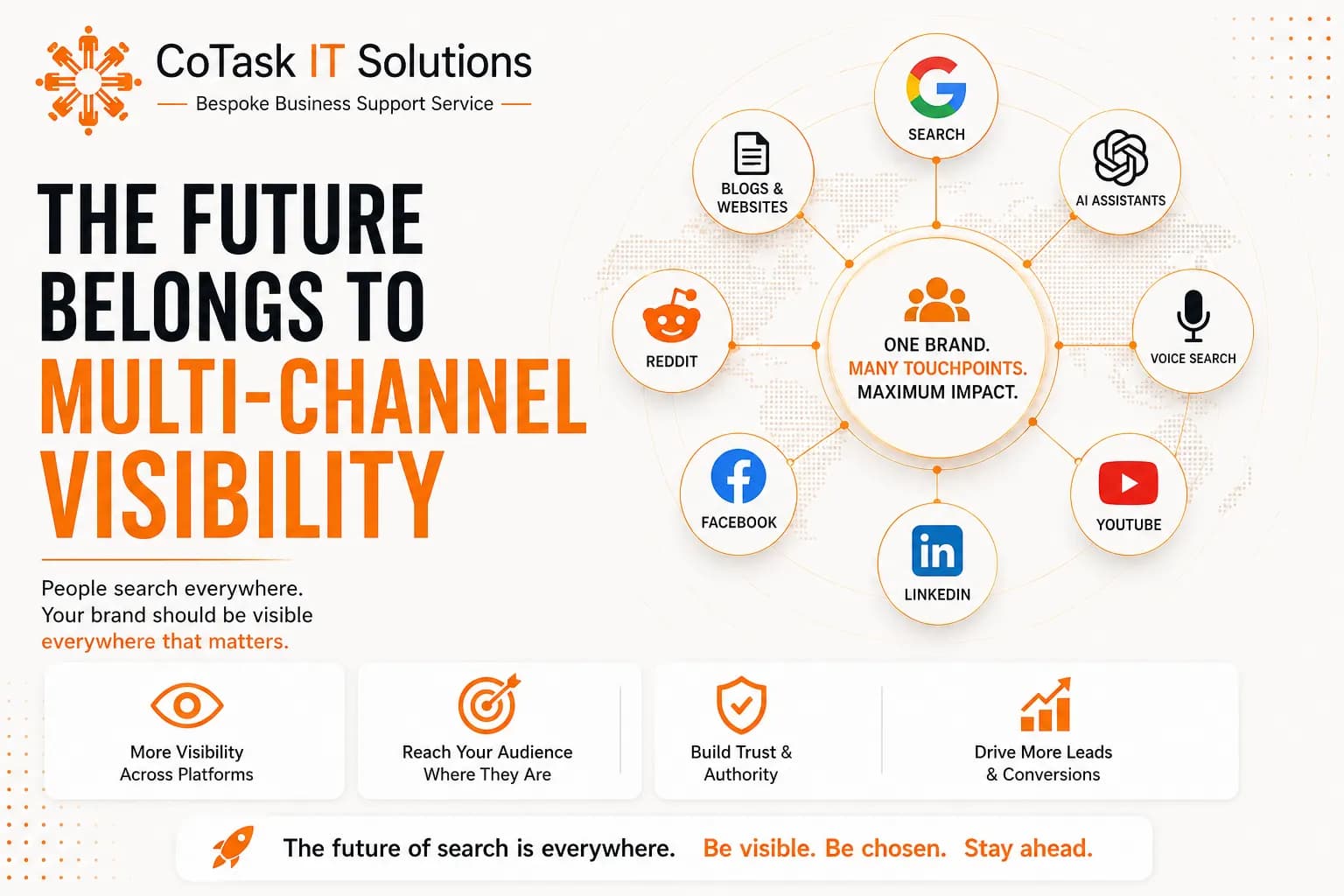
The Future Belongs to Multi-Channel Visibility
Think of modern search as an ecosystem.
Instead of optimizing for one destination, optimize for multiple discovery channels.
- Google Search → SEO
- Google AI Overviews → AEO + SEO
- ChatGPT → GEO
- Gemini → GEO
- Perplexity → GEO
- Voice Search → AEO
- Featured Snippets → AEO
- People Also Ask → AEO
- YouTube Search → Video SEO
- Social Platforms → Content Marketing
The brands that embrace this broader approach will enjoy greater visibility and resilience as search continues to evolve.
A Simple Future-Proof SEO Framework
If you're wondering where to begin, follow this roadmap.
- Create genuinely helpful content.
- Build topical authority through content clusters.
- Optimize pages for featured snippets and AI summaries.
- Answer real user questions.
- Improve technical SEO.
- Strengthen your online brand presence.
- Monitor changes in AI-powered search and refine your strategy regularly.
Small, consistent improvements often deliver better long-term results than chasing quick wins.
Frequently Asked Questions
Final Thoughts
The future of SEO isn't about choosing between traditional optimization and AI-driven strategies.
It's about understanding that search has become bigger than Google.
People now discover brands through search engines, AI assistants, voice search, social platforms, and intelligent recommendation systems. If your content is only optimized for one channel, you're limiting your potential reach.
The businesses that succeed over the next decade won't necessarily publish the most content. They'll publish the most useful, trustworthy, and accessible content—content that's easy for both people and AI to understand.
Start by strengthening your SEO foundation. Then expand into AEO and GEO. Build topical authority, answer real questions, and create content worth referencing.
Do that consistently, and you'll be prepared not just for the future of SEO—but for the future of search itself.