
Top AI Marketing Tools Every Business Should Use in 2026
AI marketing tools have gone from "nice to have" to non-negotiable. According to Salesforce's 2026 State of Marketing report, 91% of marketing professionals now actively use AI tools in their daily workflow, and the global AI-in-marketing market has crossed roughly $58 billion this year, growing at a compound rate above 35% annually. If your business isn't using AI marketing tools yet, competitors already generating faster content, sharper targeting, and better ROI are pulling ahead every quarter.
This guide breaks down the best AI marketing tools of 2026 by category — content creation, SEO and AI-search visibility, advertising, automation, and analytics — along with a practical framework for choosing the right stack for your business, not just the most hyped one.
Why AI Marketing Tools Matter More in 2026 Than Ever Before
Three shifts explain the urgency:
- AI search is now part of the funnel. With Google AI Overviews, ChatGPT, and Perplexity answering queries directly, brands must optimize for Answer Engine Optimization (AEO) and Generative Engine Optimization (GEO), not just traditional SEO. Research from Semrush shows pages already ranking first in classic search are roughly 25% more likely to be cited in AI Overviews — meaning AI visibility now compounds existing SEO strength rather than replacing it.
- Content demand has outpaced human bandwidth. Marketing teams are expected to produce content across more channels and markets than ever, and HubSpot's 2026 AI Trends report found the average marketer saves over 6 hours per week using AI tools, with senior practitioners saving 8–10 hours.
- ROI is measurable, not theoretical. McKinsey's Global AI Survey found AI-driven campaigns deliver roughly 22% higher ROI and 29% lower customer acquisition costs compared to non-AI campaigns, while Semrush data shows about 65% of businesses report a direct uplift in SEO performance from AI marketing tools.
The takeaway: AI marketing tools aren't just about speed. Used correctly, they directly move revenue, ranking, and retention metrics.
Quick Stat Snapshot: $58B+ market size in 2026 · 91% marketer adoption · 22% higher campaign ROI · 6+ hours saved weekly per marketer. These aren't projections — they're 2026 figures already reported by Salesforce, HubSpot, and McKinsey.
How to Choose the Right AI Marketing Tools (Not Just the Trendiest Ones)
Before diving into specific tools, apply this filter:
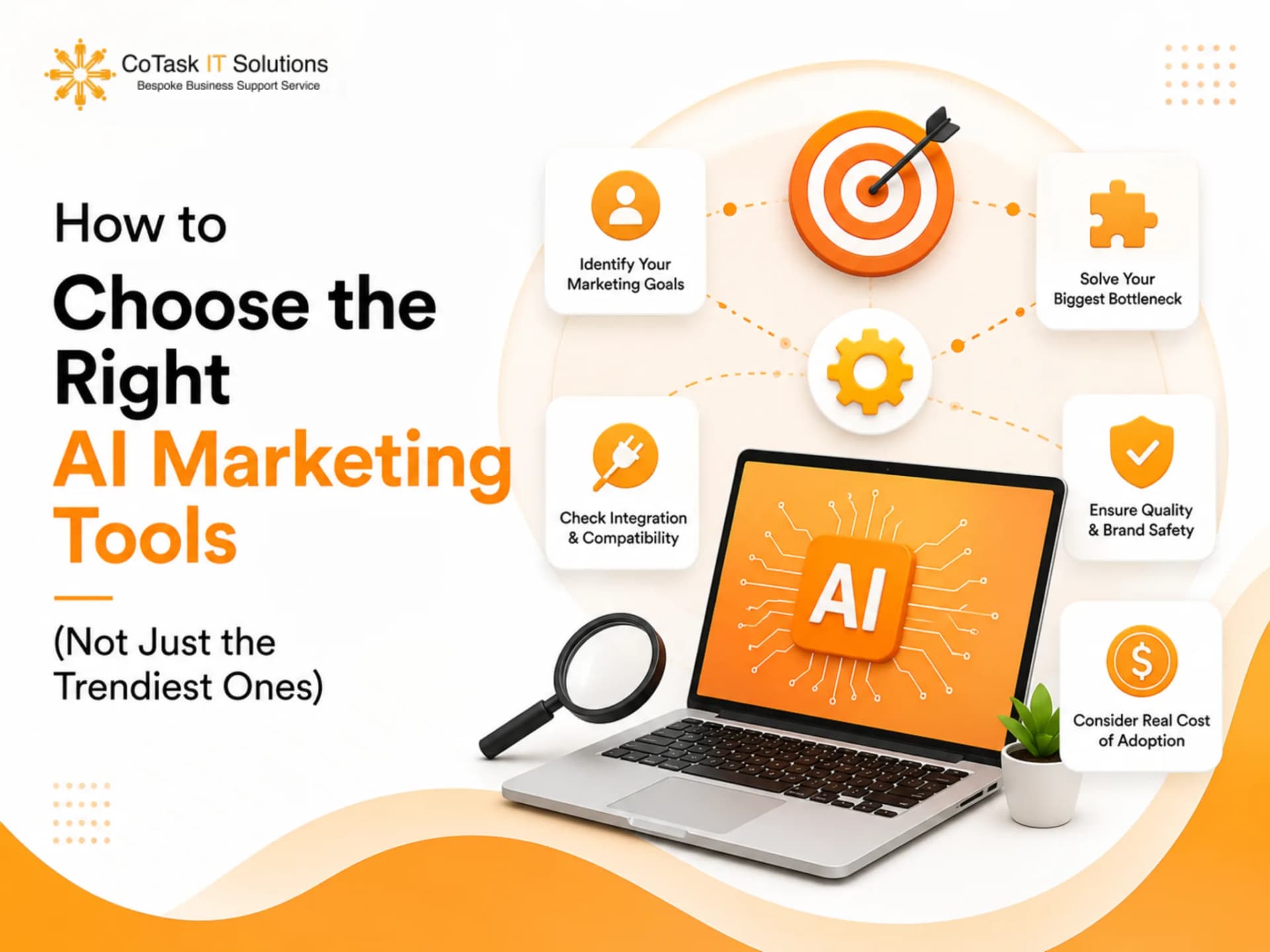
- Does it solve your biggest bottleneck? Content velocity, ad spend waste, and reporting time are the three most common. Pick tools that attack your actual constraint, not a hypothetical one.
- Does it integrate with your existing stack? A tool that can't connect to your CRM, ad platforms, or analytics creates a data silo instead of removing one.
- Is the output brand-safe and editable? AI should accelerate human judgment, not replace quality control. Look for tools that let you train brand voice, tone, and guidelines.
- What's the real cost of adoption? Software price is only part of it — CoSchedule's 2025 research found 38% of marketers cite lack of technical expertise as a barrier and only about 17% of teams using AI tools receive formal training. Budget time for onboarding, not just subscriptions.
With that framework in mind, here are the categories and tools shaping 2026.
AI Marketing Tools at a Glance (2026)
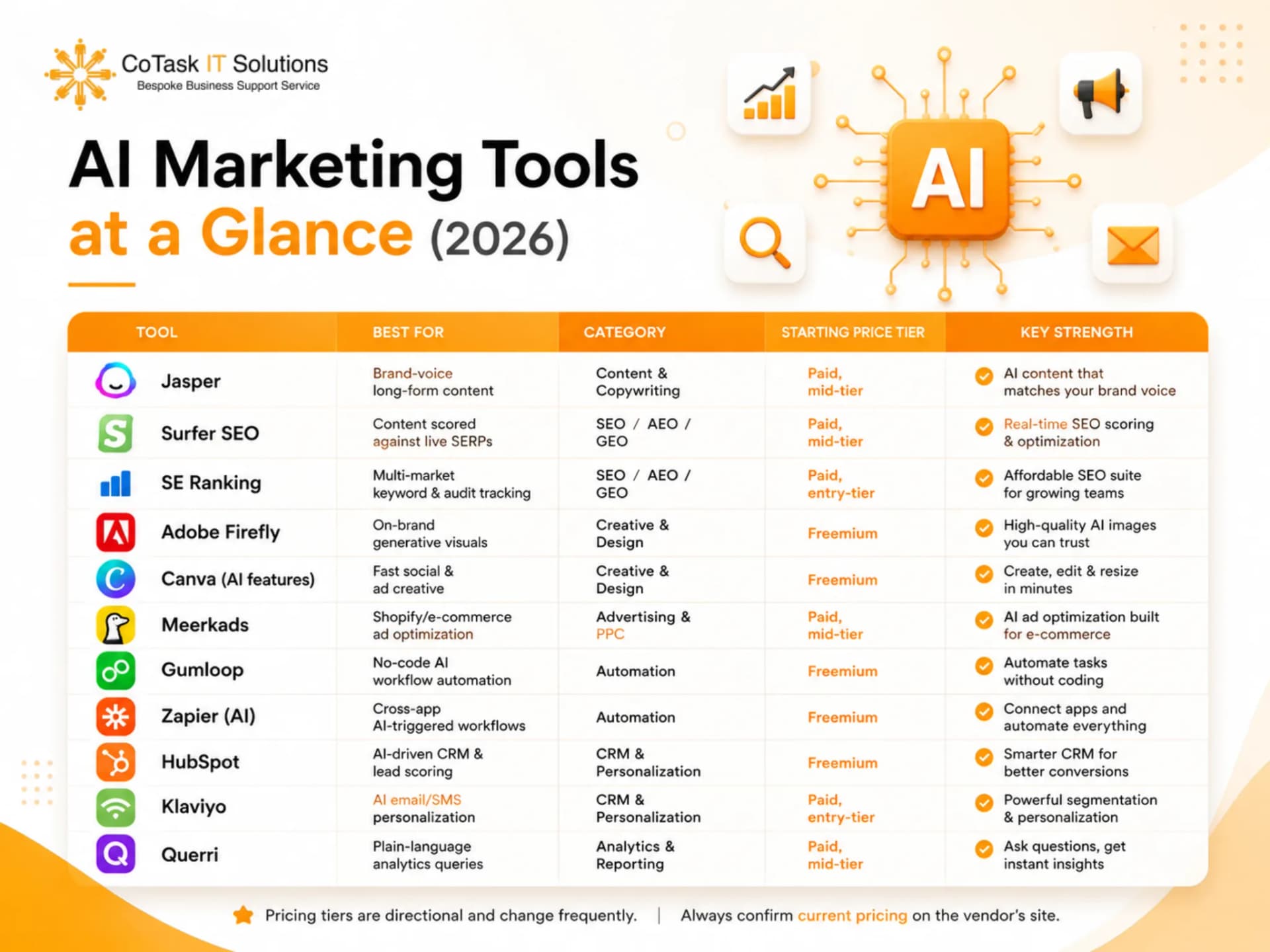
| Tool | Best For | Category | Starting Price Tier |
|---|---|---|---|
| Jasper | Brand-voice long-form content | Content & Copywriting | Paid, mid-tier |
| Surfer SEO | Content scored against live SERPs | SEO / AEO / GEO | Paid, mid-tier |
| SE Ranking | Multi-market keyword & audit tracking | SEO / AEO / GEO | Paid, entry-tier |
| Adobe Firefly | On-brand generative visuals | Creative & Design | Freemium |
| Canva (AI features) | Fast social & ad creative | Creative & Design | Freemium |
| Meerkads | Shopify/e-commerce ad optimization | Advertising & PPC | Paid, mid-tier |
| Gumloop | No-code AI workflow automation | Automation | Freemium |
| Zapier (AI) | Cross-app AI-triggered workflows | Automation | Freemium |
| HubSpot | AI-driven CRM & lead scoring | CRM & Personalization | Freemium |
| Klaviyo | AI email/SMS personalization | CRM & Personalization | Paid, entry-tier |
| Querri | Plain-language analytics queries | Analytics & Reporting | Paid, mid-tier |
Pricing tiers are directional and change frequently — always confirm current pricing on the vendor's site before budgeting.
1. AI Content & Copywriting Tools
Content creation remains the single highest-adoption use case for AI in marketing — and the one with the clearest documented ROI (McKinsey puts AI content drafting at roughly 3.2x self-reported ROI, the highest of any application studied).
- Jasper — Best for brand-voice-trained long-form and campaign copy at scale, with workflow templates for teams managing multiple product lines.
- Surfer SEO — Combines AI writing with real-time SEO scoring against top-ranking pages, making it a strong choice for teams that need content optimized for search from the first draft.
- Adobe Firefly — Generative AI for on-brand visuals and ad creative, increasingly used alongside copy tools to produce full campaign assets in one workflow.
The shift to watch: Canva's 2026 data shows 40% of creative teams now run AI end-to-end, from ideation through final asset, with human review shifting toward quality control rather than execution.
2. AI Tools for SEO, AEO, and GEO
This is the category redefining "search visibility" in 2026. It's no longer enough to rank in blue links — brands now need to be cited inside AI-generated answers.
- Surfer SEO — Content optimization scored against live SERP data, useful for aligning on-page structure with what's actually ranking.
- SE Ranking — Keyword tracking, competitor gap analysis, and technical audit reporting in one dashboard, widely used by agencies managing multiple client sites across markets.
- AI visibility trackers (an emerging tool category in 2026) — Purpose-built to monitor whether ChatGPT, Gemini, and Perplexity mention or recommend your brand for relevant queries, treating AI answer citations as a new ranking signal alongside traditional SERP position.
For any business managing this properly, the practical workflow looks like: keyword and intent research → AI-assisted drafting → schema markup implementation → internal linking → AI-citation monitoring. Agencies like Cotasks build this exact SEO-AEO-GEO pipeline for clients across multiple markets, which is worth exploring if your team needs the strategy layer, not just the software.
Read more about: The Future of SEO
3. AI Tools for Advertising and PPC
AI has moved from "suggesting" ad copy to actively managing budget allocation and creative performance.
- Google Ads' native AI features (Performance Max, automated bidding) — Baseline for most PPC accounts now, using machine learning to shift spend toward the highest-converting audiences in real time.
- Meerkads and similar platforms — Purpose-built for Shopify and e-commerce advertisers, offering creative fatigue detection, product-level ROAS tracking, and AI-generated ad copy and imagery in one tool.
- Predictive budget optimization tools — Recommend spend reallocation across channels based on live performance signals rather than end-of-month reporting, cutting the lag between insight and action.
The Australian Red Cross case, cited by Campaign Monitor, is a useful benchmark: a single AI-personalized, segmented campaign produced a 75% increase in conversions — a reminder that AI's biggest ad wins usually come from personalization and timing, not just automated bidding.
4. AI Workflow Automation Tools
As AI tool count grows, so does the risk of fragmented workflows. Automation platforms exist to connect everything.
- Gumloop — A no-code AI automation layer that connects LLMs (ChatGPT, Claude, Gemini) directly to internal marketing tools and workflows without engineering support.
- Zapier's AI features — Now capable of auto-building full email campaigns — copy, segmentation, and send-time — from a single prompt, extending its role beyond simple app-to-app triggers.
- Agentic AI platforms — The fastest-growing frontier: Deloitte's 2026 research found 43% of organizations are actively considering agentic AI adoption this year, with the earliest use cases concentrated in media buying, email sequencing, and social scheduling — tasks that are repetitive, rule-based, and easy to hand off to autonomous agents.
5. AI CRM, Personalization, and Sales Enablement
- HubSpot and Salesforce — Both have shifted AI from an add-on feature to the operating layer of the platform, powering lead scoring, next-best-action recommendations, and automated segmentation.
- Klaviyo — AI-driven email and SMS personalization for e-commerce brands, using purchase and browsing behavior to trigger individualized send timing and content.
- Creatio and similar CRM-AI hybrids — Focused on AI-driven audience segmentation for account-based marketing (ABM) programs.
6. AI Analytics and Reporting Tools
- Querri and similar conversational analytics tools — Let marketers ask plain-language questions and get instant performance insights, removing the dependency on a dedicated analyst for every report.
- AI-powered attribution platforms — Increasingly used to clean up cross-channel and cross-domain data issues (a common pain point when GA4 properties get misconfigured or contaminated across sites), giving more reliable ROI numbers per channel.
Read about: AI in Digital Marketing
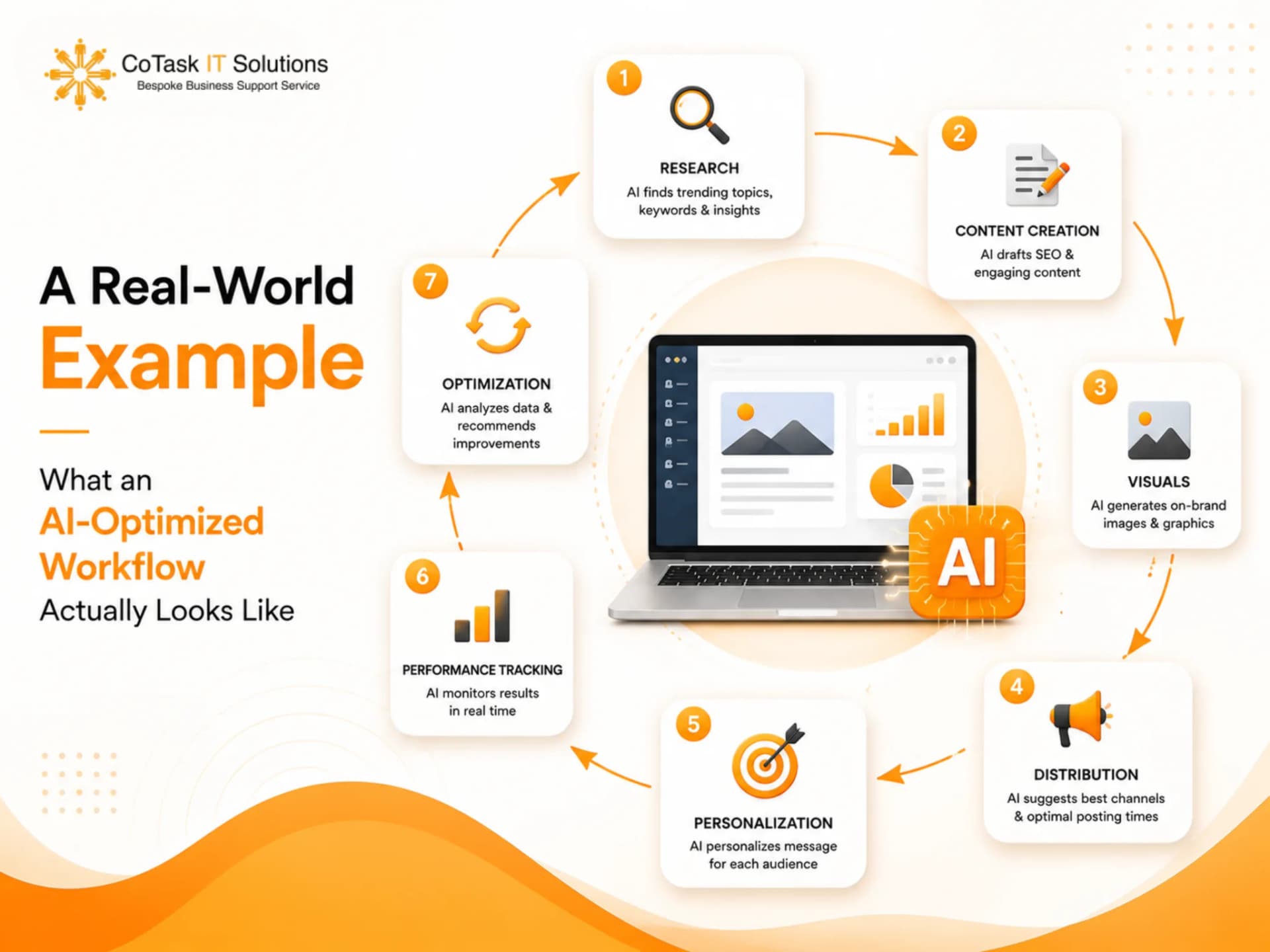
A Real-World Example: What an AI-Optimized Workflow Actually Looks Like
Theory is easy — execution is where most businesses stall. Here's what a realistic AI-assisted content-to-conversion workflow looks like for a mid-size business in 2026:
- Research (30 minutes, AI-assisted): An SEO tool like SE Ranking surfaces keyword gaps and competitor content the team hasn't covered yet.
- Draft (1 hour, AI-assisted): An AI writing tool produces a first draft trained on the brand's tone and past top-performing content.
- Optimize (20 minutes, AI-assisted): An on-page scoring tool checks the draft against what's currently ranking and flags missing subtopics or entities.
- Human review (30–45 minutes): A strategist edits for accuracy, adds real data and internal links, and confirms nothing sounds generic or AI-flattened.
- Distribute (AI-assisted): The same core content gets repurposed into social captions, an email snippet, and an ad variation — all drafted by AI, all human-approved before publishing.
- Monitor (ongoing, AI-assisted): An AI-visibility tracker checks whether the piece starts appearing in AI Overview citations or chatbot answers over the following weeks.
What used to take a content team 6–8 hours per piece now takes roughly 2–3 hours of active human time — matching HubSpot's reported average of 6+ hours saved weekly per marketer once workflows like this are standardized. The AI didn't replace anyone in this process; it compressed the slow parts so the strategist could spend more time on judgment calls that actually need a human.
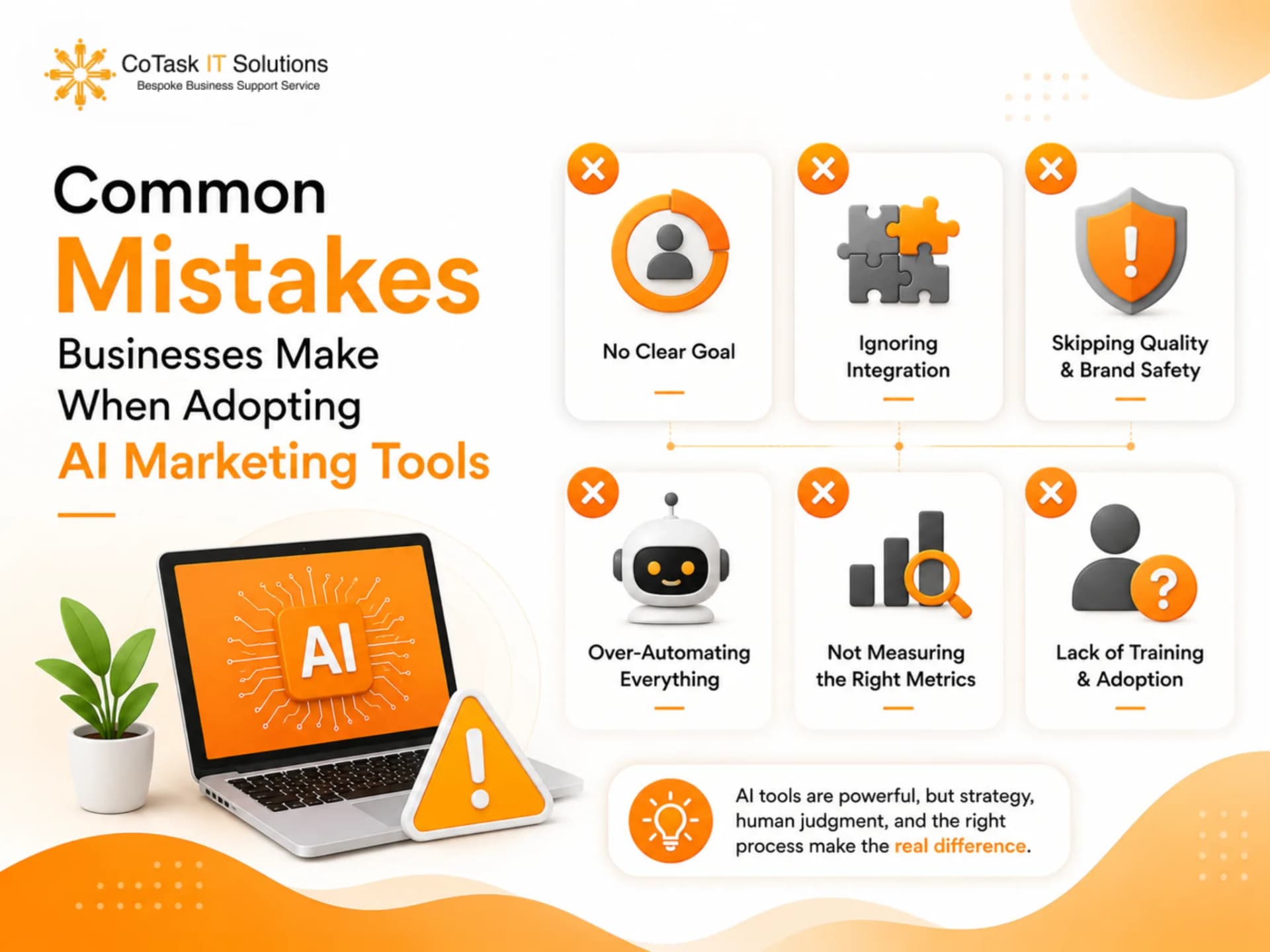
Common Mistakes Businesses Make When Adopting AI Marketing Tools
Even with the right tools, execution often goes wrong in predictable ways:
- Publishing AI drafts with zero human edit. Unedited AI content tends to sound generic, lacks real data, and is increasingly easy for both readers and search algorithms to detect — hurting trust rather than building it.
- Buying five tools before mastering one. Tool sprawl creates data fragmentation and subscription waste. Depth with one tool beats breadth across ten.
- Ignoring AEO/GEO while over-indexing on classic SEO. Ranking #1 in blue links no longer guarantees visibility inside AI Overviews or chatbot answers — both need to be tracked and optimized deliberately.
- Feeding AI tools messy or contaminated data. If your GA4 property is misconfigured or shared across unrelated sites, AI-powered recommendations built on that data will be wrong — garbage in, confidently-wrong-insights out.
- Skipping training. As noted earlier, only about 17% of marketers using AI tools receive formal training, which is a major reason ROI varies so widely between businesses using the exact same software.
Read about: Landing Page Optimization
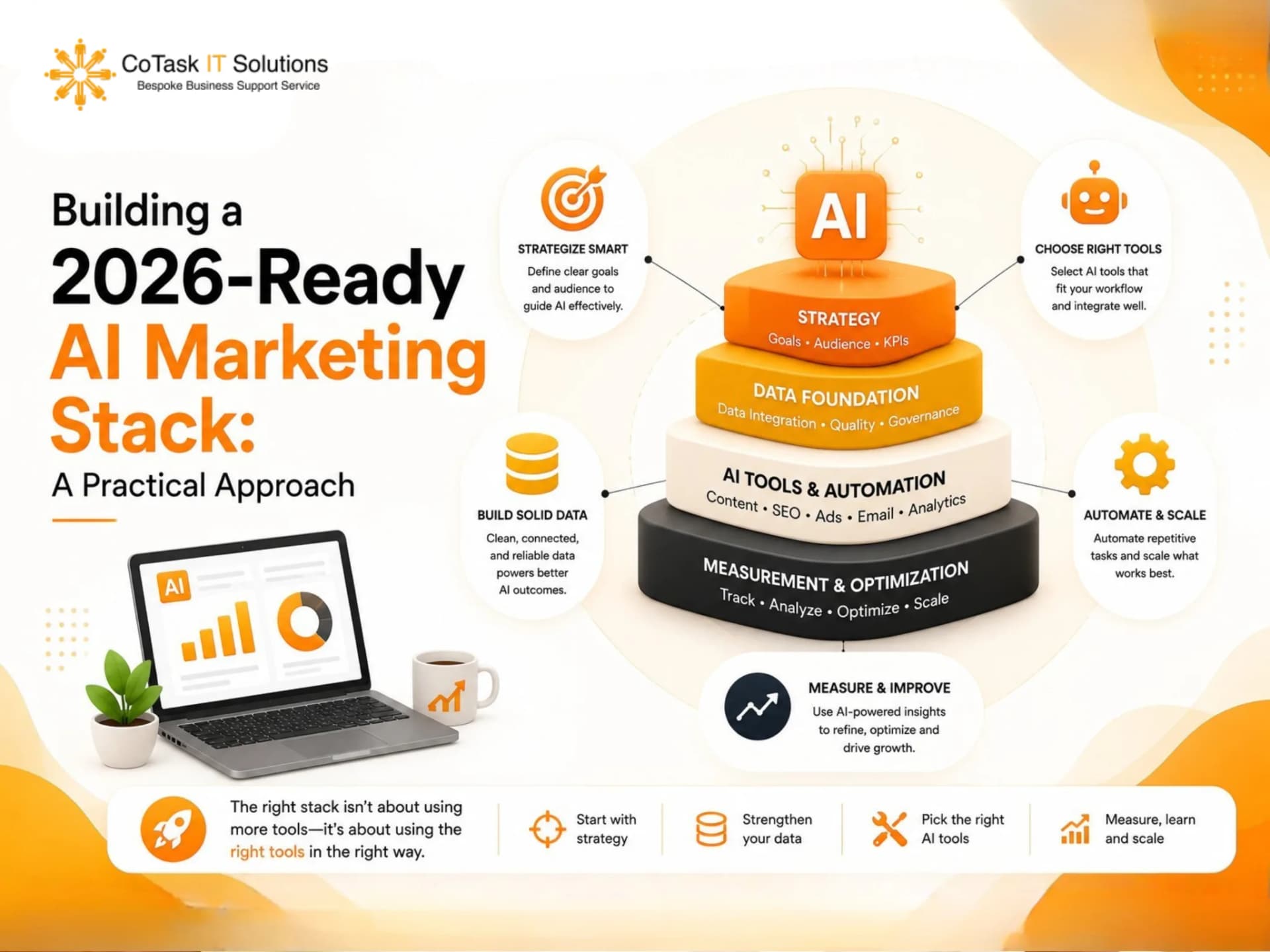
Building a 2026-Ready AI Marketing Stack: A Practical Approach
Rather than adopting every tool on this list, most businesses succeed with a phased approach:
- Start with your biggest time sink. For most teams, that's content production or reporting — pick one AI tool and master it before adding a second.
- Prove lift on one high-value workflow first. A single well-optimized, AI-assisted email journey or content cluster is a better proof point than a scattered rollout across ten tools.
- Keep data clean before scaling automation. AI recommendations are only as good as the data feeding them — bot-click filtering, tagged events, and unified analytics matter more once AI is making budget or content decisions.
- Combine AI speed with human strategy. The businesses seeing the strongest results in 2026 aren't the ones using AI everywhere — they're using it specifically where impact compounds: personalization, SEO/AEO visibility, and repetitive workflow automation.
For businesses that don't have the internal bandwidth to build and manage this stack — especially across multiple markets with different search behaviors and languages — working with a digital marketing partner that already runs AI-integrated SEO, content, and social workflows is often faster than building it in-house. This is the exact gap agencies like Cotasks are built to close, combining AI-assisted execution with human strategic oversight across SEO, paid media, and content.
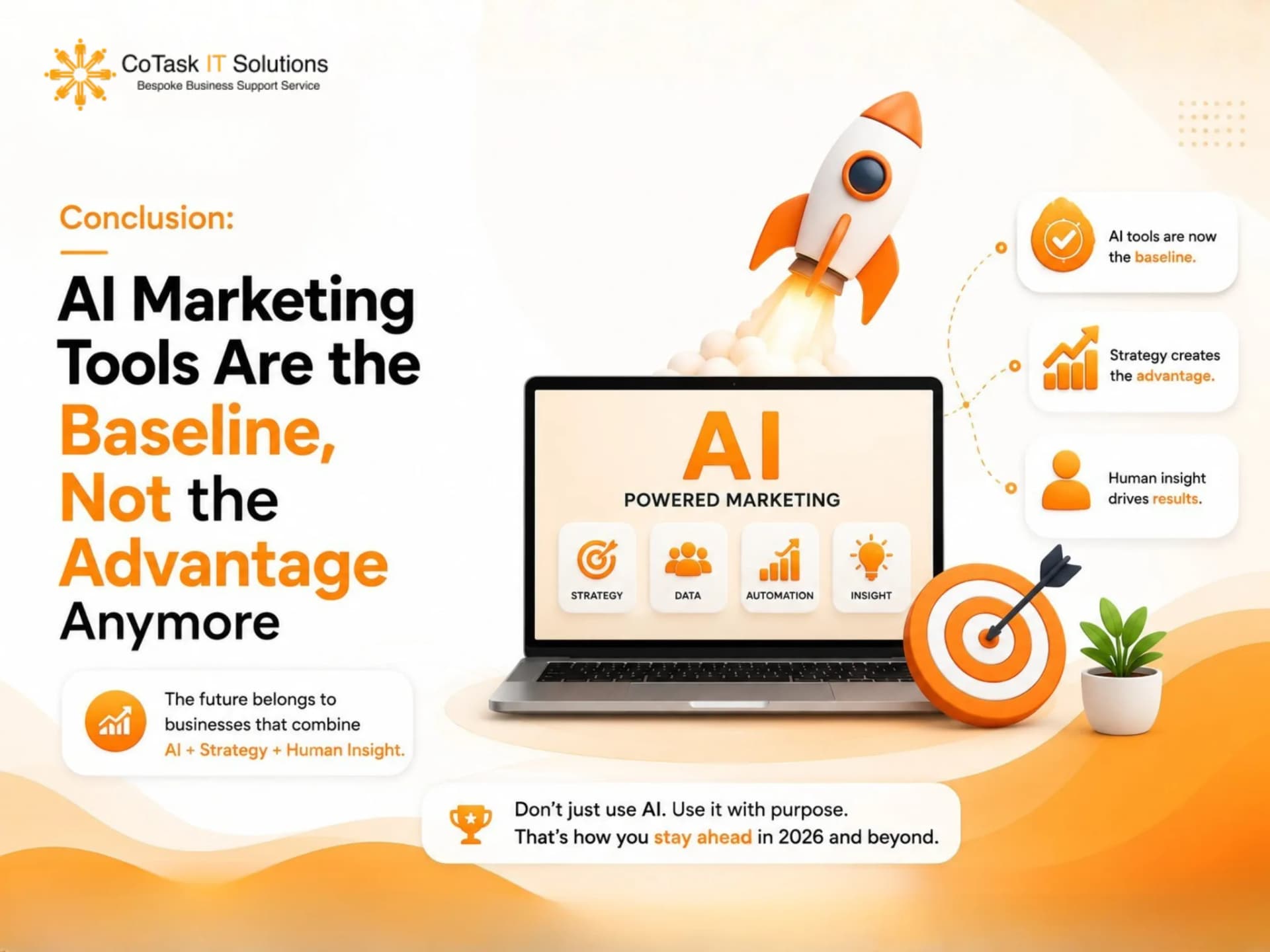
Conclusion: AI Marketing Tools Are the Baseline, Not the Advantage Anymore
By 2026, using AI marketing tools isn't what separates winning businesses from the rest — 91% of marketers already use them. The real advantage now comes from how well those tools are chosen, integrated, and supervised. Businesses that treat AI as a shortcut for lazy publishing fall behind. Businesses that use it to compress research and drafting time while keeping strategy, data quality, and human judgment front and center are the ones seeing 20%+ ROI gains and stronger AI-search visibility.
The fastest path forward isn't "use every tool on this list." It's picking the one or two tools that solve your biggest bottleneck, mastering them properly, and building AEO/GEO visibility alongside traditional SEO from day one — not as an afterthought once traffic already starts slipping.
Read about: Google AI Overviews
Don't Want to Build This Stack Alone?
Choosing, integrating, and actually getting ROI from AI marketing tools takes more than a subscription — it takes a strategy layer that most in-house teams don't have time to build from scratch, especially across multiple markets and languages. That's exactly the gap Cotasks fills for businesses across the US, UAE, UK, Saudi Arabia, Australia, and India: an AI-integrated approach to SEO, AEO/GEO visibility, content, paid media, and analytics — combining the speed of AI tools with the judgment of a team that's already run this playbook across six markets. If you'd rather have a partner build and manage the AI marketing stack than piece it together yourself, get in touch with Cotasks to see where the fastest wins are for your business.