
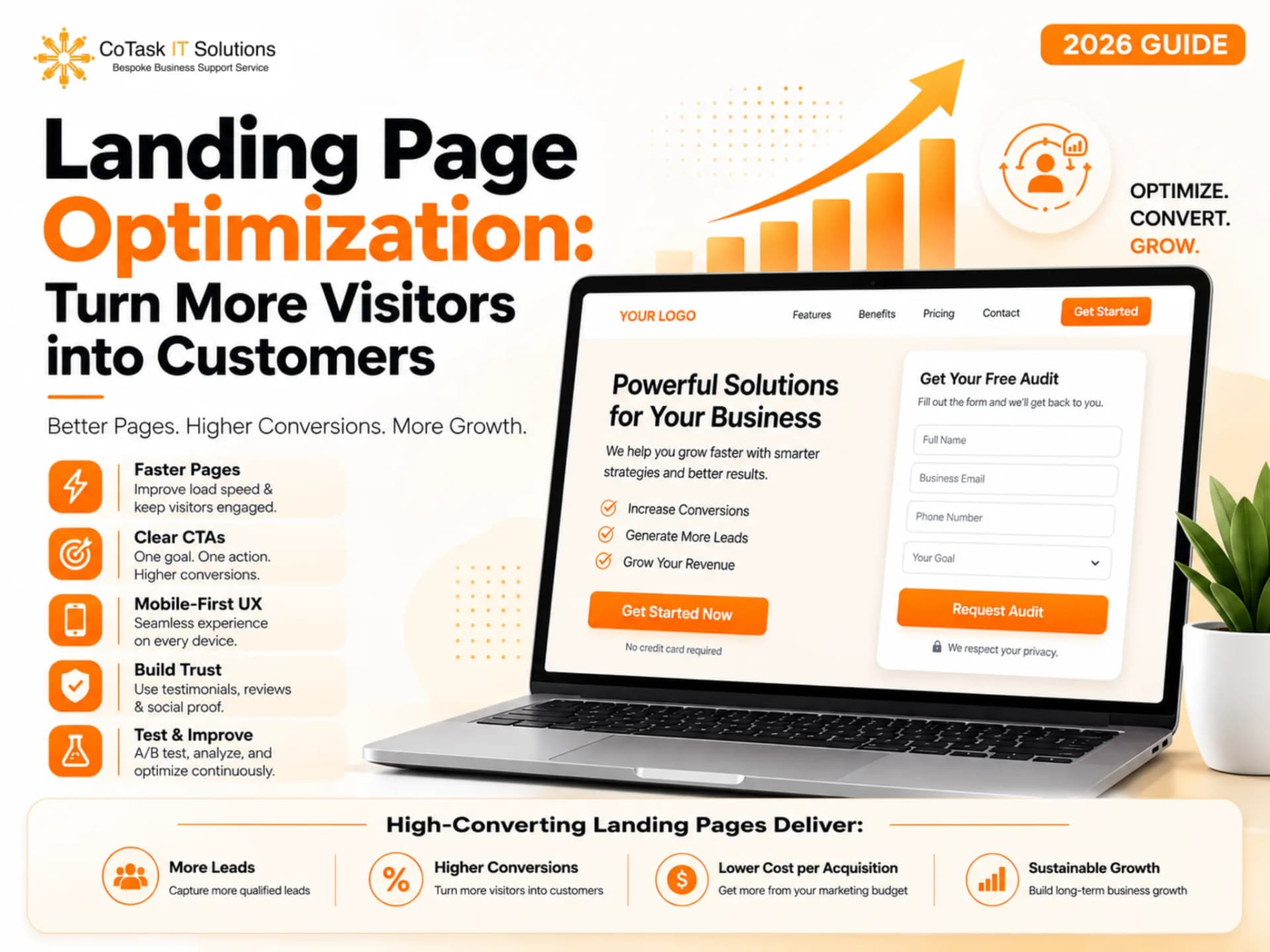
Landing Page Optimization: Turn More Visitors Into Customers (2026 Guide)
By Rahul Bisht, Digital Marketing Executive at Cotasks IT Solutions — Google & HubSpot Certified. Updated 2026.
Quick Answer
Landing page optimization is the process of improving a page's design, copy, speed, and structure to increase the percentage of visitors who take a desired action — buying, signing up, or booking a call. The highest-impact levers, in order of effort-to-return, are page speed, a single clear call-to-action, mobile-first design, trust signals like testimonials, and continuous A/B testing. Businesses running 10–15 dedicated landing pages generate 55% more leads than those running fewer than 10, according to industry 2026 analysis of landing page data.
Most visitors decide whether to stay or leave within seconds of a page loading. What happens on that page after the click — not the ad, not the email, not the search ranking — determines whether that visitor becomes a lead or a bounce statistic. That's the entire premise of landing page optimization (LPO): every click you've already paid for or earned deserves a page built to convert it.
This guide breaks down what actually moves the needle in 2026, backed by current industry data rather than guesswork.
What Is Landing Page Optimization?
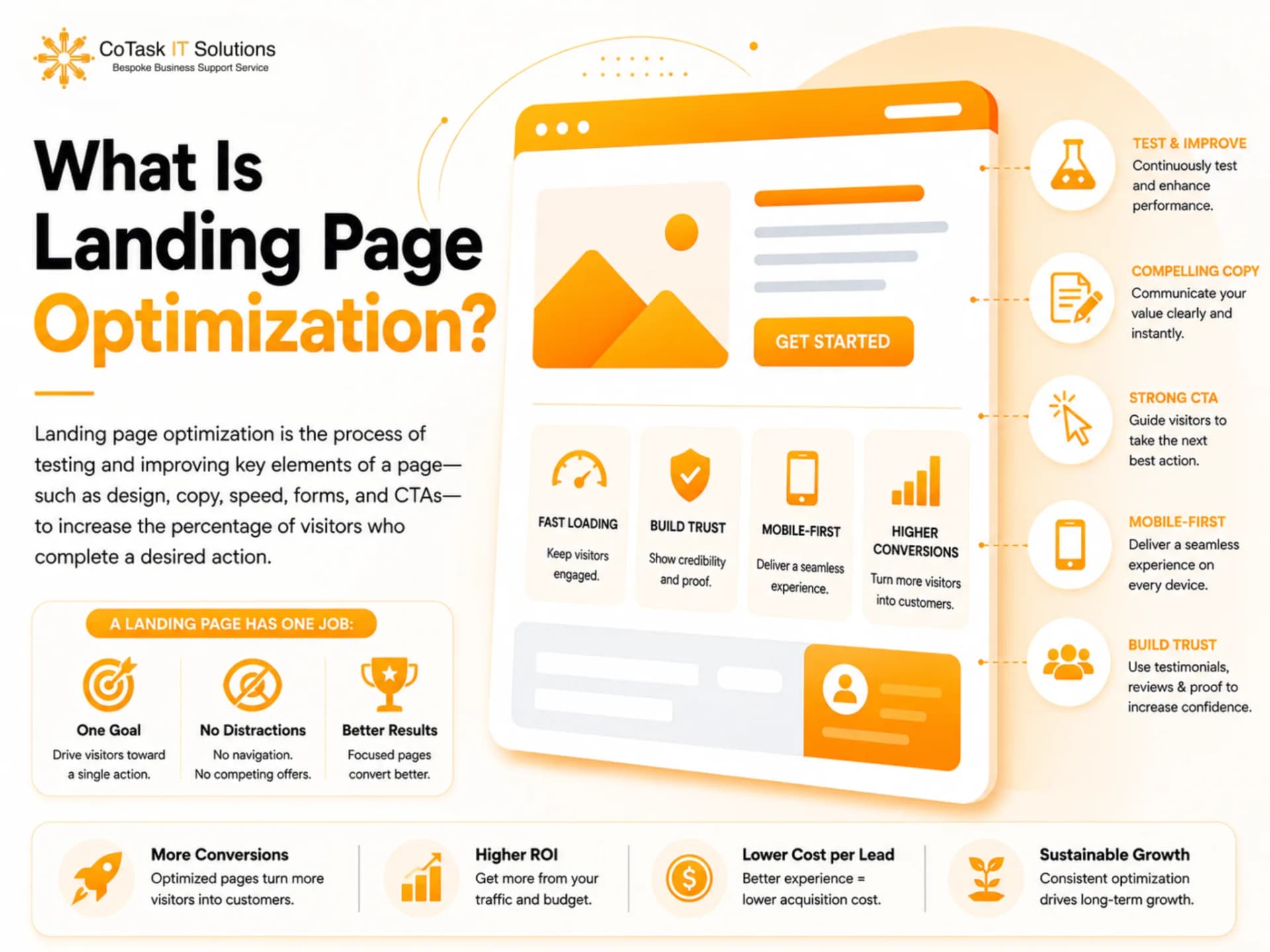
Landing page optimization is the ongoing practice of testing and refining a page's elements — headline, layout, copy, forms, visuals, and load speed — to increase conversion rate: the percentage of visitors who complete the page's goal action.
It differs from general website design in one key way: a landing page usually has one job. There's no navigation menu pulling attention away, no competing offers, no distractions. Every element on the page exists to move a visitor toward a single conversion goal.
Reported average conversion rates vary quite a bit depending on the dataset and industry, ranging from roughly 4% to 11% across studies. Some 2026 benchmarks put B2C landing pages at an average of 3.9% and B2B at 3.6%, while other datasets report medians closer to 4–7%. The takeaway isn't the exact number — it's that top-quartile pages convert at 2-3x the median, and that gap is almost entirely explained by optimization choices, not luck.
Why Landing Page Optimization Matters More in 2026
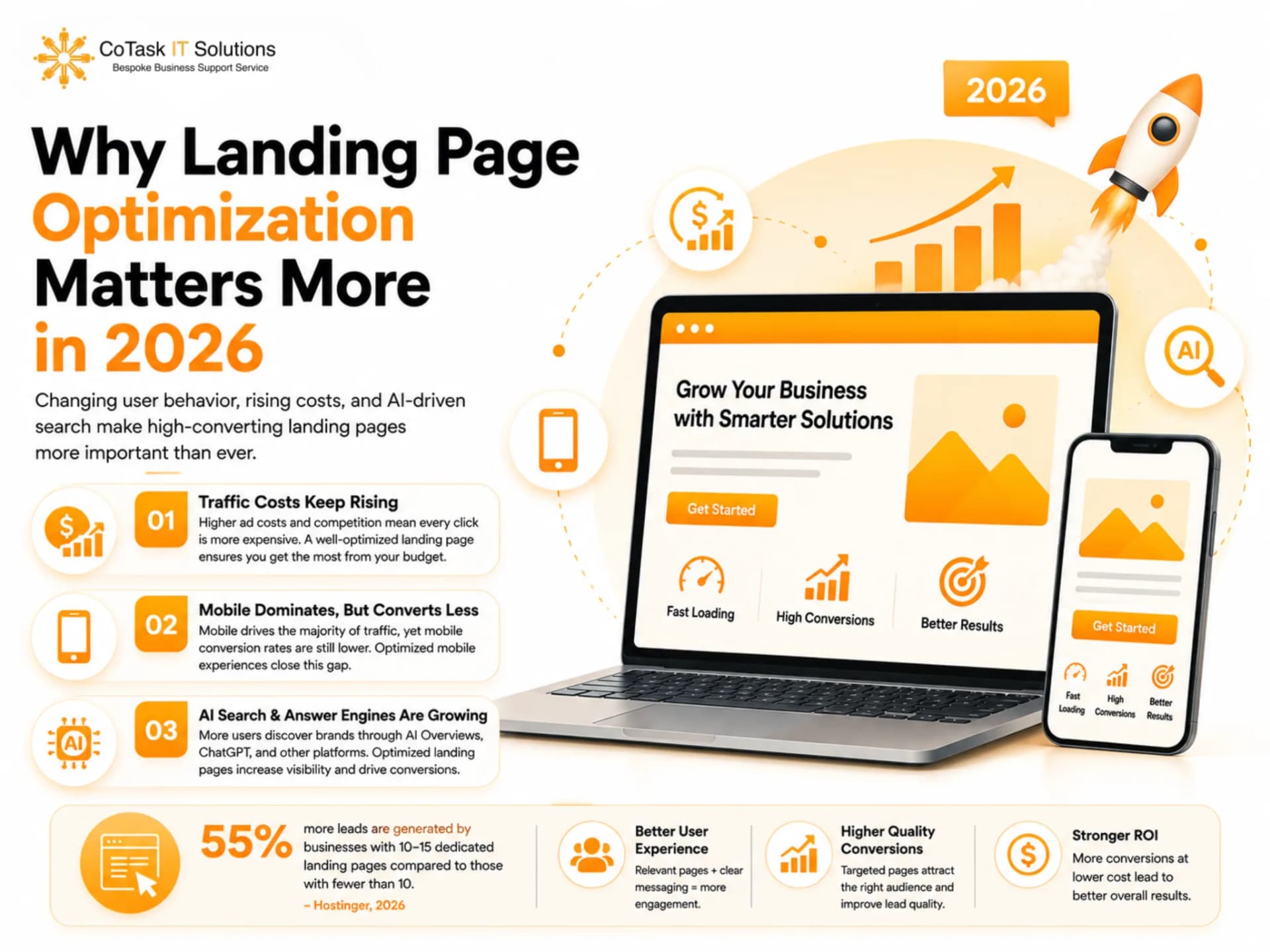
Three shifts have made LPO more important than it was even two years ago:
Traffic costs keep rising. Whether traffic comes from paid search, social ads, or organic content, acquisition costs have climbed steadily. A landing page with poor Core Web Vitals can end up paying noticeably more per click than a faster competitor bidding on the same keyword, since page experience now factors into ad quality scores and organic rankings alike.
Mobile dominates traffic but still lags in conversion. Mobile devices account for somewhere between 62% and 83% of landing page traffic depending on the industry, yet mobile conversion rates typically run 8% or more below desktop. One 2026 landing page report found mobile pages converting at roughly 2.8% against 4.8% for the equivalent desktop experience — a gap that's closing only for pages actively optimized for mobile forms and tap targets.
AI search and answer engines are reshaping discovery. A growing share of research now happens inside AI Overviews, ChatGPT, and Perplexity before a buyer ever lands on your site. That means landing pages increasingly need to work for two audiences at once: the human visitor deciding whether to convert, and the AI systems deciding whether to cite or recommend you in the first place.
This applies whether traffic is paid or organic. If you're weighing where to invest first, our comparison of Google Ads vs. SEO breaks down how landing page quality affects both channels differently — a weak landing page inflates paid CPCs immediately, while it slows organic rankings more gradually.
Landing Page Elements Ranked by Conversion Impact
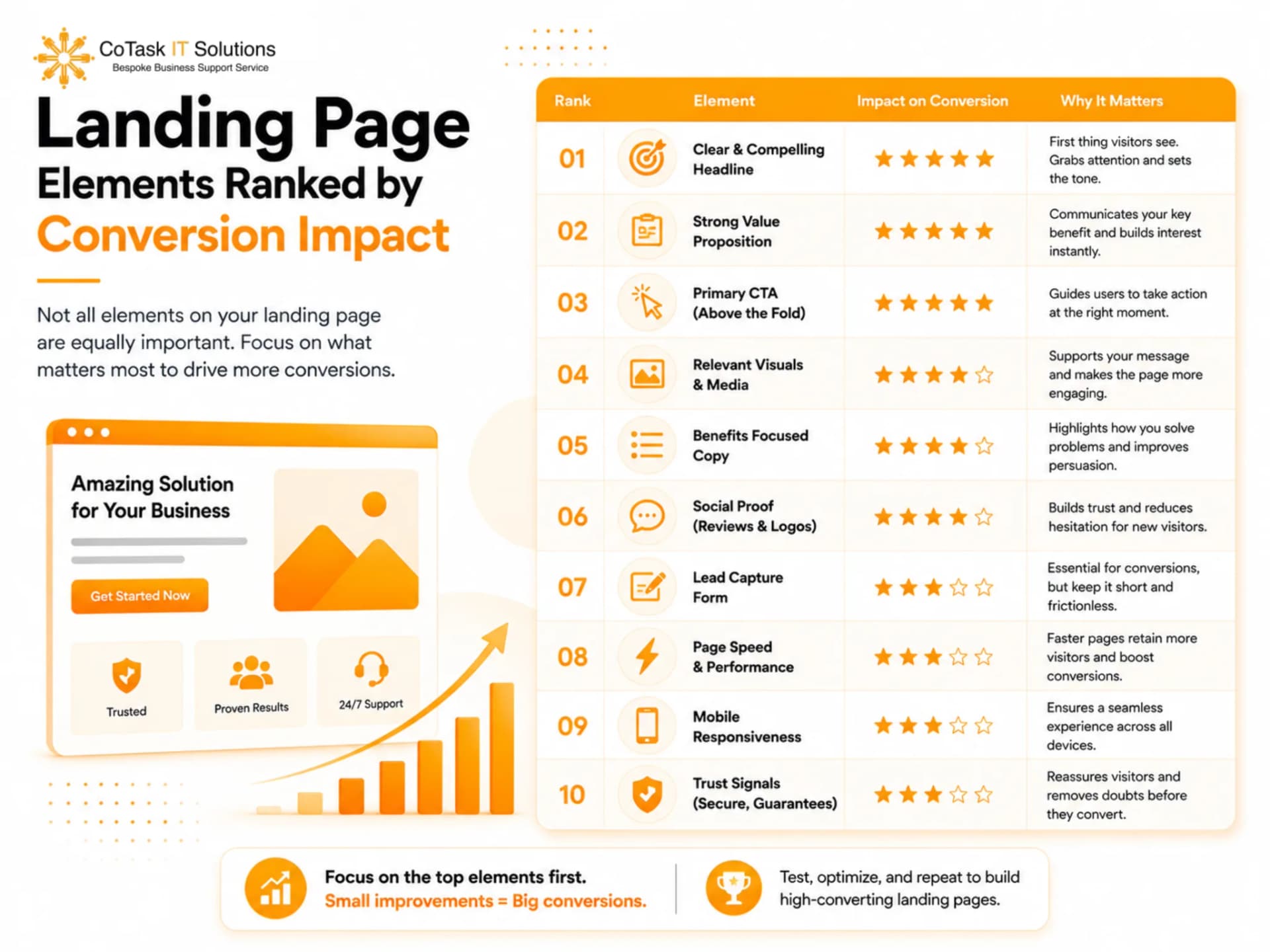
- Page speed (under 2s load) — Conversion Impact: High, up to 7% loss per 1s delay. Effort to Implement: Medium.
- Single CTA / goal — Conversion Impact: High, up to ~3pt conversion gap vs. multi-link pages. Effort to Implement: Low.
- Mobile-first UX — Conversion Impact: High, ~2pt gap between optimized and unoptimized mobile pages. Effort to Implement: Medium.
- Form field reduction (5 or fewer) — Conversion Impact: High, up to 2x conversion in some datasets. Effort to Implement: Low.
- Personalized CTAs/copy — Conversion Impact: Medium-High, up to 202% lift reported. Effort to Implement: Medium-High.
- Trust signals (testimonials, faces) — Conversion Impact: Medium. Effort to Implement: Low.
- A/B testing individual elements — Conversion Impact: Low-Medium per test, compounds over time. Effort to Implement: High (ongoing).
Note: ranges reflect reported figures across multiple 2026 industry studies; actual impact varies by industry and starting baseline.
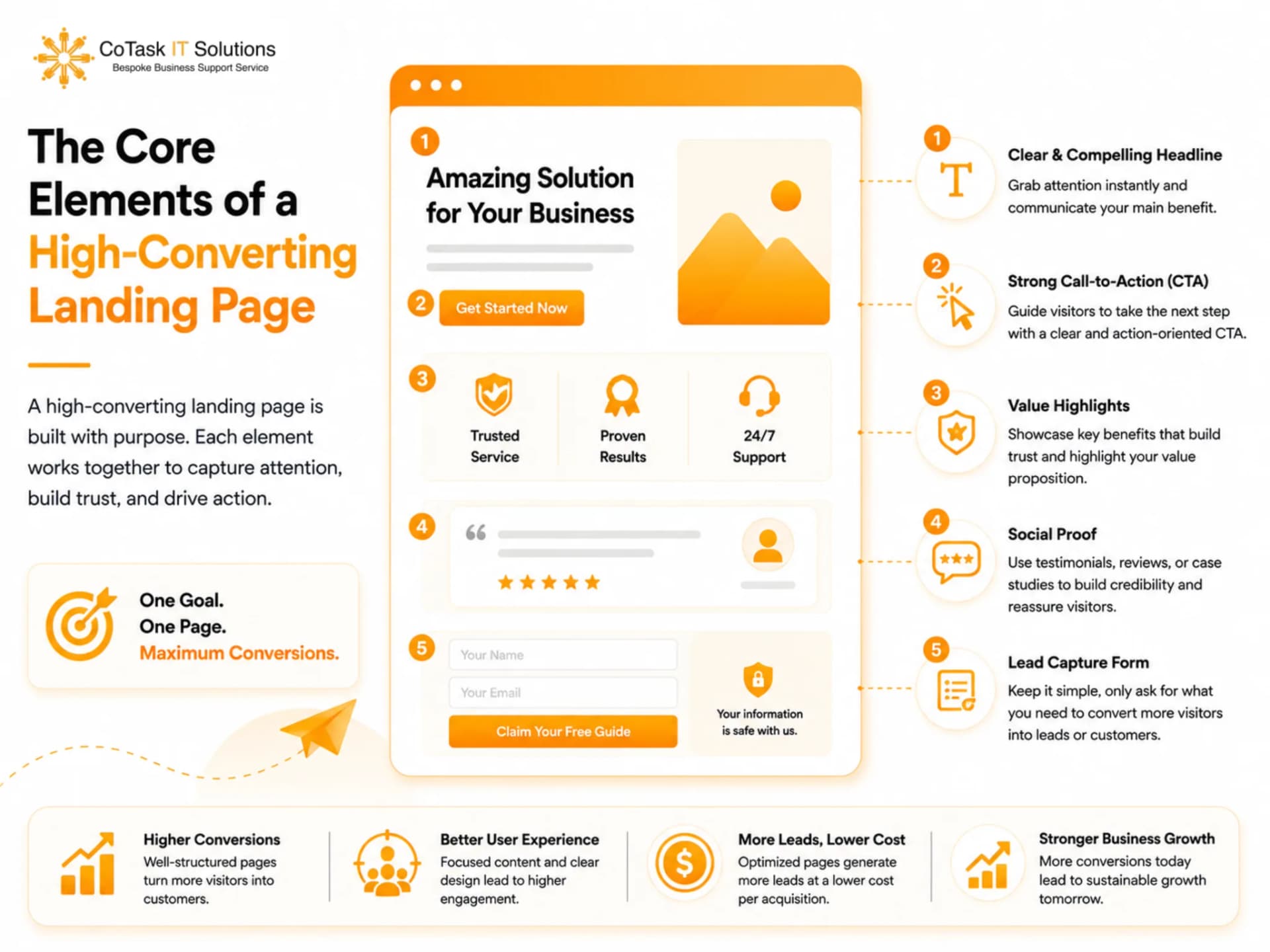
The Core Elements of a High-Converting Landing Page
1. Page Speed
Speed is consistently one of the single biggest conversion levers, and it's also one of the easiest to underinvest in. A one-second delay in load time can decrease conversions by roughly 7%, and 47% of users expect a page to load in two seconds or less. Image optimization, font-loading strategy, and cutting render-blocking third-party scripts typically deliver the biggest speed wins — often bigger than switching frameworks entirely. For a full technical breakdown, see our guide to website speed optimization.
Action items:
- Compress and lazy-load images (WebP/AVIF formats)
- Defer non-critical JavaScript
- Use a CDN for global audiences (especially relevant for a multi-market UAE/US/UK/Saudi/Australia/India footprint)
- Target a Largest Contentful Paint (LCP) under 2.5 seconds
2. One Clear, Singular Goal
Landing pages with a single link or CTA tend to convert meaningfully better than pages cluttered with five or more competing links — in some datasets, roughly 13.5% versus 10.5%. Every additional link is an exit ramp. If the goal is a demo booking, don't also link to the blog, pricing page, and social profiles from the hero section.
3. Above-the-Fold Clarity
Visitors should understand three things within seconds of landing: what you offer, who it's for, and what to do next. A concise, benefit-driven headline paired with a supporting subheadline does this job. Avoid clever wordplay that requires decoding — clarity converts better than cleverness on a landing page.
4. Mobile-First Design
With mobile now driving the majority of traffic across most industries, mobile can no longer be treated as a scaled-down afterthought. One 2026 analysis found mobile-responsive pages converting at 11.7% versus 10.7% for desktop-only optimized designs — but only for pages that actively optimized mobile forms, tap targets, and load speed, not for pages that simply "worked" on mobile.
Action items:
- Single-column layouts with thumb-friendly tap targets
- Sticky, always-visible CTA button on scroll
- Minimal form fields (more on this below)
5. Trust and Social Proof
Testimonials appear on roughly 36% of top-performing landing pages, and human faces in the hero section show up on a similar share of high-converting pages, likely because faces build immediate credibility and warmth. Trust elements worth testing:
- Client logos (especially recognizable regional brands for credibility in specific markets)
- Star ratings or review counts
- Case study snippets with real numbers
- Security badges near payment or form fields
For region-specific landing pages targeting a single city or country, pairing these trust signals with a strong Local SEO foundation — accurate NAP data, local schema, and Google Business Profile alignment — compounds both conversion rate and local rankings together.
6. Frictionless Forms
Form complexity is the most cited reason for mobile abandonment, and roughly 81% of visitors abandon a form after starting it, according to compiled 2026 benchmark data. Reducing form fields to five or fewer has been shown to roughly double conversion rates in some analyses. Ask only for what you need at this stage — you can always gather more information after the first conversion.
7. Personalization
Personalized CTAs reportedly convert around 202% better than generic ones ("Get Started" vs. "Get Your Free UAE SEO Audit," for example), and AI-powered personalization more broadly has been linked to conversion lifts approaching 40% in recent industry reporting. Dynamic text that reflects the visitor's source (ad keyword, region, or referring content) closes the relevance gap between what someone searched for and what they land on.
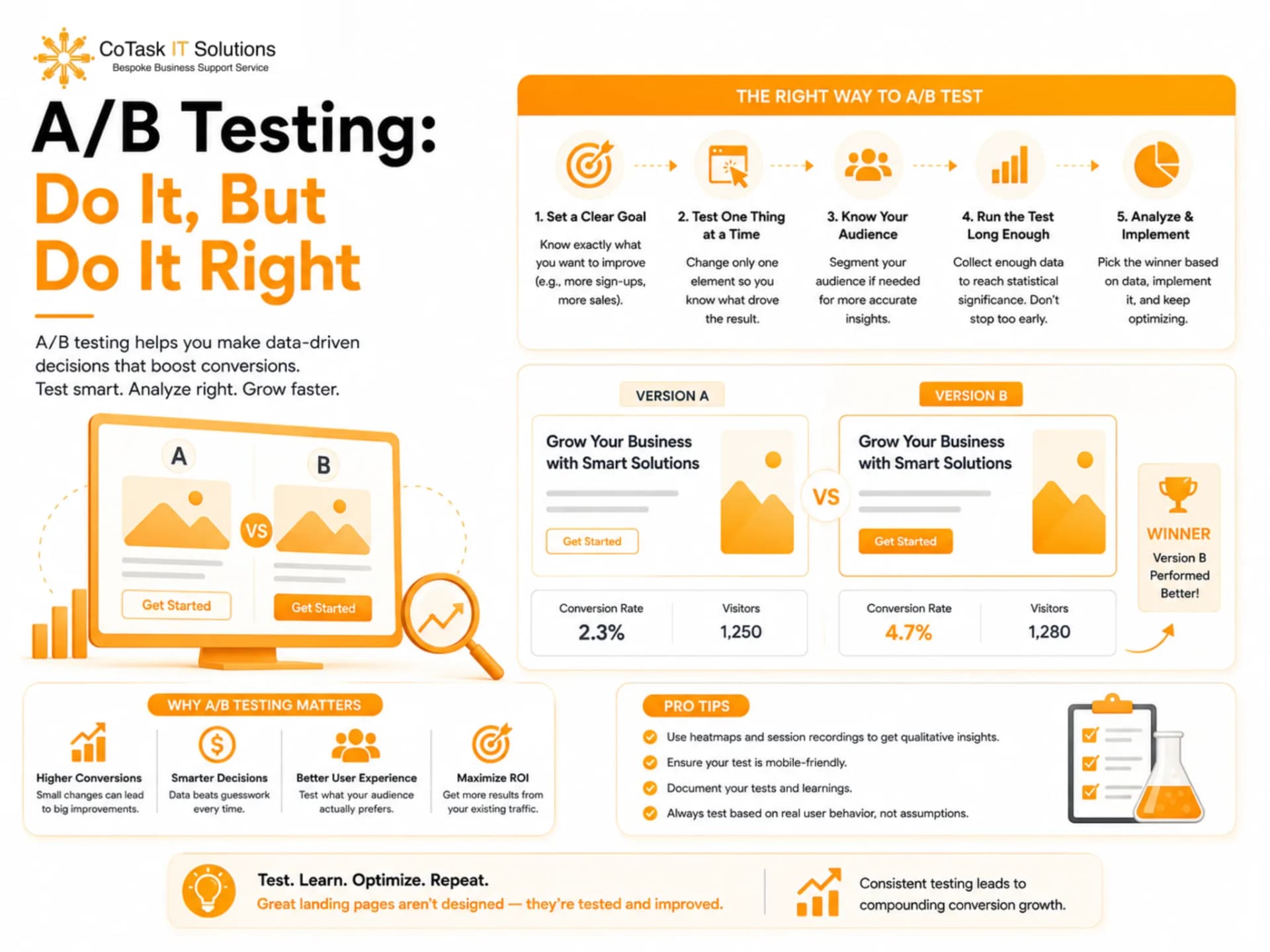
A/B Testing: Do It, But Do It Right
A/B testing remains underused — only around 17% of marketers reportedly test their landing pages systematically — and even among those who do, results are humbling. Across more than 28,000 tests analyzed by major experimentation platforms, only about 13% reached statistical significance in favor of the tested variant, while the vast majority were inconclusive.
The lesson isn't to stop testing. It's to stop testing low-variance elements (button color, minor copy tweaks) and focus on the handful of elements that actually move conversion: headline and value proposition, hero CTA and offer framing, form length, and social proof placement. A test needs enough traffic and a large enough hypothesis to produce a real signal — testing shirt-collar decisions on a page that gets 200 visits a month won't tell you much.
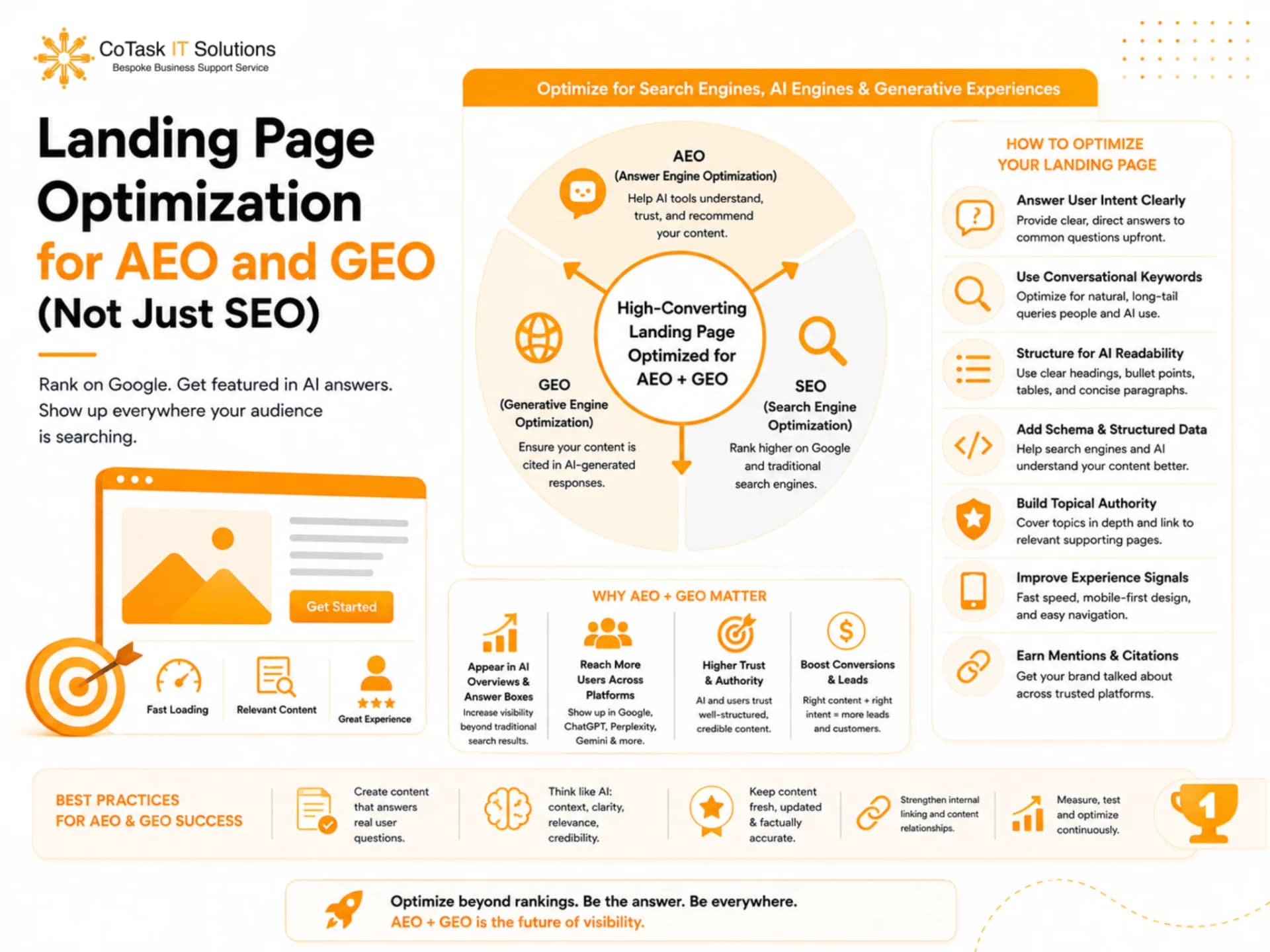
Landing Page Optimization for AEO and GEO (Not Just SEO)
Traditional SEO gets your landing page found in search results. Answer Engine Optimization (AEO) and Generative Engine Optimization (GEO) determine whether AI systems like Google AI Overviews, ChatGPT, and Perplexity cite or reference your page when someone asks a related question — increasingly common as a growing share of research now happens before a human ever visits a website.
Practical steps that help a landing page perform across all three layers at once:
- Lead with a direct answer — place a concise, factual explanation of what you offer within the first 100–150 words, separate from persuasive marketing copy. AI systems extract and cite structured, self-contained answers far more reliably than buried value propositions.
- Use structured data — Organization, LocalBusiness, FAQPage, and AggregateRating schema help both traditional search engines and AI crawlers understand what your page represents and who it's for.
- Answer real questions — add a short FAQ section addressing the specific objections or questions your buyers actually ask, which doubles as AEO-friendly content and objection-handling copy.
- Keep content fresh — pages that go long stretches without updates lose visibility in AI citations faster than actively maintained pages, according to recent industry reporting on AI search behavior.
- Maintain entity consistency — keep your business name, description, and credentials consistent across your website, Google Business Profile, and directory listings, since this consistency is what allows AI systems to confidently attribute claims to your brand.
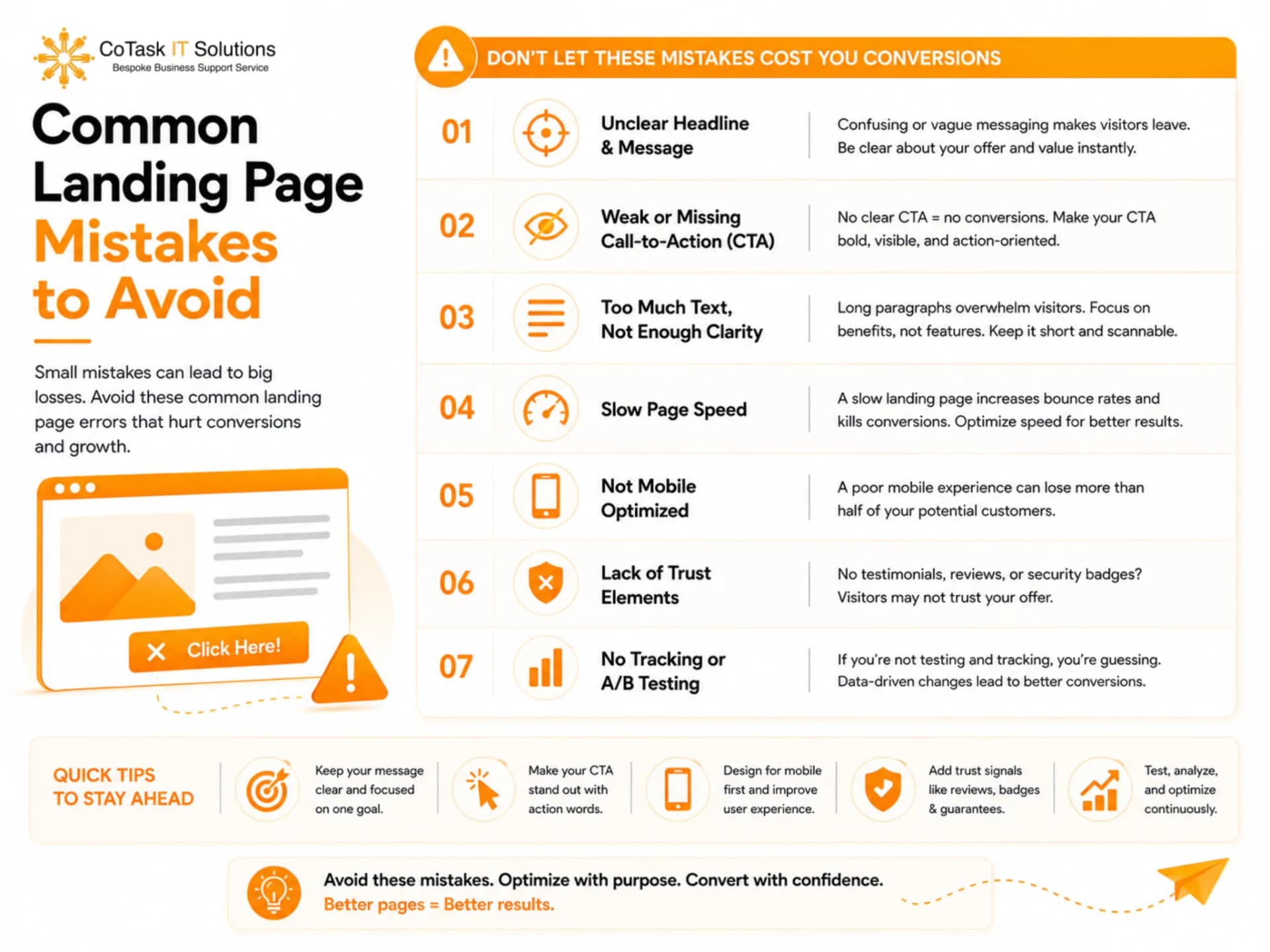
Common Landing Page Mistakes to Avoid
- Sending paid traffic to your homepage — a significant share of pages marketers call "landing pages" are actually repurposed homepages, diluting focus with navigation and multiple offers, a well-documented gap between best practice and common execution.
- Burying the CTA below the fold on mobile, where scroll behavior differs sharply from desktop.
- Ignoring page speed until it's a ranking or ad-cost problem — by then, you've already paid the penalty in lost conversions and higher CPCs.
- Treating one landing page as enough — businesses running a broader library of purpose-built landing pages, one per campaign, offer, or audience segment, consistently outperform those relying on a single generic page.
- Testing without enough traffic to reach significance, then acting on noise as if it were a real result.
Frequently Asked Questions
Ready to Fix Your Landing Pages?
Most underperforming landing pages have the same two or three issues — slow load times, unclear CTAs, or forms asking for too much too soon. Cotasks runs a free 20-minute landing page audit covering speed, mobile UX, and conversion structure across UAE, US, UK, Saudi, Australia, and India markets. Get your audit →