
Technical SEO Checklist 2026: 15 Steps to Improve Rankings
Most websites don't have a content problem. They have a technical problem that never gets diagnosed.
Recent industry data puts this in sharp focus: a large share of websites have slow pages that fail Google's performance standards, and only a minority of sites currently pass Google's Core Web Vitals thresholds. On top of that, most indexed pages receive effectively zero organic traffic from Google — not because the content is bad, but because search engines can't crawl, render, or trust the page properly in the first place.
That's what technical SEO fixes. It's the foundation layer — crawlability, indexing, site speed, structured data, and security — that decides whether your content even gets a chance to rank, let alone win.
This checklist walks through every major technical SEO factor that matters in 2026, including what's changed with Core Web Vitals, how structured data now feeds AI search results, and how to make your site both search-engine and AI-engine ready.
What Is Technical SEO?
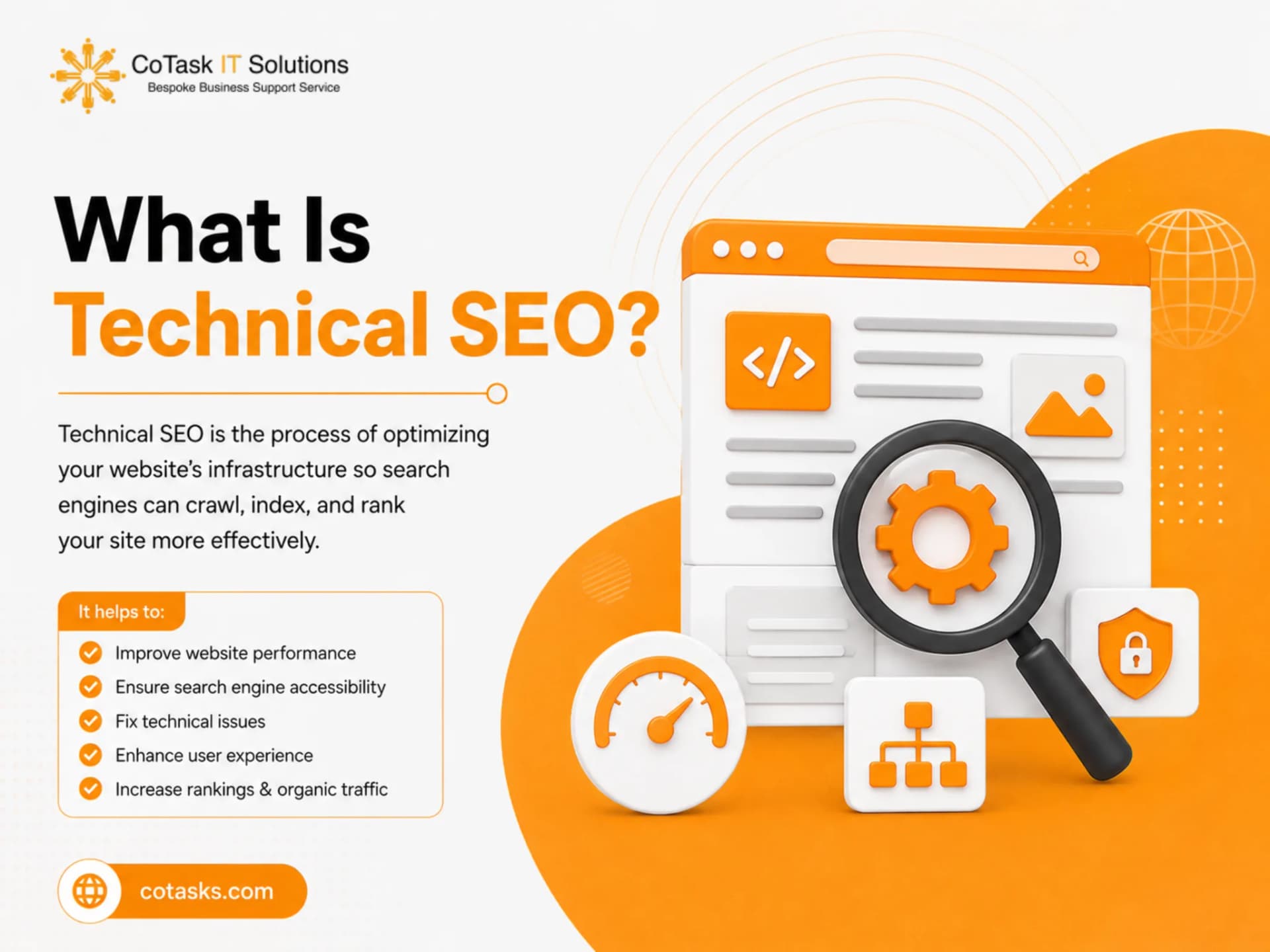
Technical SEO is the practice of optimizing a website's infrastructure — crawlability, indexability, site speed, mobile usability, structured data, and security — so search engines can access, understand, and rank its content correctly. It doesn't involve keywords or content writing directly. Instead, it removes the barriers that stop good content from ranking at all.
Think of it this way: content and backlinks are what earn you a high ranking. Technical SEO is what makes ranking possible in the first place.
Why Technical SEO Still Matters in 2026
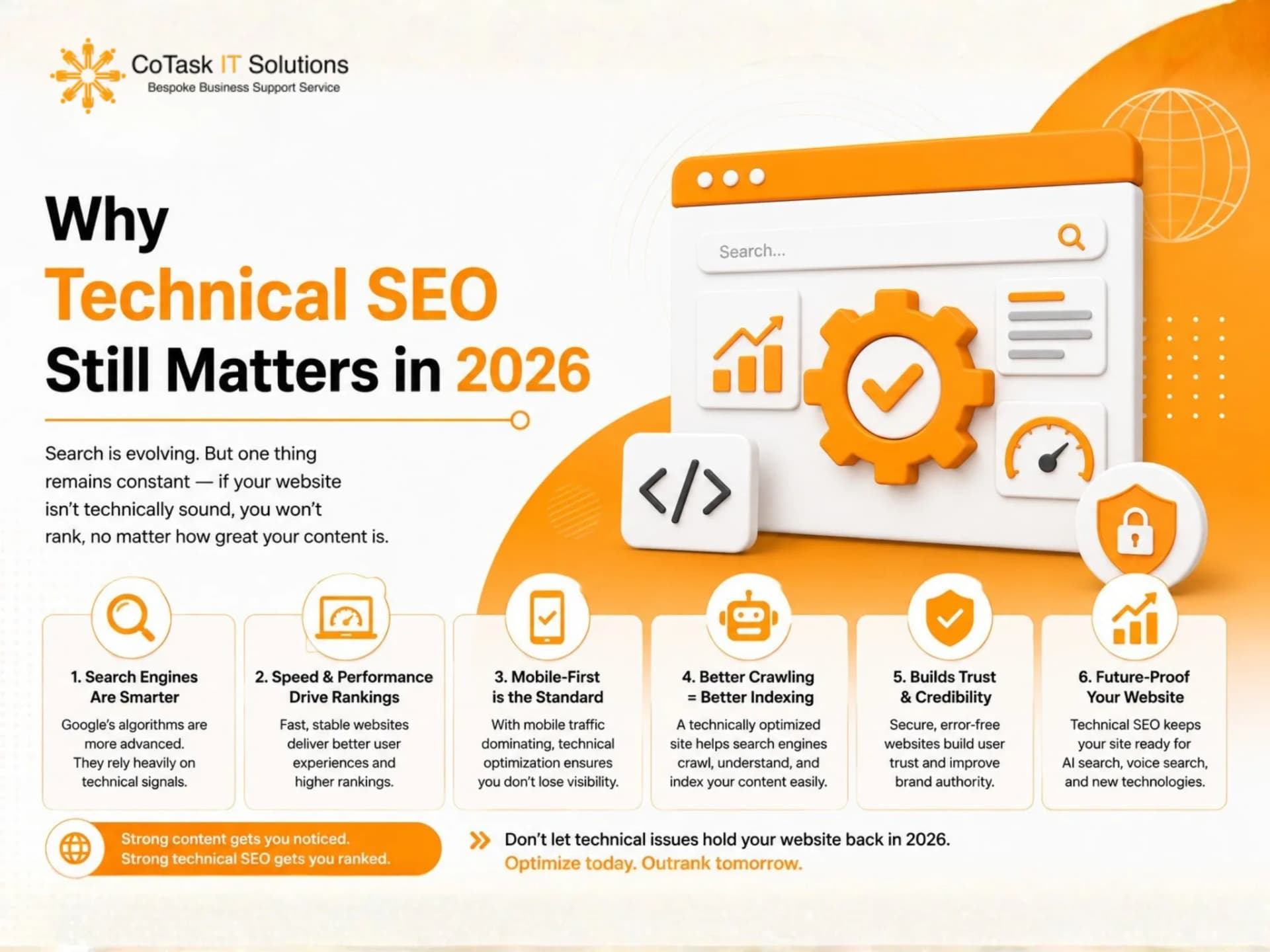
Search hasn't gotten simpler — it's gotten more demanding. Google's Core Web Vitals thresholds are stricter, the shift from FID to INP has changed how interactivity is measured, and structured data now plays a direct role in whether your content gets pulled into AI Overviews, ChatGPT answers, and Perplexity citations.
The gap between what's required and what most sites actually deliver is wide. A large share of websites fail at least one critical technical SEO factor, and industry analysis shows pages ranking in position 1 are meaningfully more likely to pass Core Web Vitals than pages sitting at position 9. Technical health isn't a bonus anymore — it's a tiebreaker Google openly uses when content quality is similar between competitors.
The Complete Technical SEO Checklist
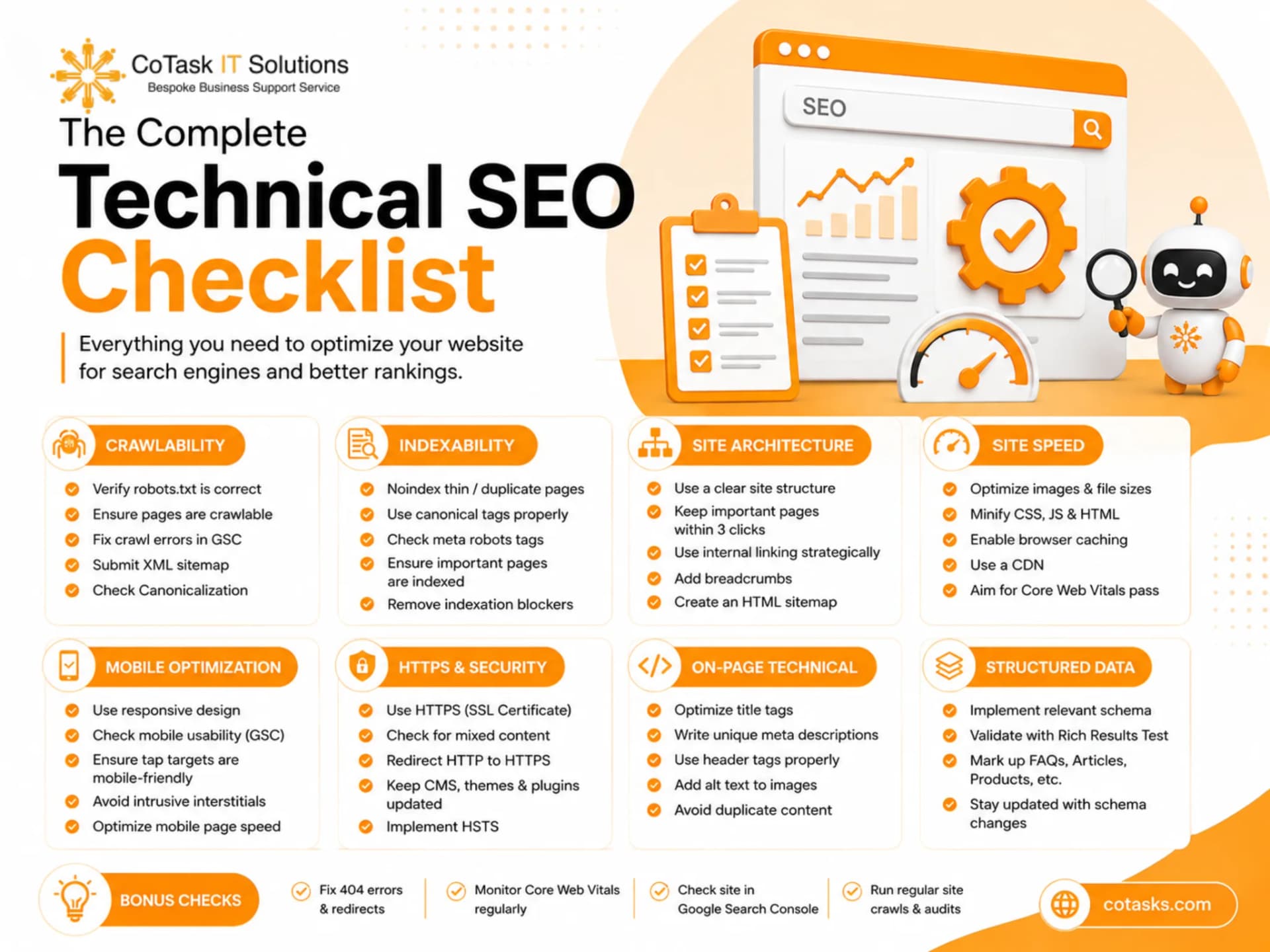
1. Confirm Your Site Is Crawlable
Before anything else, verify search engines can actually reach your pages.
- Check robots.txt isn't accidentally blocking important sections
- Confirm no pages carry a stray noindex tag from staging or migration
- Review crawl stats in Google Search Console for sudden drops
- Fix orphan pages (pages with no internal links pointing to them)
Crawl budget is a real constraint, especially for larger sites or sites mid-migration between platforms (a common issue when moving between systems like WordPress and a custom framework). If Googlebot wastes crawl budget on broken or duplicate URLs, your important pages get crawled less often.
2. Audit Your XML Sitemap
Your sitemap should be a clean, accurate map of the pages you actually want indexed.
- Submit it in Google Search Console and Bing Webmaster Tools
- Remove non-canonical, redirected, or noindexed URLs from the sitemap
- Split large sitemaps by content type (blog, product, service pages)
- Update it automatically when new content is published
3. Fix Indexing Issues
Roughly 96.55% of all indexed pages receive zero organic traffic from Google, and only about 1.74% of newly published pages reach Google's top 10 within a year. A lot of that isn't a content failure — it's an indexing failure.
If you're not comfortable navigating Search Console yet, our complete Google Search Console guide for 2026 walks through setup, verification, and every key report step by step.
- Use the URL Inspection tool to check indexing status page by page
- Look for "Crawled — currently not indexed" patterns and investigate why
- Consolidate thin or duplicate pages instead of letting them compete with each other
- Make sure canonical tags point to the correct preferred version of each page
4. Get Core Web Vitals Into the "Good" Range
This is where most audits fall apart. Only about 33% of websites currently pass Google's Core Web Vitals threshold, and on mobile specifically, only around 42% of origins pass all three metrics.
The three metrics to track:
- Largest Contentful Paint (LCP) — measures how long it takes for the largest visible content element, usually an image, video, or text block, to appear on screen. Target under 2.5 seconds.
- Interaction to Next Paint (INP) — replaced FID as the responsiveness metric. It's the most commonly failed Core Web Vital in 2026 because it requires optimizing JavaScript execution throughout the entire session, not just on initial load. Heavy third-party scripts, unoptimized front-end components, and synchronous JavaScript execution are the primary causes of failure.
- Cumulative Layout Shift (CLS) — measures visual stability. Reserve space for images and ads to prevent content jumping around as the page loads.
Why this is worth fixing: websites that pass all three Core Web Vitals metrics see notably lower bounce rates than sites that fail them, and pages loading in under two seconds see far lower bounce rates than pages taking over five seconds to load. Slow sites aren't just a ranking risk — they're a revenue leak.
Quick wins:
- Compress and lazy-load images (WebP/AVIF formats)
- Defer non-critical JavaScript and remove unused scripts
- Use a CDN to reduce server response time
- Audit third-party embeds (chat widgets, ad tags, tracking pixels) — they're frequently the biggest INP offenders
For a deeper walkthrough of each fix, see our full guide on website speed optimization for SEO, UX, and conversions.
5. Make Mobile-First a Reality, Not a Checkbox
Google indexes the mobile version of your site by default. Test every key template — homepage, service pages, blog posts — on an actual mobile device, not just a browser resize.
- Tap targets should be large enough to avoid mis-taps
- Text should be readable without zooming
- No horizontal scrolling on any core page
6. Migrate Fully to HTTPS
If any part of your site still serves mixed content (HTTP resources loading on HTTPS pages), browsers will flag it and it can quietly undercut trust signals. Confirm certificates are valid, force HTTPS redirects sitewide, and check for mixed-content warnings in Search Console.
7. Clean Up Duplicate Content and Canonicalization
Duplicate or near-duplicate content — common during platform migrations or when URL parameters create multiple versions of the same page — splits ranking signals across pages instead of consolidating them.
- Set self-referencing canonical tags on every page
- Use 301 redirects (not 302) for permanently moved content
- Standardize on one URL format: with or without trailing slash, www or non-www — pick one and enforce it everywhere
8. Build Out Structured Data (Schema Markup)
This is no longer optional, and its role has expanded well beyond rich snippets. JSON-LD has evolved from a display signal for rich snippets into a data layer that feeds machine understanding for LLM-powered search systems — large language models absorb, embed, link, and reuse JSON-LD as part of their internal knowledge graph, functioning as a kind of semantic fingerprint for the content.
Priority schema types to implement:
- Organization / LocalBusiness — establishes who you are as an entity
- Article — for blog and resource content
- FAQPage — one of the highest-impact tactics for AI assistants, which favor question-answer pairs because they map directly to how users query them
- Service — for individual service or product pages
- BreadcrumbList — reinforces site structure
- AggregateRating / Review — where genuinely applicable
Important: structured data doesn't directly increase rankings, but it improves visibility and eligibility for rich results, featured snippets, and AI-generated summaries, which in turn improves click-through rate. Use JSON-LD format — it's the most widely supported and recommended schema format.
9. Optimize for AEO and GEO, Not Just Traditional SEO
This is the part most technical SEO checklists still skip. AEO (answer engine optimization) optimizes for being the answer surfaced in featured snippets, People Also Ask, and increasingly AI Overviews, while GEO — generative engine optimization — is the practice of optimizing content to be cited inside generative engines such as Google's AI Overviews, ChatGPT, Perplexity, Gemini, and Claude.
Practical steps:
- Structure content with clear H2/H3 questions followed by direct, 40–60-word answers in the first one to two sentences of each section so each section functions as a self-contained, quotable chunk
- Add an llms.txt file and consider a brand-facts.json file to make your entity data machine-readable
- Keep your Google Business Profile complete and current — Google AI Overviews and Gemini pull business data directly from GBP, making it one of the fastest off-site AEO wins available
- Use comparison tables for anything evaluative — AI models extract tabular data more reliably than prose for comparative queries
This matters because structured data is the foundation of both AEO and GEO — AI assistants parse JSON-LD to understand entities, relationships, and facts before generating recommendations — so the schema work in step 8 and the AEO work here reinforce each other directly.
10. Strengthen Internal Linking Architecture
A clean internal linking structure does two jobs: it distributes authority across your site, and it helps both crawlers and AI systems understand entity relationships between pages.
- Link from high-authority pages to newer or underperforming pages
- Use descriptive, keyword-relevant anchor text (avoid generic "click here" links)
- Build topic clusters — a pillar page supported by related cluster content, all internally linked
11. Eliminate Crawl Traps and Broken Links
Run a crawl audit (Screaming Frog, Semrush, or Search Console's Index Coverage report) to catch:
- 404 errors on internally linked pages
- Redirect chains (A → B → C instead of a direct A → C)
- Infinite crawl spaces created by faceted navigation or session parameters
12. Improve Server Response Time (TTFB)
Time to First Byte affects every other performance metric downstream. Use quality hosting, enable server-side caching, and consider a CDN if your audience spans multiple regions or countries — especially relevant if you're targeting several international markets from one domain.
13. Add an XML Image Sitemap and Optimize Alt Text
Image search and AI visual search both rely on properly described images. Use descriptive, natural alt text (not keyword-stuffed) and compress images without visibly sacrificing quality.
14. Set Up Proper Log File Monitoring
For larger sites, server log analysis shows you exactly how Googlebot is crawling your site — which pages it visits, how often, and where it's wasting crawl budget. This is one of the most underused technical SEO tactics because it requires server access most audits skip.
15. Monitor Continuously, Not Just Once a Quarter
Technical SEO isn't a one-time audit — it's an ongoing discipline. A theme update, a new third-party script, or a botched migration can undo months of work overnight. Set up Core Web Vitals alerts in Search Console and re-audit crawlability and indexing on a recurring schedule, not just when rankings drop.
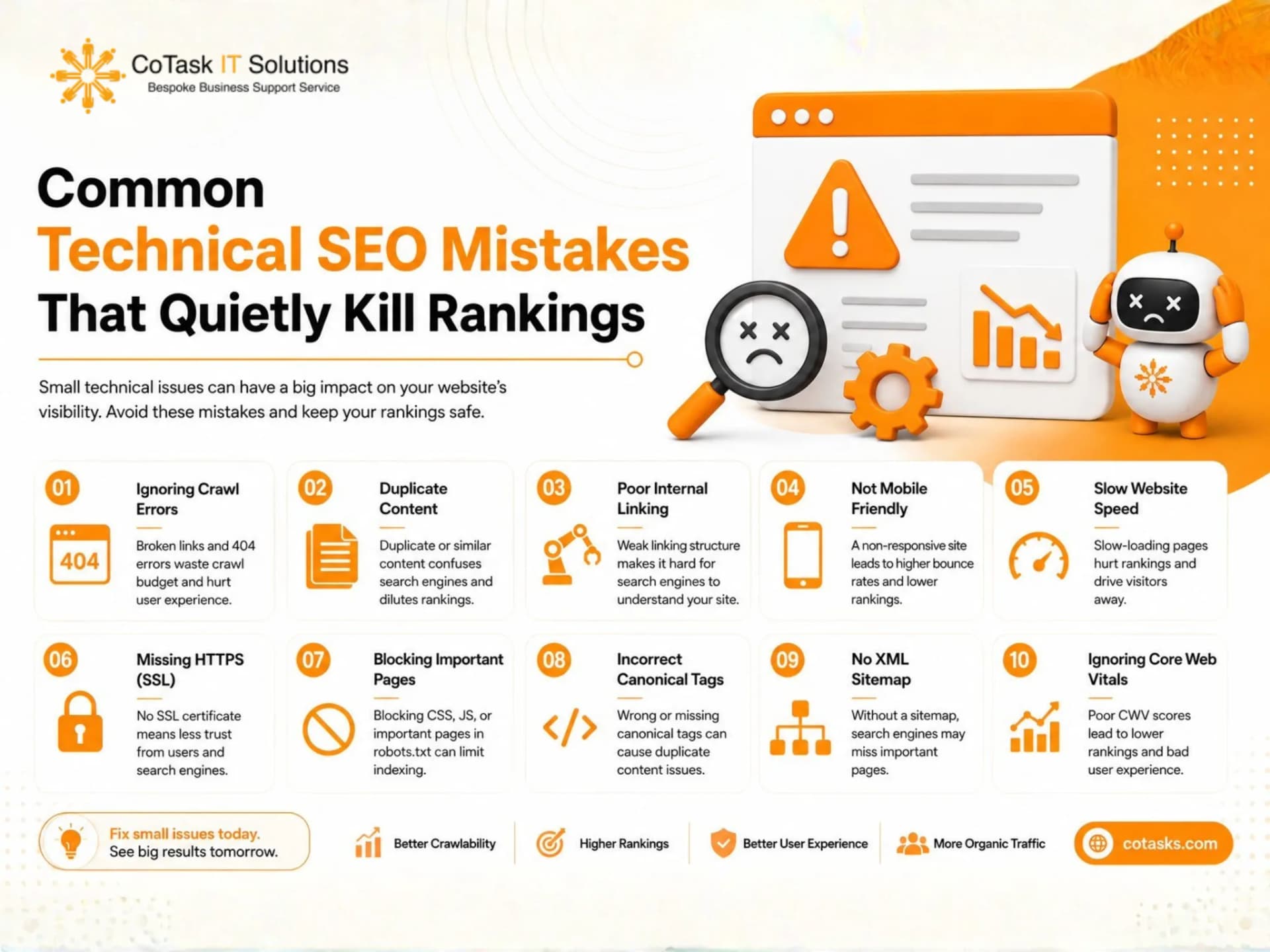
Common Technical SEO Mistakes That Quietly Kill Rankings
- Blocking CSS/JS in robots.txt — this prevents Google from rendering the page the way users actually see it
- Orphan pages — content with no internal links pointing to it is nearly invisible to crawlers
- Ignoring INP — it's the most commonly failed Core Web Vital in 2026 precisely because most audits still focus on load speed and skip interactivity
- Treating schema as decorative — skipping FAQPage and Organization schema means missing out on both rich results and AI citation eligibility
- Fixing technical issues once and never re-checking — CWV scores and indexing status drift as sites grow and change
Technical SEO is only one half of the equation — it clears the runway, but you still need a strategy for content, PPC, and social to actually take off. If you'd rather have this audited and fixed by a team that does it daily, explore our digital marketing services (SEO, PPC & social media) or book a free consultation.