
Proven Digital Marketing Strategies to Grow Your Business in 2026
Most businesses don't fail at marketing because they lack budget — they fail because they're running five channels with no strategy connecting them. If your website, ads, and social pages all point in different directions, you're paying for traffic that never converts.
That's the real problem this guide solves. Below are the digital marketing strategies that actually move revenue in 2026 — not a list of buzzwords, but a working playbook you can apply whether you're a solo founder or a marketing manager at a growing enterprise. You'll learn what each strategy does, how it works, the mistakes that quietly waste budget, and the KPIs that tell you it's working.
Table of Contents
- What Are Digital Marketing Strategies?
- Why Digital Marketing Strategies Matter for Business Growth
- The 2026 Shift You Can't Ignore: Search Is Becoming an Answer, Not a List
- Top Digital Marketing Strategies for 2026
- SEO vs PPC vs Organic vs Paid - Comparison Tables
- Digital Marketing Checklists
- FAQs
- Conclusion
What Are Digital Marketing Strategies?
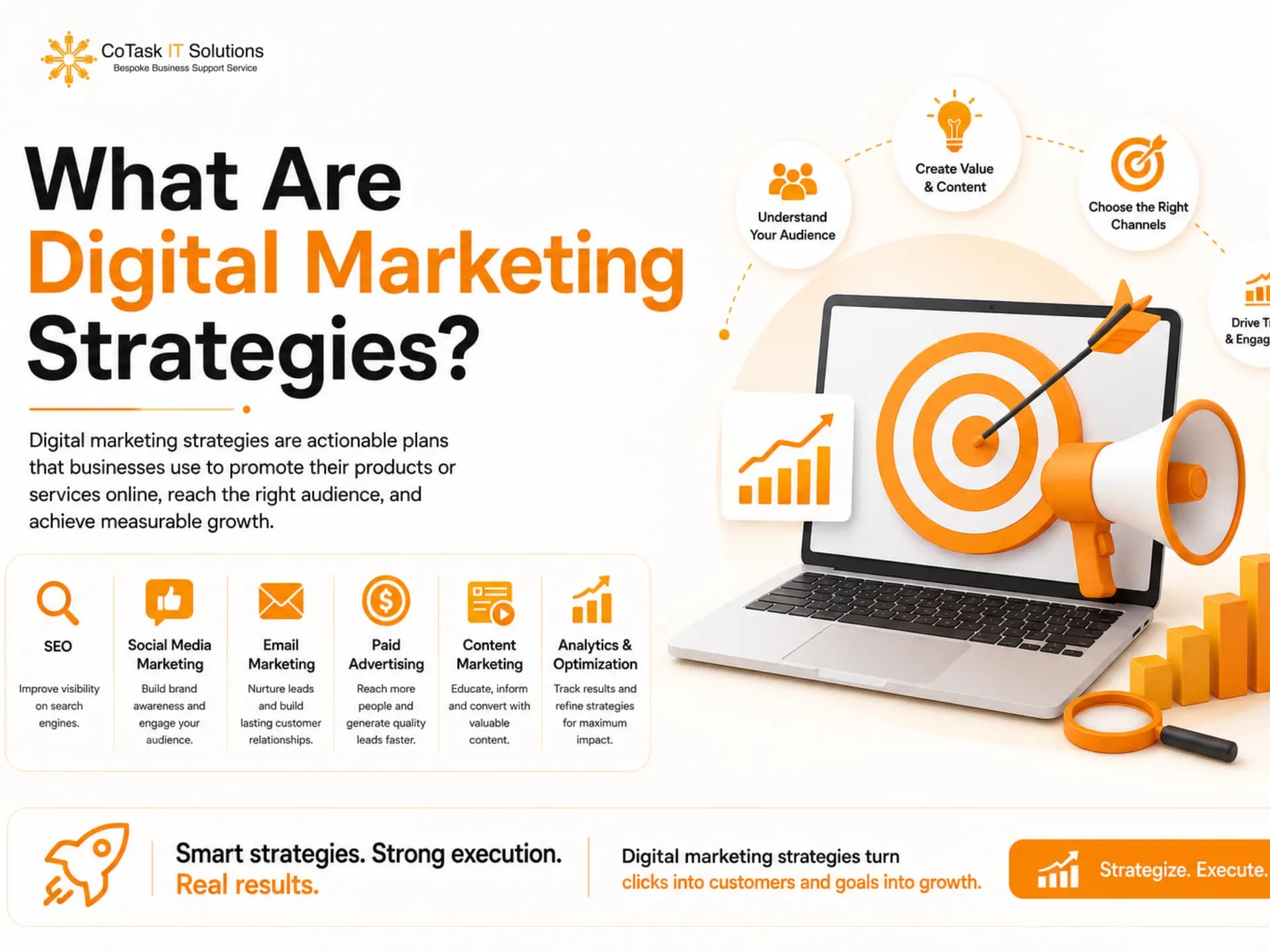
Digital marketing strategies are the planned, coordinated actions a business takes across online channels — search, social, email, paid ads, and content — to reach a defined audience and convert them into customers. A strategy is different from a tactic: posting on Instagram is a tactic; deciding why, for whom, and with what message you post is the strategy.
A sound digital marketing strategy typically includes:
- A clearly defined target audience and buyer persona
- Goals tied to business outcomes (leads, sales, retention) rather than vanity metrics
- A content and channel mix matched to where that audience actually spends time
- A measurement framework (Google Analytics, CRM data, ad platform dashboards)
- A feedback loop that adjusts spend based on what's working
👉 Key takeaway: Strategy is the "why" and "for whom." Channels like SEO, PPC, and social media are the "how."
Why Digital Marketing Strategies Matter for Business Growth
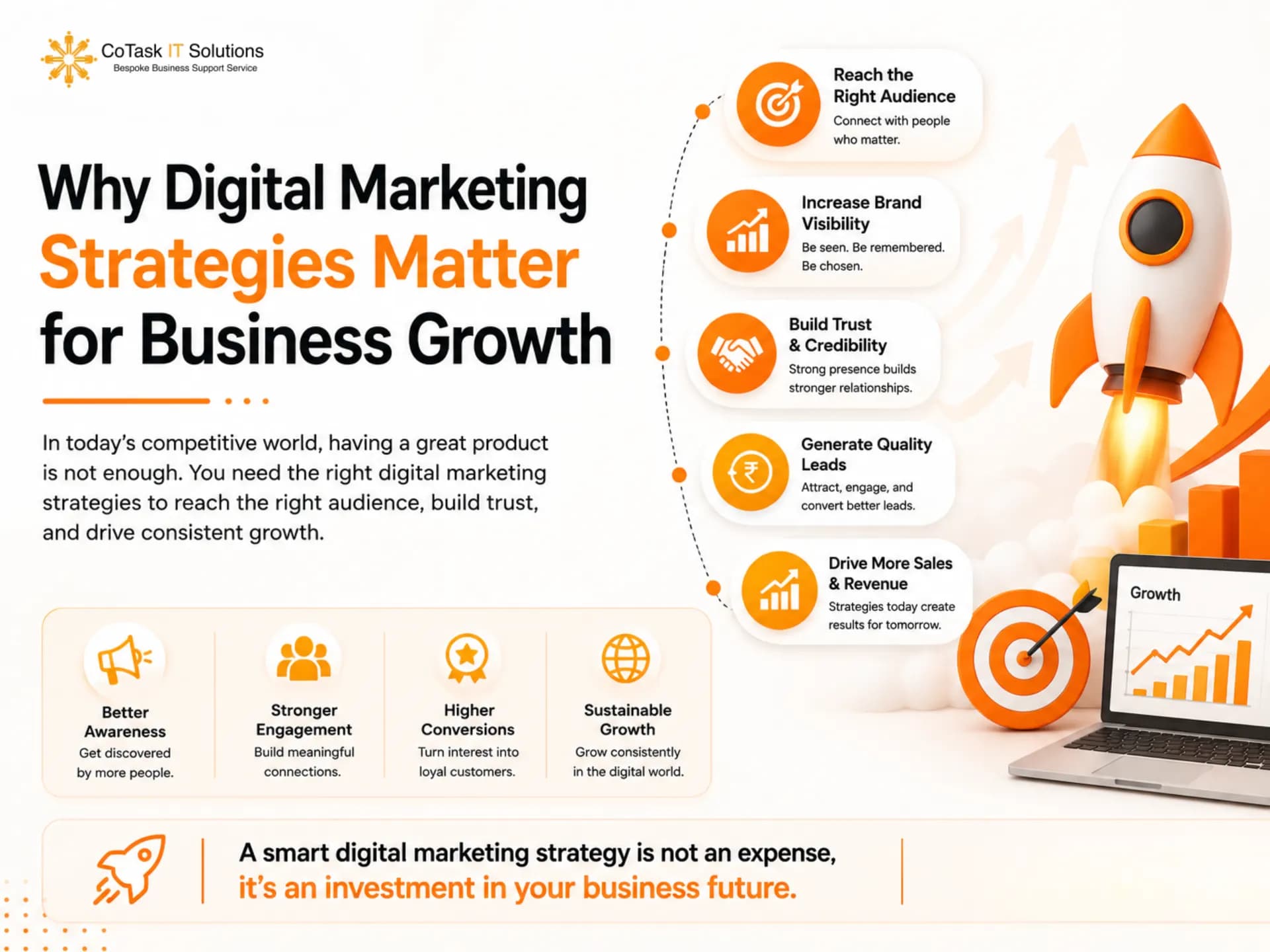
Digital marketing strategies matter because they turn unpredictable marketing spend into a repeatable growth system. Without one, businesses chase trends channel by channel — a boosted post here, a Google Ads campaign there — with no way to tell which activity actually drove revenue.
A defined strategy matters because it:
- Improves ROI by directing budget toward channels proven to convert your specific audience
- Builds compounding assets — an SEO-optimized blog or an email list keeps generating leads long after the work is done, unlike paid ads that stop the moment spend stops
- Creates consistency across every touchpoint, which builds the trust that turns a first-time visitor into a repeat customer
- Makes performance measurable, so decisions are based on data instead of guesswork
For SMEs and startups competing against larger, better-funded competitors, strategy is often the only real advantage available — bigger budgets win on spend, but sharper strategy wins on efficiency.
The 2026 Shift You Can't Ignore: Search Is Becoming an Answer, Not a List
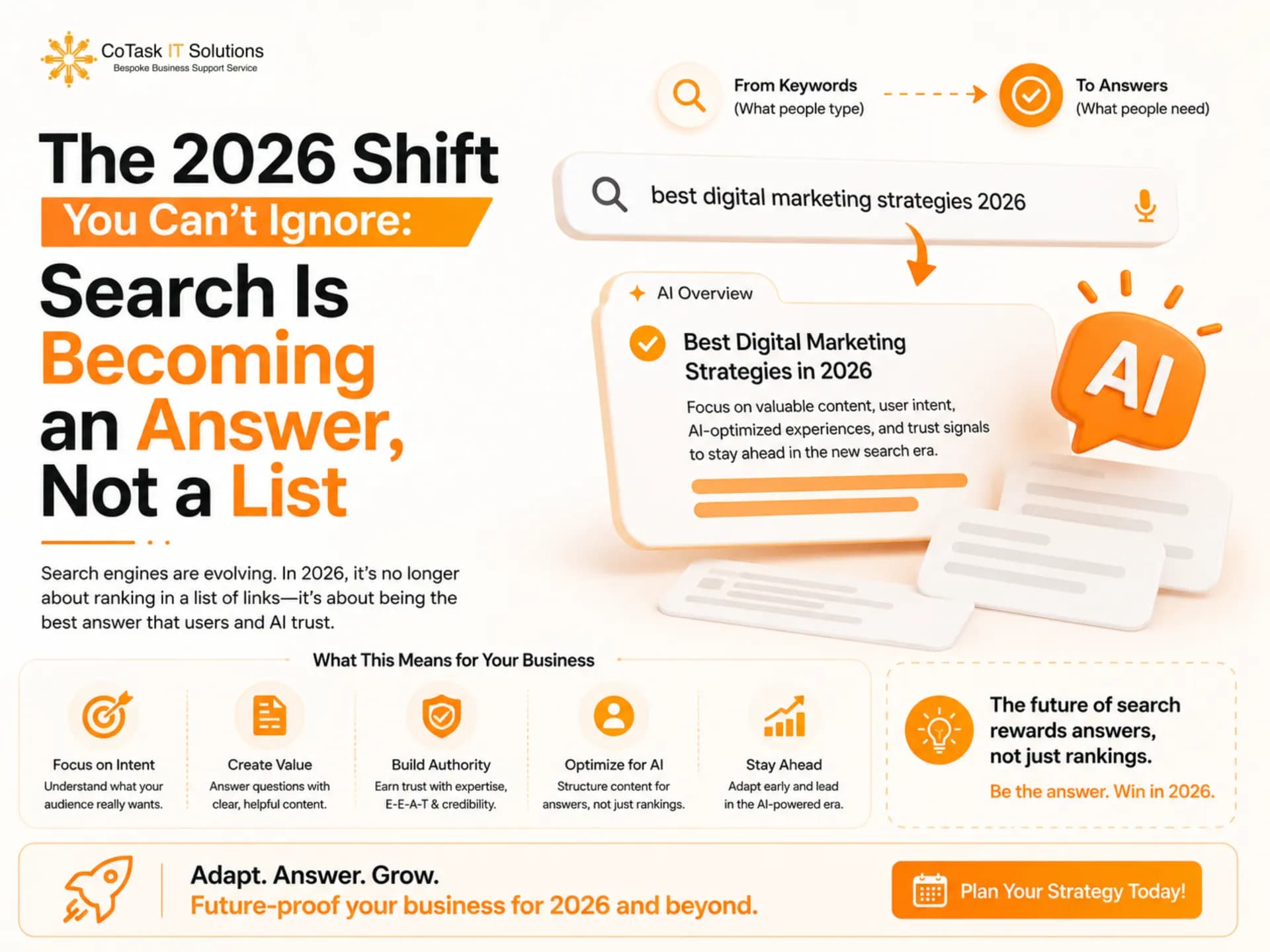
If you take one thing from this guide, take this: the ground under organic search moved more in the last 18 months than in the previous decade, and most businesses haven't adjusted their strategy for it yet.
Google's AI Overviews now show up on roughly a third to nearly half of all searches depending on the query type and tracking method, and industries like healthcare, education, and B2B tech see them even more often. When an AI Overview appears, organic click-through rates typically fall by somewhere between a third and two-thirds, because a growing share of searchers get their answer without visiting a website at all — some studies put total zero-click search behavior above 40%, and much higher once Google's AI Mode is active.
Here's the part that should change your strategy, not just your mood: brands that get cited inside the AI answer don't lose out the way uncited brands do. Cited brands see meaningfully higher organic and paid click-through than competitors who rank on page one but never get pulled into the summary. In other words, the prize has moved from "rank #1" to "get quoted by the answer engine" — which is exactly why GEO and AEO aren't optional add-ons anymore. They're now core SEO strategy, not a bonus chapter.
👉 What this means practically: structure content so a system can lift a clean, self-contained answer from it — a direct definition, a comparison table, a numbered list — near the top of the page, then go deep below it for the humans who do click through. Traditional long-form writing that buries the answer under three paragraphs of preamble is the single biggest reason good content stops getting cited in 2026.
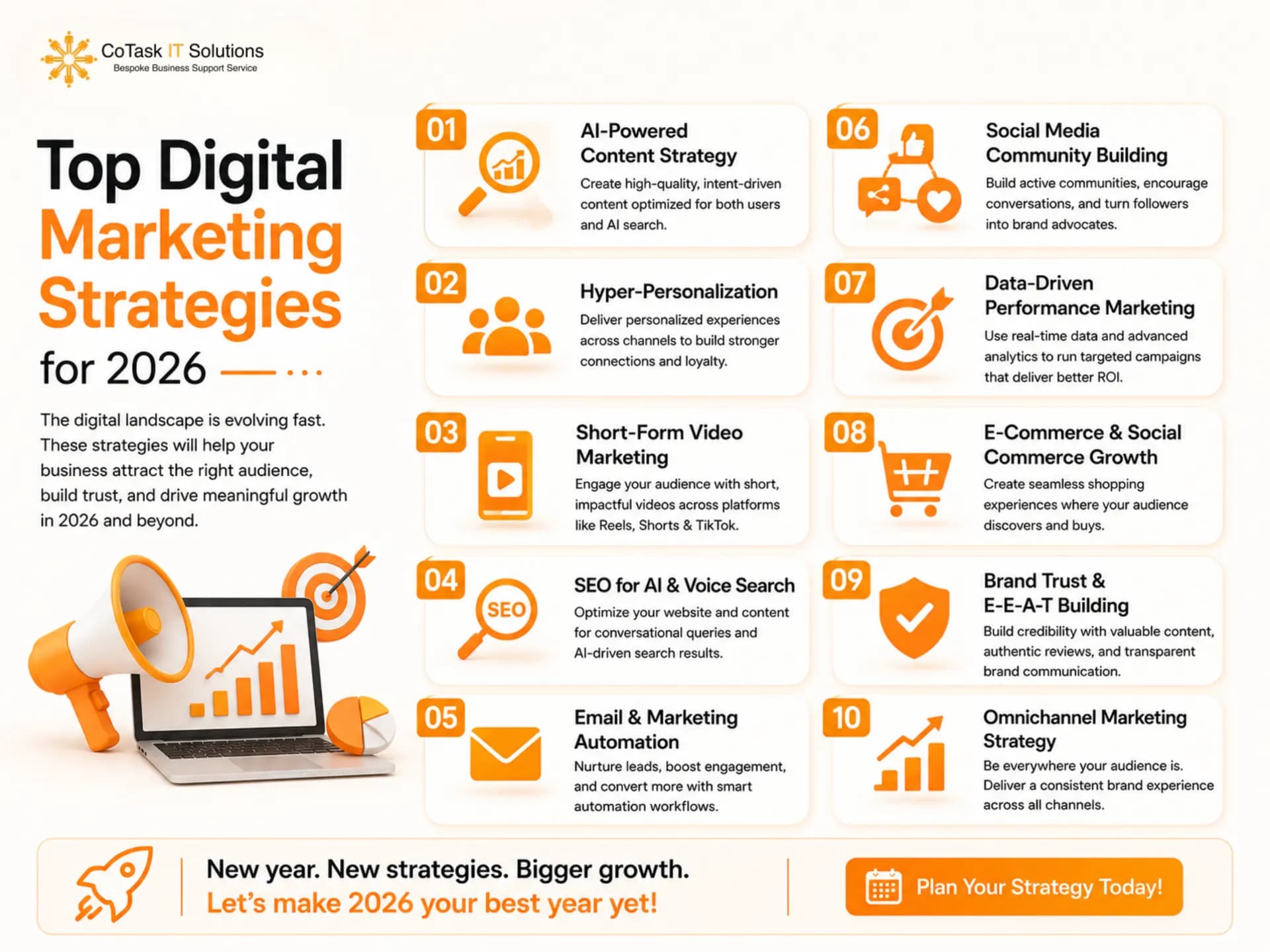
Top Digital Marketing Strategies for 2026
1. Search Engine Optimization (SEO)
Definition: SEO is the practice of optimizing a website's content, structure, and authority so it ranks higher in organic (unpaid) search results.
Why it matters: Organic search remains one of the highest-intent traffic sources — people searching are actively looking for a solution, not just scrolling past an ad. But 2026 adds a wrinkle: ranking well and being cited are no longer the same win. A page can hold position one and still lose the click to an AI-generated summary sitting above it.
How it works: SEO combines on-page optimization (titles, headers, internal linking, schema markup), technical SEO (site speed, crawlability, mobile-friendliness), and off-page authority building (backlinks, brand mentions, and increasingly, earned media coverage — third-party publications now feed the majority of what AI answer engines choose to cite).
Best practices: Target search intent before keyword volume. Use structured data (schema.org) so search engines and AI overviews can parse your content. Fix technical issues before scaling content production. Track pipeline and conversions from remaining clicks, not just raw traffic — several 2026 studies suggest the smaller pool of clicks surviving an AI Overview often converts better, because the visitor is already pre-qualified.
Common mistakes: Chasing keyword volume over relevance. Ignoring technical SEO audits. Measuring success by impressions alone when clicks — and what happens after the click — are what pay the bills.
Expert tip: Run a full technical audit before investing in new content — a fast, crawlable site multiplies the return on every article you publish.
Tools: Google Search Central, Semrush, Google Analytics, Google Search Console. KPIs: Organic traffic, keyword rankings, click-through rate, organic conversion rate, AI citation frequency.
👉 Curious whether SEO still pays off in an AI-search world? Read our take on whether SEO is dead.
2. Content Marketing
Definition: Content marketing is creating valuable, relevant content — blogs, guides, videos — to attract and retain a clearly defined audience.
Why it matters: Content builds topical authority, feeds SEO, and gives sales teams material that answers prospect questions before a call even happens.
Best practices: Build content around a pillar-and-cluster model so related articles reinforce each other's authority. Write for a single, clear search intent per page. Update older content rather than only publishing new pages — content decay is real, and a refreshed 12-month-old post often outperforms a brand-new one.
Common mistakes: Publishing generic, AI-sounding content with no original insight. Ignoring content decay.
Expert tip: Prioritize bottom-funnel content (comparison pages, service pages) alongside top-funnel blogs — it converts faster and validates ROI sooner.
Tools: HubSpot, Google Analytics, Semrush Content Toolkit. KPIs: Time on page, organic traffic growth, content-assisted conversions.
👉 This is the exact playbook behind our digital marketing services.
3. Social Media Marketing
Definition: Social media marketing uses platforms like Instagram, LinkedIn, and Facebook to build brand awareness, engage audiences, and drive traffic.
Why it matters: It's where discovery happens for most consumer and B2B audiences today, and it builds the brand familiarity that makes paid ads convert better.
Best practices: Match content format to platform behavior (carousels and Reels on Instagram, thought-leadership posts on LinkedIn). Post consistently rather than in bursts. Use polls and questions to drive engagement signals.
Common mistakes: Cross-posting identical content across every platform. Measuring success by followers instead of engagement or conversions.
Expert tip: Short, punchy captions consistently outperform long-form captions for engagement on visual platforms — lead with the hook, not the explanation.
Tools: Meta Business Suite, LinkedIn Campaign Manager, Buffer. KPIs: Engagement rate, reach, follower growth, social-driven conversions.
4. Google Ads (PPC)
Definition: PPC (pay-per-click) advertising, primarily through Google Ads, places your business at the top of search results instantly, charging only when someone clicks.
Why it matters: PPC delivers immediate visibility and highly measurable ROI, making it ideal for testing offers and generating leads while organic SEO builds momentum. It's also becoming a hedge against AI Overviews eating organic clicks — paid results still sit clearly outside the AI summary, and cited-brand data suggests strong organic presence lifts paid performance too.
Best practices: Match ad copy tightly to landing page content. Use negative keywords to cut wasted spend. Test multiple ad variations continuously.
Common mistakes: Sending paid traffic to a generic homepage instead of a dedicated landing page. Ignoring Quality Score, which raises cost-per-click over time.
Expert tip: Run SEO and PPC together — PPC data on which keywords convert can directly inform your organic content priorities.
Tools: Google Ads, Microsoft Advertising, Google Analytics. KPIs: Cost per click (CPC), cost per acquisition (CPA), conversion rate, quality score.
👉 See how we structure this for clients: Google Ads services.
5. Local SEO
Definition: Local SEO optimizes your online presence so your business appears in location-based searches like "near me" queries and Google Maps results.
Why it matters: For service businesses and multi-location brands, local visibility often drives more qualified leads than broad national rankings.
Best practices: Keep your Google Business Profile fully updated. Maintain consistent NAP (Name, Address, Phone) across directories. Collect and respond to reviews.
Common mistakes: Inconsistent business listings across platforms. Ignoring local schema markup. Neglecting Google Business Profile posts and Q&A.
Expert tip: NAP inconsistency across just a handful of directories can quietly suppress local rankings — audit this before investing in new local content.
Tools: Google Business Profile, Semrush Local, BrightLocal. KPIs: Map pack rankings, local search visibility, direction requests, review volume.
👉 We wrote a full walkthrough on this: Local SEO checklist for ranking on Google Maps.
6. Email Marketing
Definition: Email marketing is the direct promotion of products, content, or offers to a permission-based subscriber list.
Why it matters: Email remains one of the highest-ROI channels because it reaches an audience that has already opted in — no algorithm dependency, and no AI summary standing between you and the reader.
Best practices: Segment lists by behavior and lifecycle stage. Automate welcome and abandoned-cart sequences. Test subject lines rigorously.
Common mistakes: Batch-and-blast emails with no segmentation. Neglecting deliverability.
Expert tip: Automated lifecycle emails typically outperform one-off broadcast campaigns on both open and conversion rates.
Tools: HubSpot, Mailchimp, Klaviyo. KPIs: Open rate, click-through rate, list growth, revenue per email.
7. Video Marketing
Definition: Video marketing uses short-form and long-form video content to explain, demonstrate, and build emotional connection with an audience.
Why it matters: Video consistently drives higher engagement and retention than static content across nearly every platform, including search.
Best practices: Optimize video titles and descriptions for search. Repurpose long-form video into short clips for social. Add captions for accessibility and silent viewing.
Common mistakes: Over-polishing videos at the expense of speed to publish. Ignoring YouTube as a search engine in its own right — it's also one of the most frequently cited sources inside AI answer engines.
Tools: YouTube Studio, CapCut, Canva. KPIs: Watch time, view-through rate, video-assisted conversions.
8. AI in Digital Marketing
Definition: AI marketing uses machine learning and generative AI tools to automate content creation, personalize customer journeys, and optimize ad targeting.
Why it matters: AI reduces the time between insight and execution — from generating ad variations to predicting customer churn — giving smaller teams enterprise-level capability.
Best practices: Use AI for speed and iteration, not final output — always add human review and brand voice. Use AI for data analysis and pattern detection, not just content generation.
Common mistakes: Publishing unedited AI-generated content that reads generically. Over-relying on AI targeting without human strategic oversight.
Expert tip: The businesses winning with AI marketing today are using it to analyze customer data and personalize journeys — not just to write blog posts faster.
Tools: Claude, ChatGPT, HubSpot AI, Google Performance Max. KPIs: Content production velocity, personalization lift, campaign efficiency.
9. Influencer Marketing
Definition: Influencer marketing partners with individuals who have engaged, trusted audiences to promote your brand authentically.
Why it matters: Audiences trust recommendations from people they follow more than direct brand advertising, especially Gen Z and millennial consumers.
Best practices: Prioritize audience fit and engagement rate over raw follower count. Use micro-influencers for niche, high-trust markets. Set clear content guidelines while allowing authentic voice.
Common mistakes: Choosing influencers by follower count alone. Treating influencer content like a traditional ad script.
Tools: Meta Business Suite, influencer marketplaces, Google Analytics. KPIs: Engagement rate, referral traffic, promo-code redemptions.
10. Conversion Rate Optimization (CRO)
Definition: CRO is the systematic process of improving your website or landing pages to convert more visitors into leads or customers.
Why it matters: Improving conversion rate multiplies the value of every other channel — the same traffic converts into more revenue without additional spend. This matters even more now that overall click volume is shrinking industry-wide; you can't out-content a smaller pool of clicks, but you can convert more of it.
Best practices: Run structured A/B tests on headlines, CTAs, and forms. Reduce friction in checkout and lead forms. Use heatmaps to identify where users drop off.
Common mistakes: Testing too many elements at once. Making design decisions on opinion instead of data.
Tools: Hotjar, Google Analytics. KPIs: Conversion rate, bounce rate, average order value.
👉 If your site itself is the bottleneck, start here: website design services.
11. Marketing Automation
Definition: Marketing automation uses software to trigger personalized marketing actions — emails, retargeting ads, lead scoring — based on user behavior.
Why it matters: It lets small teams run enterprise-level, personalized campaigns without manual effort for every lead.
Best practices: Map the customer journey before building automations. Use lead scoring to prioritize sales follow-up. Regularly audit workflows for outdated logic.
Common mistakes: Automating too early without a defined customer journey. Sending automated messages that feel robotic.
Tools: HubSpot, Mailchimp, ActiveCampaign. KPIs: Lead-to-customer conversion rate, workflow completion rate, time-to-conversion.
12–15. The Supporting Cast: Affiliate, Remarketing, Mobile, and Voice
These four rarely carry a strategy on their own, but they quietly protect or extend the return of everything above them:
- Affiliate marketing pays partners a commission for driving sales, making it a performance-based, low-risk way to test new audiences. Its biggest failure mode is recruiting affiliates with no real audience overlap with your brand — track with unique referral links and vet for fit, not follower count.
- Remarketing (retargeting) shows ads to people who already visited your site but didn't convert, typically at a lower cost than cold traffic. Segment by behavior (cart abandoners vs. blog readers) and cap frequency — the most common mistake is showing an identical ad to warm and cold audiences alike, which wastes the one advantage retargeting has.
- Mobile marketing optimizes campaigns and websites specifically for smartphone users, who now account for the clear majority of search traffic in most markets. Design mobile-first, not desktop-first, and treat mobile page speed as a ranking factor, not a nice-to-have.
- Voice search optimization structures content to answer conversational, spoken queries — longer and more natural-sounding than typed searches. Target question-based long-tail keywords and use FAQ schema so a direct answer sits near the top of the page.
Tools across all four: Google Ads, Meta Ads Manager, Google PageSpeed Insights, AnswerThePublic. KPIs across all four: ROAS, mobile conversion rate, featured snippet appearances, affiliate-driven revenue.
16. Generative Engine Optimization (GEO)
Definition: GEO is the practice of structuring content so it gets cited, summarized, or referenced by AI-powered answer engines like Google AI Overviews, ChatGPT, and Perplexity.
Why it matters: As covered above, a growing share of searches never reach a website at all — and the businesses still winning traffic from those queries are disproportionately the ones getting quoted inside the answer, not just ranking near it. This is no longer a future-facing tactic; it's a 2026 baseline.
Best practices: Lead every section with a direct, self-contained answer. Use clear definitions, comparison tables, and structured lists AI systems can extract cleanly. Back claims with credible, dated, citable data rather than vague statements — and where possible, earn coverage in third-party publications, since AI engines increasingly favor citing independent sources over brand-owned pages.
Common mistakes: Writing content that requires the full page to make sense of a single section. Avoiding structured formatting. Relying only on your own blog for authority signals.
Tools: Schema.org markup, Semrush AI visibility tracking, citation-tracking tools for ChatGPT/Perplexity/Gemini. KPIs: AI citation frequency, referral traffic from AI platforms, share of voice inside AI answers.
👉 We go deeper on this shift here: The future of SEO — why ranking on Google isn't enough anymore.
17. Answer Engine Optimization (AEO)
Definition: AEO structures content to directly answer specific questions, optimizing for featured snippets, "People Also Ask" boxes, and voice assistants.
Why it matters: AEO captures visibility even when a user never clicks through to a website — brand exposure at the answer level builds authority and trust, and featured-snippet-style placements now convert traffic at a higher rate than a standard first-place organic listing in several 2026 benchmarks.
Best practices: Use question-based headings matching real search queries. Answer in 2–3 concise sentences before elaborating. Use FAQ and How-To schema.
Common mistakes: Writing vague headings instead of exact question phrasing. Failing to match answer length to what snippets typically display.
Tools: Google Search Console, AnswerThePublic, schema markup generators. KPIs: Featured snippet share, "People Also Ask" appearances.
18–20. The Foundations: Reputation, Website Health, and Analytics
- Online reputation management monitors and shapes how a brand is perceived across reviews, social mentions, and search results — buyers routinely check reviews before purchasing, and a handful of unaddressed negative reviews can outweigh strong ad spend. Respond to every review, and request them proactively rather than only after a bad experience is already public.
- Website optimization improves site speed, structure, and user experience — the foundation every other channel depends on. Audit Core Web Vitals regularly and keep calls to action consistent across pages; a slow or confusing site quietly taxes every dollar spent elsewhere.
- Data analytics & performance tracking is what ties all nineteen strategies above back to revenue. Without consistent tracking, it's impossible to know which channel is actually working. Set up conversion tracking before launching any campaign, review a consistent KPI set monthly, and connect ad platform data to CRM data wherever possible.
Tools across all three: Google Business Profile, Trustpilot, Google PageSpeed Insights, Google Analytics, HubSpot reporting. KPIs across all three: Review rating and response rate, Core Web Vitals scores, customer acquisition cost (CAC), marketing-qualified leads (MQLs).
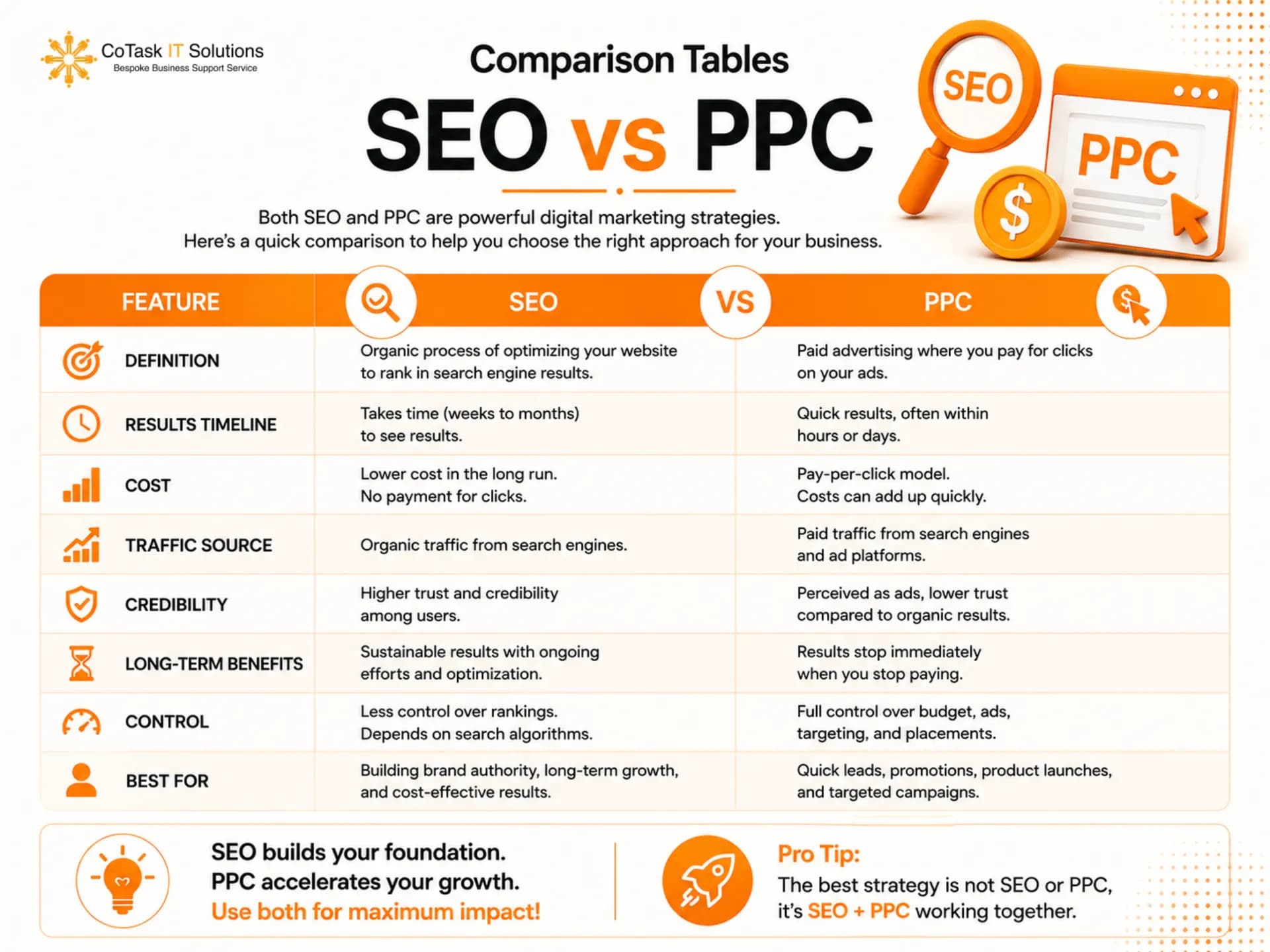
Comparison Tables
SEO vs PPC
- Cost structure — SEO: time and content investment / PPC: pay per click
- Speed to results — SEO: weeks to months / PPC: immediate
- Longevity — SEO: compounding, long-term asset / PPC: stops when spend stops
- Best for — SEO: long-term organic growth / PPC: fast, testable lead generation
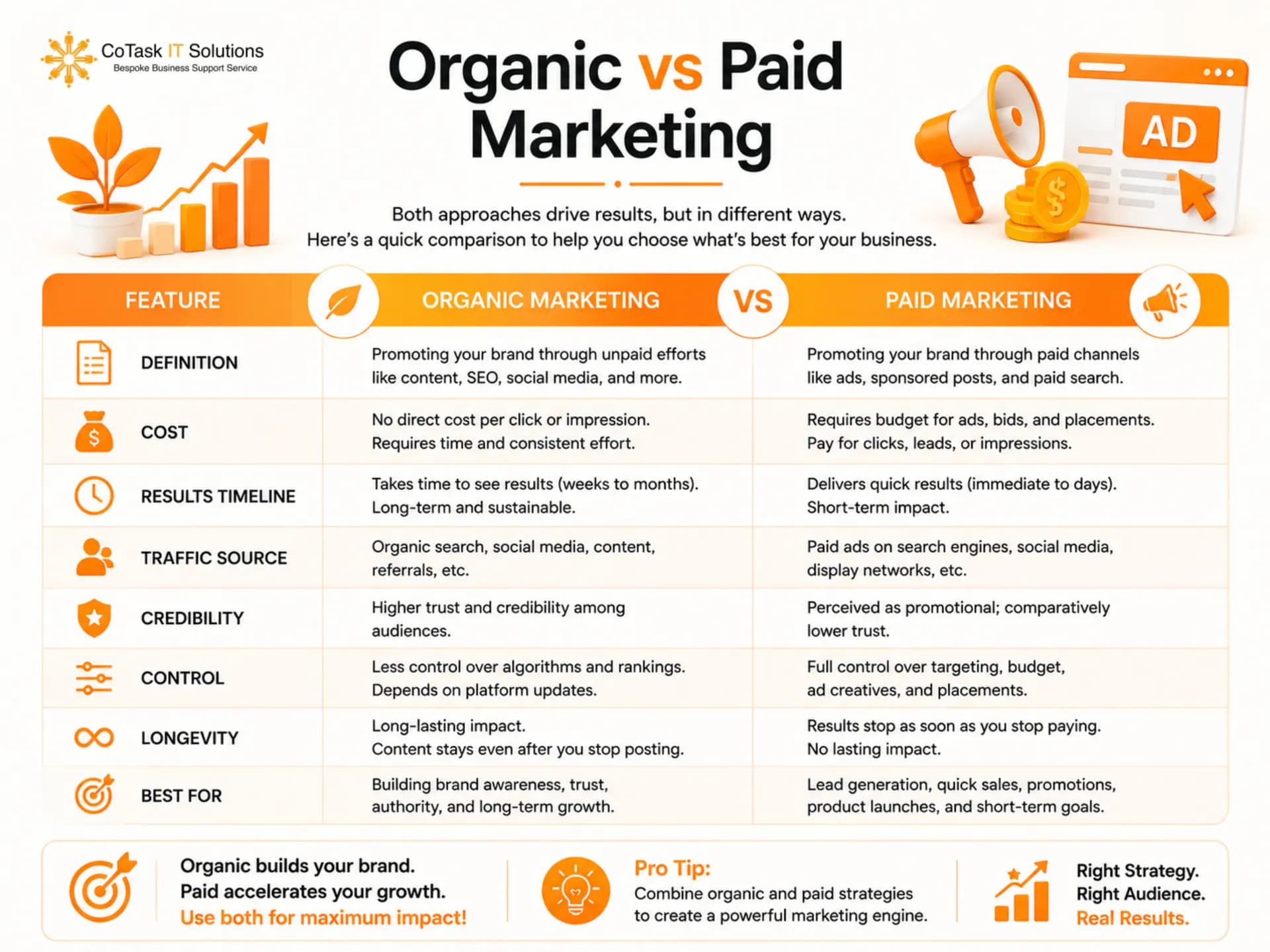
Organic vs Paid Marketing
- Trust signal — Organic: higher perceived credibility / Paid: clearly labeled as an ad
- Control — Organic: less control over ranking timing / Paid: full control over placement and budget
- Scalability — Organic: limited by content and authority growth / Paid: scales instantly with budget
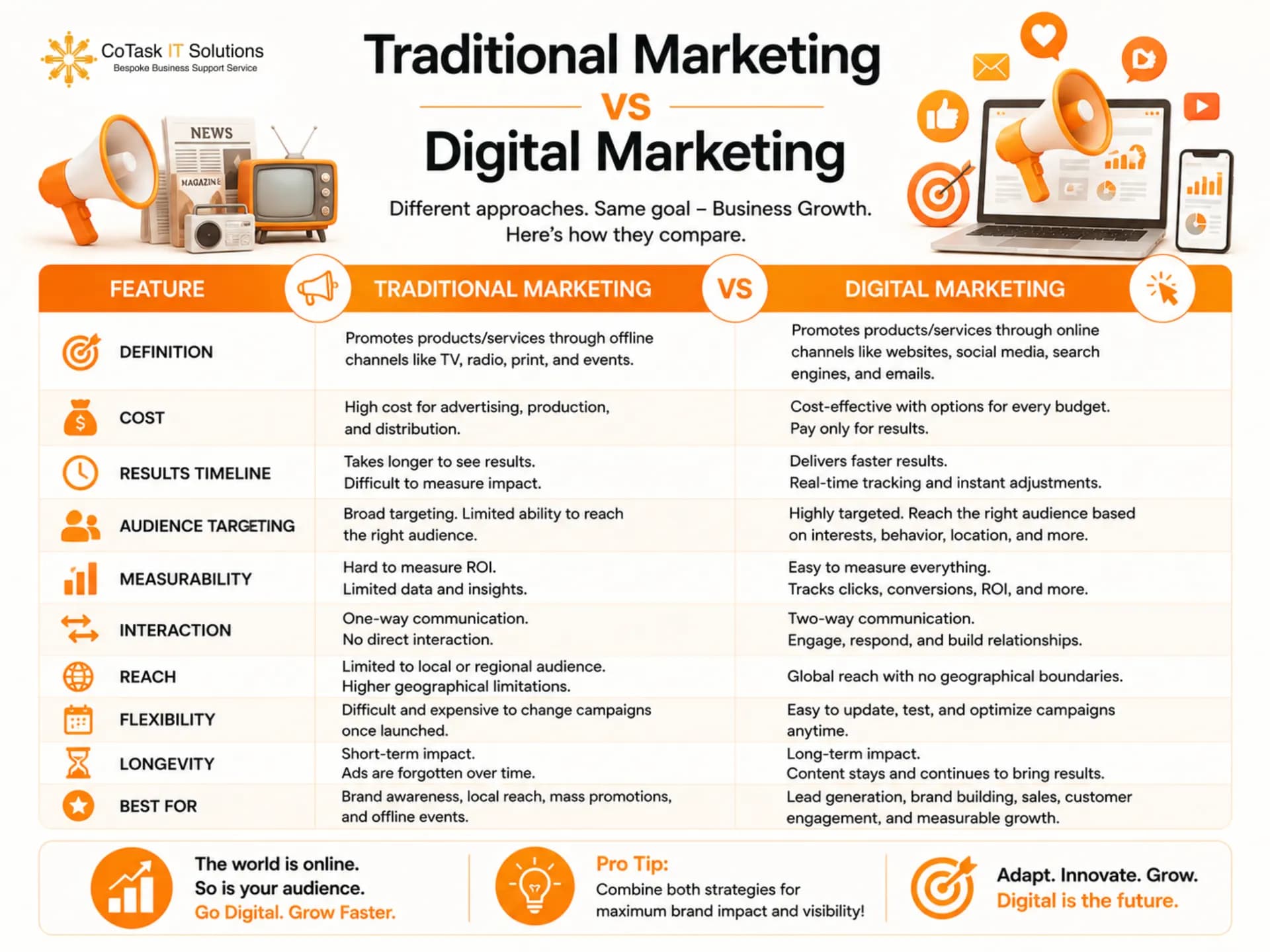
Traditional Marketing vs Digital Marketing
- Targeting — Traditional: broad, demographic-based / Digital: precise, behavior and intent-based
- Measurability — Traditional: difficult to attribute directly / Digital: trackable to the click and conversion
- Cost flexibility — Traditional: high fixed costs (print, TV) / Digital: scalable from small to large budgets
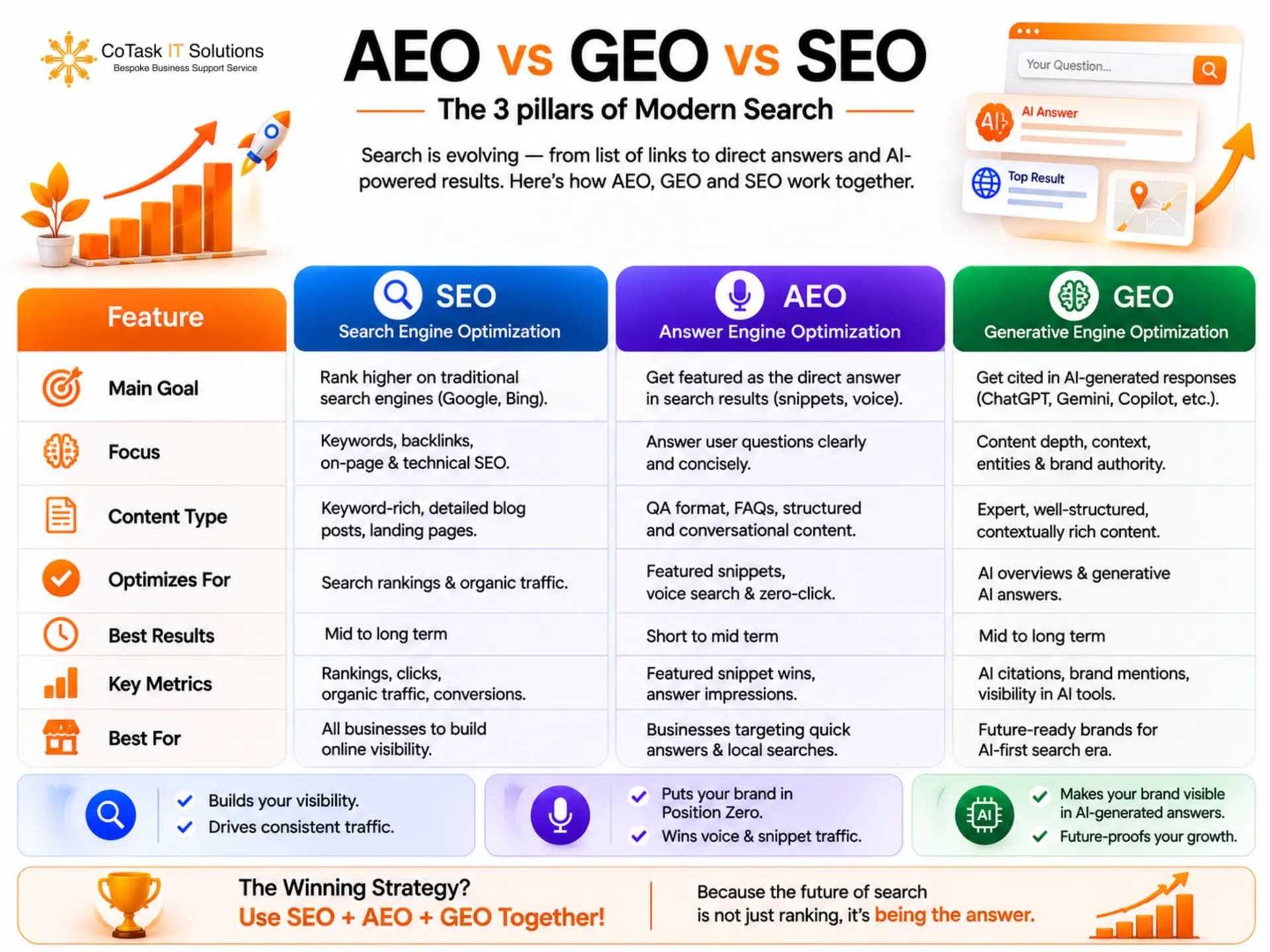
AEO vs GEO vs SEO
- Goal — SEO: rank in search results / AEO: answer specific questions directly / GEO: get cited by AI answer engines
- Format — SEO: optimized web pages / AEO: Q&A structured content / GEO: self-contained, structured sections
- Where it shows up — SEO: search results pages / AEO: featured snippets, voice assistants / GEO: AI Overviews, ChatGPT, Perplexity
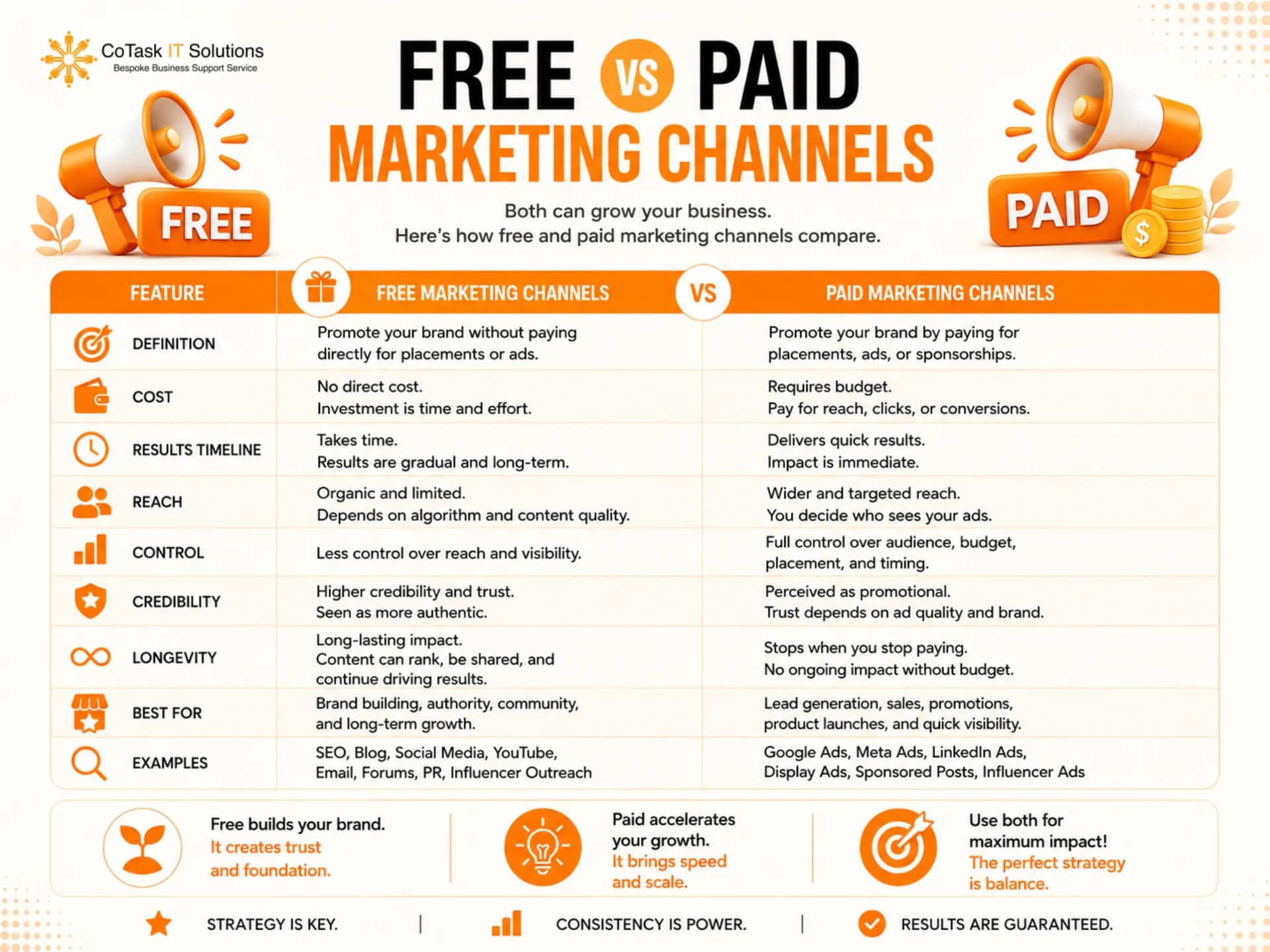
Free vs Paid Marketing Channels
- Examples — Free (Organic): SEO, organic social, email to owned list / Paid: Google Ads, Meta Ads, sponsored content
- Time to results — Free (Organic): slower / Paid: faster
- Ongoing cost — Free (Organic): time-intensive / Paid: budget-intensive
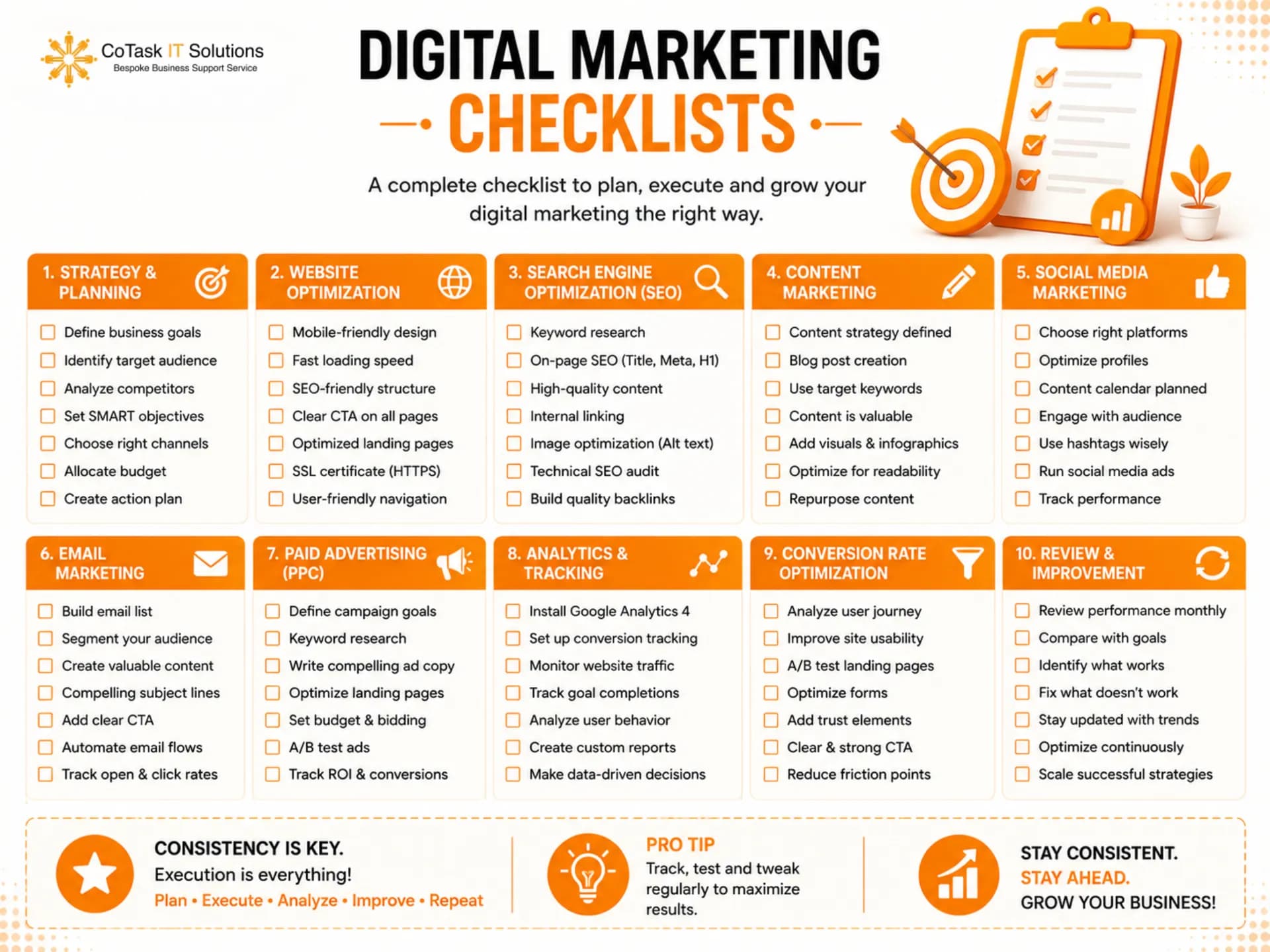
Digital Marketing Checklists
Digital Marketing Strategy Checklist
- Defined target audience and buyer personas
- Clear, measurable goals tied to revenue
- Channel mix matched to audience behavior
- Analytics and tracking configured before launch
- Monthly performance review cadence
SEO & GEO Checklist
- Technical audit completed (speed, crawlability, mobile)
- Keyword research validated with real search data
- On-page optimization (titles, headers, schema)
- Content leads with a direct, extractable answer
- Google Business Profile optimized (if local)
Content Checklist
- Content mapped to a specific search intent
- Pillar-cluster structure planned
- Original insight, not just summarized information
- Clear CTA on every piece
Social Media Checklist
- Platform-specific content formats
- Consistent posting schedule
- Engagement tracked beyond follower count
- Short, high-impact captions
AI Marketing Checklist
- Human review on all AI-generated content
- AI used for data analysis, not just content output
- Brand voice guidelines applied consistently
Frequently Asked Questions
Conclusion
The strategies covered here — SEO, content, social, paid ads, email, AI marketing, GEO, and AEO — aren't independent tactics to pick from. They work as a system: SEO and content build long-term visibility, GEO and AEO determine whether that visibility survives an AI-generated summary, paid ads and social media create immediate reach, email and automation nurture the relationship, and analytics ties it all back to revenue so you know what's actually working.
The businesses that grow fastest in 2026 aren't necessarily the ones spending the most — they're the ones running a coordinated strategy built for the search landscape that actually exists today, not the one from three years ago.
👉 Ready to build a digital marketing strategy that actually connects your channels to revenue? Contact Cotasks IT Solutions for a free consultation, and let's map out a strategy built around your business goals — not a generic template.
Visit Us: CoTasks.com