
Digital Marketing Trends 2026: 10 Shifts Redefining Growth
Search is no longer just search. In 2026, more than six in ten Google queries end without a single click, and when an AI Overview appears, that number climbs even higher — meaning the old playbook of "rank #1 and wait for traffic" is quietly breaking down. At the same time, short-form video, social commerce, and AI-driven automation are rewriting how brands earn attention in the first place.
For businesses across the US, UAE, UK, Saudi Arabia, Australia, and India, this shift isn't theoretical — it's already changing lead quality, ad costs, and content ROI. Marketing teams that built their strategy around ranking positions and click-through rates are finding those metrics tell only part of the story now. Below are the 10 digital marketing trends shaping 2026, backed by current industry data, with practical next steps for each — so you can act on them instead of just reading about them.
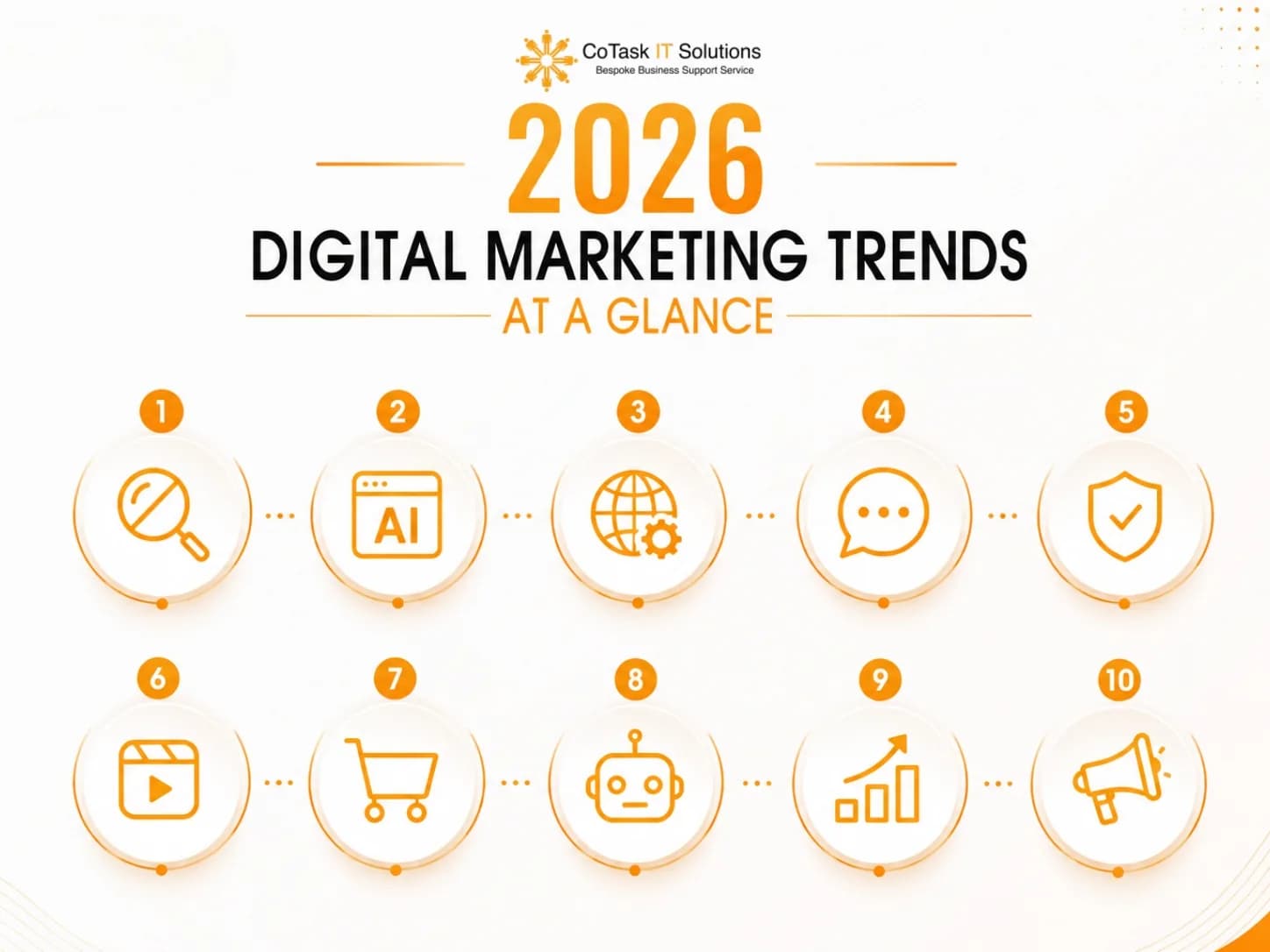
2026 Digital Marketing Trends at a Glance
- Zero-click search — Key 2026 Data Point: ~65% of searches end without a click; ~83% when an AI Overview appears. Immediate Action: Track impressions and citations, not just clicks.
- AI Overviews — Key 2026 Data Point: Trigger on roughly 25%–60%+ of queries depending on tracker/industry. Immediate Action: Put self-contained answers in the first 40–60 words.
- Generative Engine Optimization (GEO) — Key 2026 Data Point: Sourced stats/citations lift AI citation rate ~30–40%. Immediate Action: Write in factual, quotable blocks, not vague copy.
- Answer Engine Optimization (AEO) — Key 2026 Data Point: Growing share of queries are conversational/voice-style. Immediate Action: Add natural-language FAQ sections to core pages.
- E-E-A-T as an AI trust filter — Key 2026 Data Point: AI systems favor sourced, credentialed content over generic copy. Immediate Action: Add author credentials and dated, sourced stats.
- Short-form video — Key 2026 Data Point: ~49% of marketers rank it top ROI format. Immediate Action: Repurpose blog content into 30–60 second clips.
- Social commerce — Key 2026 Data Point: Projected to reach trillions of dollars globally in 2026. Immediate Action: Prioritize native in-app checkout over off-platform links.
- AI marketing automation — Key 2026 Data Point: Up to ~85% of routine marketing tasks can be automated. Immediate Action: Audit and clean data before automating workflows.
- Digital ad spend & efficiency — Key 2026 Data Point: Global spend projected to surpass $700B in 2026. Immediate Action: Shift budget from broad-match to trackable conversion paths.
- Retail/commerce media — Key 2026 Data Point: Expanding beyond retailers into cross-category ad buying. Immediate Action: Treat marketplace ads as a core acquisition channel.
1. Zero-Click Search Is Now the Default, Not the Exception
Roughly 65% of Google searches end without a click, and that figure jumps to around 83% when an AI Overview appears on the page, according to zero-click research compiled from SparkToro, Similarweb, and Bain–Dynata data. Mobile searches are hit even harder than desktop, with zero-click rates running significantly higher on phones, where users are more likely to accept an on-screen answer than tap through to a website.
This doesn't mean search traffic is disappearing — it means the relationship between ranking and visiting has broken apart. A page can rank #1, get seen by thousands of people, and still send almost no one to the website. Ranking #1 no longer guarantees a visit — it guarantees visibility, which is not the same thing, and marketers who don't separate the two will keep making decisions based on incomplete data.
What to do: Stop measuring content success by clicks alone. Track impressions, SERP feature visibility, and brand mentions inside AI-generated answers as core KPIs alongside traffic. If a page ranks well but traffic looks flat, check whether an AI Overview is now absorbing the query before concluding the content underperformed.
2. AI Overviews Have Gone Mainstream
Google's AI Overviews now surface across a large and growing share of queries, with independent trackers reporting anywhere from roughly a quarter to well over half of US search results depending on keyword set and industry. When an AI Overview triggers, the traditional #1 organic result can lose over half its expected clicks, and click-through rates for every position below it compress further still.
The pattern is consistent across informational and comparison-style queries especially — "best," "how to," and "what is" searches are the most likely to trigger a summarized answer instead of a list of links. Transactional, high-intent queries are still less affected, which is useful context when deciding where to prioritize AEO effort first.
What to do: Structure content so the answer appears in the first 40–60 words of a section — that's the extractable block AI systems tend to lift for summaries. Pair every core topic page with a concise, self-contained definition near the top, then expand into detail below it for readers who want more.
3. Generative Engine Optimization (GEO) Is a Distinct Discipline Now
GEO — optimizing content specifically for AI platforms like ChatGPT, Perplexity, and Gemini rather than traditional blue-link search — has moved from buzzword to budget line. Research from Princeton and Georgia Tech (KDD 2024) found that adding clear citations, statistics, and quotations to a page can lift AI citation frequency by roughly 30–40%. Traffic referred from generative AI platforms also grew nearly 8x year-over-year, and while the total volume is still smaller than organic search, that traffic tends to convert well above average because visitors arrive already informed.
What makes GEO different from classic SEO is the unit of optimization. SEO optimizes a page to rank. GEO optimizes a specific passage, statistic, or claim to be lifted, quoted, and attributed. That means writing in self-contained, factual blocks rather than long narrative paragraphs that require the reader — or the model — to piece meaning together across several sentences.
What to do: Build pages around named data points, sourced statistics, and clearly labeled expert claims. AI models cite specificity, not vague marketing copy, so replace generic lines like "many businesses see results" with an actual sourced figure wherever possible.
4. AEO Turns Content Into Answers, Not Just Rankings
Answer Engine Optimization (AEO) focuses on structuring content so it can be lifted whole into an AI answer — think FAQ blocks, definition-style paragraphs, and structured markup that clearly labels what a page is actually about. AEO and GEO overlap heavily, but AEO leans specifically toward Google's AI Overviews and voice-style query answers, while GEO covers the broader universe of generative AI platforms including ones users navigate to directly rather than through Google.
"what's the best time to post on Instagram" instead of "best Instagram posting time"). Content written to match that conversational phrasing performs better across both voice results and AI-generated answers.
Voice search plays into this too. As more queries are spoken rather than typed — through phones, smart speakers, and in-car assistants — the phrasing shifts toward full, natural questions.
What to do: Add a dedicated FAQ section to every cornerstone page, written in natural question form, matching how a person would actually ask the question out loud rather than how they'd type a keyword into a search bar.
5. E-E-A-T Has Become the Trust Filter for AI Systems, Not Just Google
As AI systems decide which sources to cite and recommend, experience, expertise, authoritativeness, and trust signals — bylines, credentials, original data, and cited sources — matter more than ever. AI models are conservative about which brands they surface, and unverifiable or generic content is far less likely to get quoted, regardless of how well it's written or how competitively it's positioned for keywords.
This is a meaningful shift for agencies and in-house teams that have relied heavily on volume — publishing frequently without strong differentiation. In an AI-mediated search environment, one well-sourced, clearly authored piece of content can outperform ten generic ones, because trust signals are now doing part of the ranking work that backlinks used to do alone.
What to do: Add visible author credentials, publish original research, case data, or client results where possible, and keep every statistic sourced and dated — exactly the standard behind this article.
6. Short-Form Video Is the Highest-ROI Content Format
Short-form video is now the most-used content format among marketers, with roughly half citing it as their top ROI driver, and a majority of consumers saying they prefer a short video over text to learn about a product. This holds across Instagram Reels, TikTok, and YouTube Shorts alike, and increasingly across LinkedIn as B2B audiences shift viewing habits too.
The advantage isn't just reach — it's efficiency. A single well-produced short-form video can be repackaged as a carousel post, a blog excerpt, a paid ad creative, and a script for a longer YouTube explainer, giving teams far more mileage per production hour than a single long-form article typically delivers.
What to do: Repurpose long-form blog and SEO content into 30–60 second video summaries. A single pillar article can realistically fund five to seven short-form clips across platforms without needing a separate content plan.
7. Social Commerce Is Becoming a Primary Sales Channel
Global social commerce is projected to reach into the trillions of dollars in 2026, driven by in-app checkout, shoppable posts, and creator-led product discovery. For Gen Z and younger millennial audiences especially, the social feed is now a shopping surface, not just a discovery channel — the line between browsing and buying has effectively disappeared.
This matters most for direct-to-consumer and marketplace-adjacent brands, where every extra step between "seeing a product" and "buying it" costs conversions. Brands still routing social traffic to an external website checkout are competing against native in-app purchase flows that remove friction entirely.
What to do: If you sell direct-to-consumer, prioritize native checkout features on Instagram and TikTok Shop over sending traffic off-platform, where drop-off is highest. Sellers active on marketplaces like Amazon or Noon should treat social as a discovery layer feeding directly into those storefronts.
8. AI-Powered Marketing Automation Is Now Standard Infrastructure
A large majority of routine marketing tasks — segmented email sends, lead scoring, dynamic audience segmentation, social scheduling, and first-pass reporting — can now be automated with AI tools, and adoption is climbing fast among mid-size and enterprise marketing teams. Automation is also linked to meaningful productivity gains when implemented with clean data and clear workflows, though the gains depend heavily on data quality going in.
The risk teams are running into isn't automation itself — it's automating before fixing underlying data issues. Automated segmentation built on messy or duplicated contact data, for example, tends to amplify errors rather than solve them, which is why data hygiene has become a prerequisite step rather than a nice-to-have.
What to do: Audit your stack for repetitive manual tasks first — reporting and segmentation are usually the fastest wins — before automating anything customer-facing like ad creative or messaging, and only after confirming the underlying data is clean.
9. Search and Digital Ad Spend Keep Climbing, But Efficiency Is the New Metric
Global digital advertising spend is projected to surpass $700 billion in 2026, with search still commanding a substantial share of that budget and mobile now accounting for more than half of total ad spend worldwide. But with rising costs and shrinking organic click-through, marketers are being judged on cost-per-qualified-lead, not just impressions or reach.
This is where broad, high-volume keyword targeting quietly becomes expensive. Casting a wide net can look good on impression and traffic reports while producing a flood of low-intent leads that sales teams end up filtering out manually — a pattern worth reviewing in any account where lead volume has grown but close rates haven't.
What to do: Reallocate budget toward channels with measurable, trackable conversion paths, and treat broad-match, high-volume keyword targeting with caution — it tends to produce lower-quality leads at scale even when the top-line numbers look strong.
10. Commerce Media and Retail Media Are Expanding Beyond Retail
Retail media networks (Amazon Ads, Walmart Connect, and similar) are no longer just for retailers — brands across categories are buying placement inside commerce platforms to reach shoppers at the point of decision. This "commerce media" trend is one of the defining shifts identified in Experian's 2026 outlook, alongside deeper integration of AI into everyday campaign execution and a growing focus on connecting activation and measurement in real time rather than reporting after the fact.
For sellers active on Amazon, Noon, or similar platforms, this shift means advertising budgets increasingly need to live inside the marketplace itself, not just on Google and social, since that's where a growing share of product searches now start and end.
What to do: If your brand sells on marketplaces, treat retail media as a core acquisition channel, not an experimental add-on, and integrate its data back into your broader attribution model so it isn't evaluated in isolation from the rest of your funnel.
The Common Thread: Visibility Beyond the Click
Every trend above points to the same underlying shift: being findable is no longer enough — brands now need to be cited, quoted, and recommended by both search engines and AI systems. That means SEO, AEO, and GEO aren't three separate strategies anymore; they're three layers of the same visibility stack, and treating them as separate projects with separate owners is one of the fastest ways to fall behind in 2026.
If you're auditing your own strategy against these shifts, our digital marketing services team works across SEO, PPC, and social to align content with how people — and AI — actually search in 2026. For a deeper look at how AI is already reshaping search results specifically, see our breakdown of Conversion Rate Optimization.