
eCommerce SEO Guide 2026: How to Increase Online Store Sales
Most online store owners treat SEO like a checklist: add some keywords, write a few blog posts, wait for sales. But traffic alone doesn't grow revenue — the goal was always more sales, and search is just the channel that gets the right buyers to your door.
Organic search is still the single biggest source of those buyers. It drives 43% of all online store traffic, outperforms social media by more than 1,000% in volume, and converts at 2.8% on average — well above social media's 0.7–1.5%. Stores in the top 10% for conversion push past 4.7%. In short, search isn't a marketing line item — it's the highest-ROI channel most stores have, and the one most owners under-invest in.
The way people search has also changed. Google's AI Overviews, ChatGPT, and other AI shopping tools now sit between a lot of buyers and your product pages, so getting found means being visible in three places at once: traditional Google rankings, AI-generated answers, and AI shopping recommendations. That's the "eCommerce SEO" this guide covers — but the point of all of it, every tactic below, is the same: put more of the right buyers in front of your products, and remove everything standing between them and checkout.
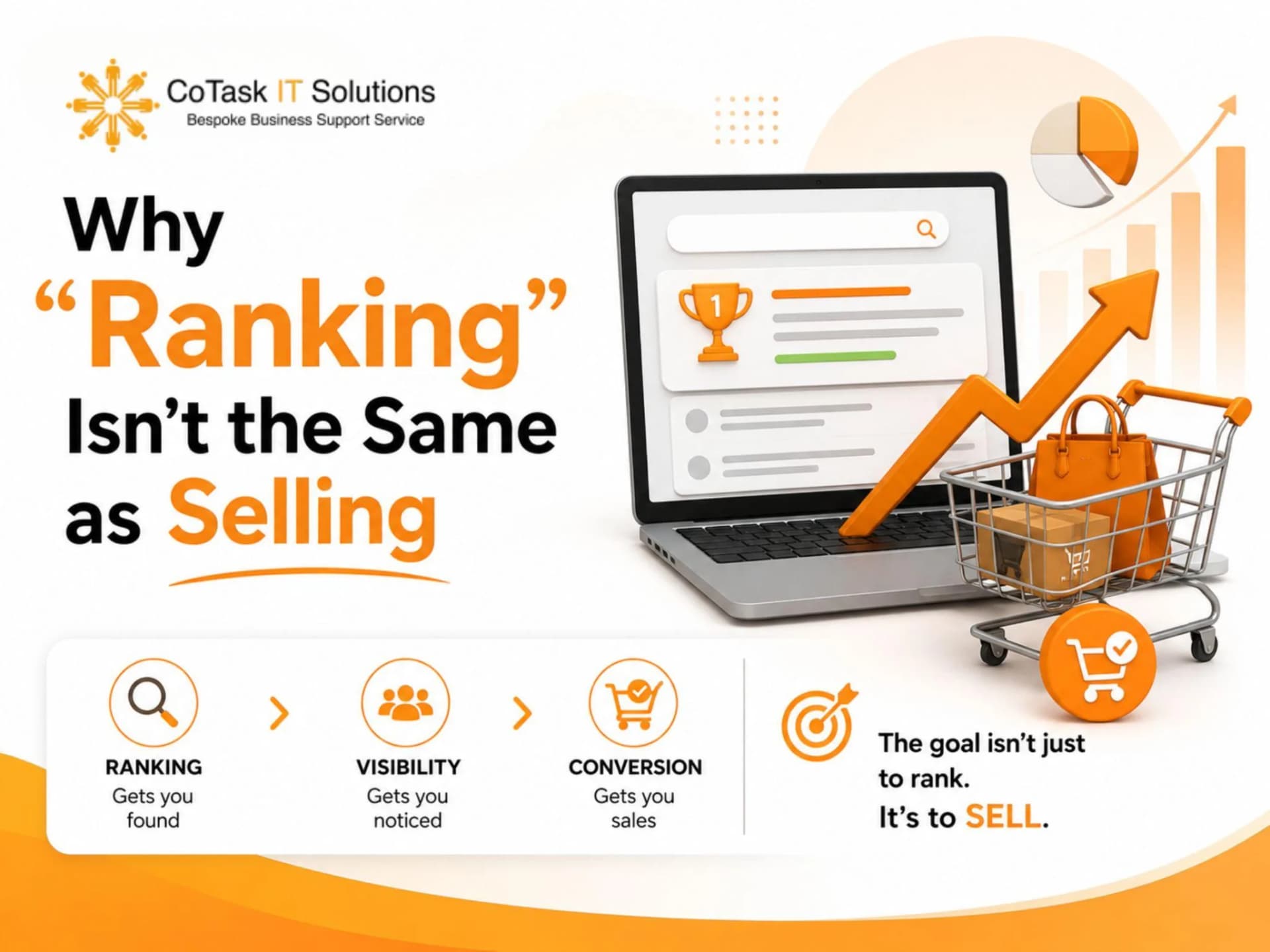
Why "Ranking" Isn't the Same as "Selling"
Search now works through three overlapping systems, and a store that only optimises for one of them is leaving sales on the table:
- Traditional SEO gets you ranked in classic Google results — the foundation everything else builds on.
- AEO (Answer Engine Optimization) gets you cited when AI Overviews, ChatGPT, or Perplexity answer a buyer's question directly instead of showing ten blue links.
- GEO (Generative Engine Optimization) gets your products recommended by name when a buyer asks an AI shopping assistant what to buy.
Here's why that distinction matters for revenue specifically: AI Overviews now appear on 86.8% of commercial searches, and when they do, click-through to the old top-ranking pages falls by roughly 55–61%. But brands that earn a citation inside that AI answer see 35% more organic clicks than a standard ranking would have gotten them, and ChatGPT-driven traffic converts 31% higher than average organic traffic — because a shopper who arrived via an AI assistant has usually already done their research and is closer to buying.
The practical upshot: ranking on page one used to be the finish line. Now it's the entry point. The stores winning the most sales are the ones showing up in the AI answer and the classic ranking and the generative shopping recommendation — because each one reaches a buyer at a different, increasingly common, point in their search.
1. Fix the Technical Foundation First
No amount of content will rank a store that's slow, unindexed, or riddled with broken links, and this is where most stores lose the most easily recoverable revenue.
- Site speed: Stores that load in under one second see roughly 3x higher conversion rates than slower competitors. Compress images, use a modern CDN, and eliminate render-blocking scripts on product and category pages.
- Mobile-first indexing: Mobile now generates around 75% of eCommerce traffic. Google indexes and ranks based on the mobile version of your site, so a desktop-only "good enough" layout is actively costing you rankings.
- Crawlability and internal linking: 86% of eCommerce brands have poorly optimised internal links, and even high-visibility sites frequently leave money on the table here. Every product should be reachable within three clicks from the homepage, and every category page should link to its most relevant subcategories and best-selling products.
- Broken links and orphan pages: Over 62% of eCommerce sites have broken links dragging down crawl efficiency and user trust. A quarterly technical audit catches these before they compound.
If your store's architecture has grown organically over a few years — new categories bolted on, old collections left live, a platform migration or two along the way — this is usually the highest-leverage place to start. A structured technical and on-page audit like the one covered in Cotasks' on-page SEO checklist is a practical place to benchmark where your store currently stands.
2. Turn That Traffic Into Sales, Not Just Visits
This is the step most SEO guides skip, and it's often the single biggest lever available: ranking well and earning a click means nothing if the store leaks the sale afterward. The industry-wide numbers make the opportunity clear — the global average cart abandonment rate sits at 70.22%, meaning roughly 7 out of every 10 shoppers who add something to their cart leave without buying. Baymard Institute estimates $260 billion of that is recoverable in the US and EU alone, purely through better checkout design, and a large store can see up to a 35% conversion lift from fixing checkout friction — turning the same SEO traffic into meaningfully more revenue without spending an extra rupee on acquisition.
The highest-impact fixes, in order of typical revenue impact:
- Show total cost early. Unexpected shipping costs revealed at the last step is still the single biggest driver of abandonment. Display shipping and taxes before the final page, not after.
- Offer guest checkout by default. Forcing account creation before purchase costs 15–20% of would-be buyers who simply want to check out. Let them create an account after the sale, not before.
- Reduce form fields. The average checkout asks for 23 fields when 12–14 is optimal. Every unnecessary field is a chance for a buyer to lose momentum and leave.
- Show trust signals at the moment of payment. Security concerns around entering payment details cause roughly 18–25% of abandonment. SSL badges, recognisable payment logos, and clear return policies do measurable work right where the buyer is hesitating.
- Support the payment methods your buyers actually use. Digital wallets now account for roughly half of global eCommerce transaction value, and one-click options like Shop Pay or Apple Pay reduce abandonment by around 28% by removing the input step entirely.
- Set up cart abandonment email recovery. It's the highest-converting automated email flow in eCommerce, generating meaningfully more revenue per recipient than standard campaigns — and it's one of the cheapest fixes on this list to implement.
None of this replaces the SEO work above — it multiplies it. A store ranking well but leaking 70% of carts is optimising the wrong end of the funnel first.
3. Structure Product Pages to Rank and Get Cited
Your product pages carry disproportionate weight: they account for roughly 51% of organic eCommerce traffic but generate 62% of organic conversions. Optimising them well pays back faster than almost anything else you'll do.
For traditional SEO:
- Write unique product titles and descriptions — never rely on manufacturer copy, which competes against every other retailer selling the same item.
- Target the exact phrase buyers search, including long-tail variations. Long-tail keywords convert at roughly 2.5x the rate of broad head terms because they carry clearer purchase intent.
- Use descriptive, keyword-rich image alt text and compressed file names.
For AEO (getting cited in AI answers):
- Answer the specific question a buyer would ask about the product in plain language near the top of the page — sizing, materials, compatibility, care instructions.
- Use clear headers and short, direct paragraphs. AI summarisation tools favour content that's already structured like an answer.
- Add an FAQ section addressing the 3–5 questions buyers most commonly ask before purchasing.
For GEO (getting recommended by AI shopping assistants):
- Implement Product schema markup with accurate price, availability, and review data — pages with proper schema see 20–40% higher click-through rates, and rich results outperform standard listings by up to 82%.
- Keep specifications in structured, consistent formats (tables, bullet attributes) rather than buried in narrative paragraphs, since generative engines parse structured data far more reliably.
- Maintain accurate, current stock and pricing feeds, since AI assistants deprioritise sources with stale or conflicting data.
4. Do Keyword Research the Way Buyers Actually Search
Most stores build their keyword list around what they'd like to rank for — broad category terms like "leather bags" or "wireless earbuds" — rather than what buyers actually type when they're close to purchasing. That's expensive, because broad head terms are the most competitive and the least likely to convert.
A better process for a growing store looks like this:
- Start from your best-sellers, not your homepage. Pull the products already driving revenue and map every phrase a buyer might use to search for them, including size, colour, material, and use-case variations.
- Prioritise long-tail, high-intent phrases. "Waterproof running shoes for flat feet" will convert at a far higher rate than "running shoes," even with a fraction of the search volume, since long-tail terms convert at roughly 2.5x the rate of broad ones.
- Segment by funnel stage. Bottom-funnel terms ("buy," "price," "vs," "best [product] for [use case]") should map to product and category pages. Top-funnel terms ("how to choose," "what is," "guide") should map to blog content that eventually links down into those product pages.
- Check what's already ranking. If a competitor's thin category page is outranking your well-built one, the gap is usually backlinks or internal linking — not content quality. Don't assume you need more content before checking the actual cause.
- Revisit quarterly. Search behaviour shifts with AI adoption, seasonality, and new product lines, so a keyword map built once and never revisited quietly goes stale.
Tools like SE Ranking, Ahrefs, or Semrush will validate real search volume and difficulty — template-estimated figures are a reasonable starting point for planning but shouldn't be the final word before you commit content budget to a topic.
5. Earn Backlinks That Actually Move Rankings
Backlinks remain one of Google's strongest ranking factors, and the data backs it up starkly: the first organic result captures roughly 27.6% of all clicks, dropping to 15.8% for position two and just 2.4% by position ten. Getting there for competitive commercial terms almost always requires a real backlink profile, not just on-page optimisation.
A few realities worth knowing before you invest here:
- Product pages rarely earn links naturally. Nobody links to a "Buy Now" page. Your linkable assets are guides, original research, tools, and comparison content — built specifically to attract editorial links, then internal-linked down into your product and category pages so authority flows to where it converts.
- Relevance beats raw authority. A backlink from a smaller, tightly relevant niche publication routinely outperforms a link from a much bigger, generic site. Context and topical fit matter more than a headline Domain Rating number.
- Digital PR is now the leading tactic. The majority of SEO professionals now rank digital PR — getting genuinely covered by relevant publications — as the single most effective link-building method available, ahead of guest posting or directory submissions.
- Set realistic timelines. Expect early ranking movement in 3–6 months, with meaningful compounding effects on traffic and revenue between 12–18 months. Stores starting from a weak backlink profile often see measurable authority gains within the first 2–3 months, a useful early signal the strategy is working.
6. Build Category and Collection Pages That Actually Rank
Category pages are where most stores under-optimise the hardest, treating them as pure navigation rather than ranking assets.
- Write 150–300 words of genuinely useful buying-guide content above or below the product grid — what distinguishes the options in this category, how to choose between them.
- Avoid keyword cannibalization: if two categories or filters target the same core term, consolidate them or set clear canonical direction. This is one of the most common structural issues in growing stores, particularly after a platform migration.
- Use breadcrumb schema so both search engines and AI tools understand your site hierarchy.
7. Solve the Content Gap With a Real Content Engine
Product and category pages capture existing demand. Blog and guide content captures demand that hasn't reached a product page yet — and it's where most of your AEO citations will come from, since AI Overviews pull disproportionately from informational content rather than transactional pages.
A working content engine for a store typically includes:
- Buying guides built around comparison and "best for X" queries
- How-to and use-case content answering the questions buyers ask before and after purchase
- Seasonal and trend content timed to search demand spikes
Consistency matters more than volume here. Publishing without a strategic content loop — topic research, structured drafting, internal linking, performance review — tends to plateau quickly, while a disciplined content and internal-linking loop compounds. If content production is the bottleneck, this is exactly the kind of engine Cotasks' SEO, PPC, and social media services are built to run on an ongoing basis.
8. Turn Store Speed and UX Into an SEO Advantage
Google's ranking systems and AI answer engines both weigh page experience heavily, and for stores this shows up directly in the bounce-to-conversion relationship. Once the bounce rate on a product or category page crosses roughly 65%, organic conversion rate drops below 1% — less than half the 2.3% eCommerce benchmark. Pages loading above three seconds bounce roughly 32% more than pages under two seconds.
If your store is on a platform that's fighting you on speed or structure — a common issue after a CMS migration or when a site has outgrown its original build — a rebuild on a conversion-focused, SEO-ready foundation is often more cost-effective long-term than continuing to patch technical debt. This is the kind of foundational work covered in Cotasks' Shopify and eCommerce website development services.
9. Avoid These Common eCommerce SEO Mistakes
A few recurring issues quietly cap growth even for stores doing most things right:
- Keyword cannibalization from platform migrations. Moving between platforms (or adding a new front-end while keeping legacy URLs live) often leaves multiple pages competing for the same keyword, splitting link equity between them instead of consolidating it.
- Missing hreflang tags on multi-market stores. If you sell across more than one country or language, missing hreflang implementation causes search engines to show the wrong regional page to the wrong audience — a common gap for brands scaling into new markets without updating technical SEO alongside expansion.
- Thin, templated location or collection pages. Programmatically generated pages with little unique content are increasingly flagged as low-value by both search engines and AI crawlers. Every near-duplicate page you publish dilutes the authority of the ones that matter.
- Analytics contamination. A shared Google Analytics Measurement ID across multiple properties, or tracking code left over from a previous platform, quietly corrupts the data you're using to make SEO decisions. Audit your GA4 setup whenever you migrate platforms or launch a new property.
- Chasing rankings instead of revenue. Ranking #1 for a broad term with low purchase intent is a vanity metric if it doesn't convert. Prioritise the keywords your best customers actually search, not the ones with the highest volume.
10. Track the Right Numbers
SEO ROI shows up on a longer timeline than paid ads, but it compounds where paid spend doesn't. Ecommerce SEO typically delivers a 317% ROI with a break-even window around nine months, and cost-per-acquisition through organic channels runs roughly 68% lower than paid search once a strategy matures.
Track monthly:
- Organic sessions and organic revenue share (not just rankings)
- Conversion rate by landing page type (product vs. category vs. blog)
- AI Overview and citation appearances for your core queries
- Core Web Vitals pass rate across product and category templates
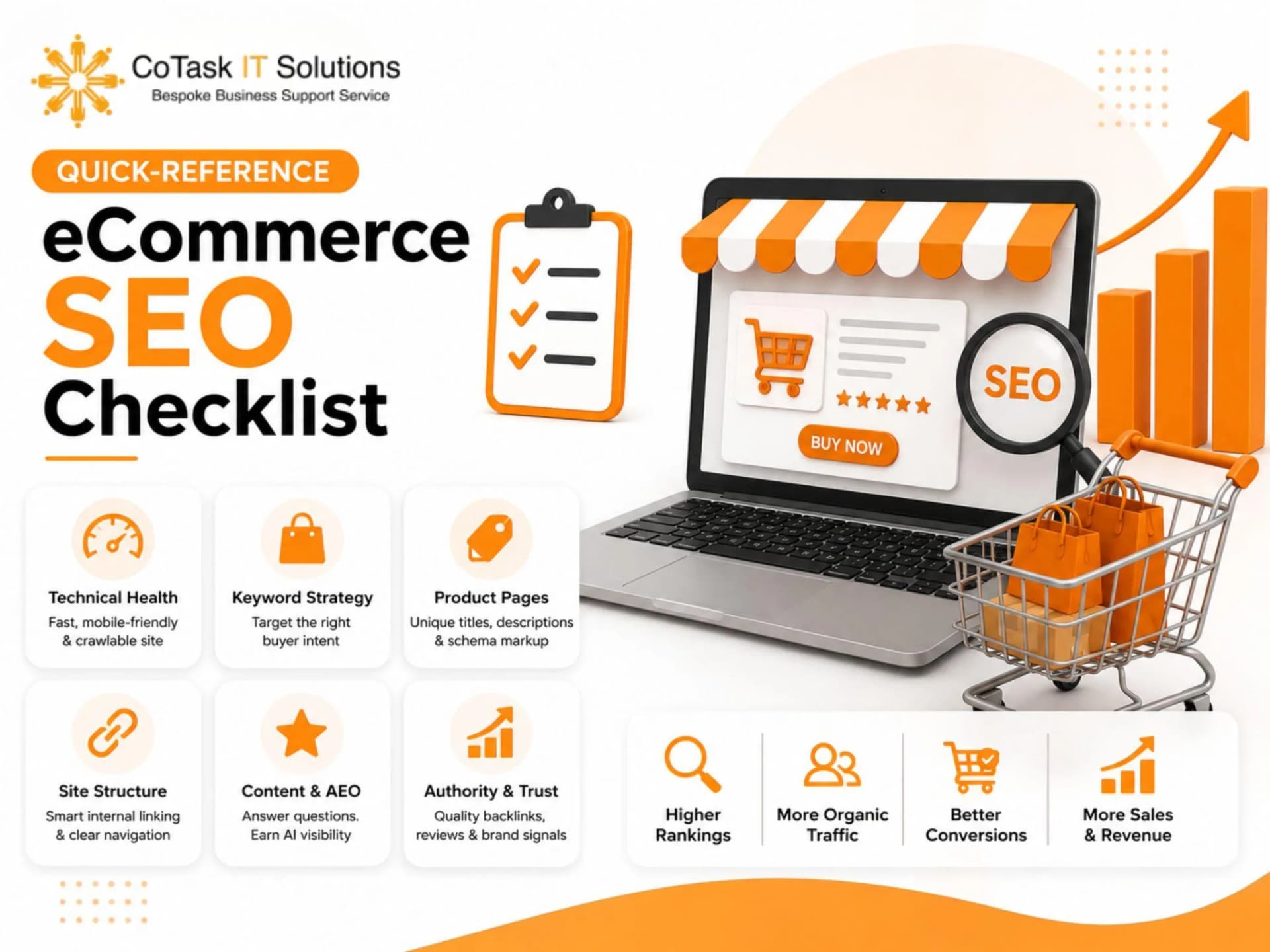
Quick-Reference eCommerce SEO Checklist
- Site loads in under 2 seconds on mobile and desktop
- Every product reachable within 3 clicks from the homepage
- No broken links or orphan pages (quarterly audit)
- Unique product descriptions — no manufacturer copy
- Product schema markup live with accurate price and availability
- FAQ section on high-intent product and category pages
- Keyword map segmented by funnel stage and mapped to specific URLs
- No duplicate or cannibalizing URLs across categories
- hreflang tags implemented if selling across multiple markets
- GA4 tracking verified as clean and property-specific
- At least one linkable content asset in active outreach
- Shipping and taxes shown before the final checkout step
- Guest checkout available by default
- Cart abandonment email flow live
- Monthly tracking of organic revenue share, not just rankings
Putting It Together
Increasing online store sales through search isn't about chasing one algorithm update at a time. It's about getting the right buyers to your site — through classic rankings, AI answer citations, and AI shopping recommendations — and then making sure nothing between their click and checkout costs you the sale.
Start with the technical foundation, fix the checkout leaks, then build product pages and content that keep earning visibility over time. Each layer makes the next one more profitable — traffic without conversion is wasted, and conversion without traffic has nothing to work with.
If you'd rather have a specialist team run this audit-to-execution process for you, Cotasks' digital marketing and SEO team has managed organic growth for 200+ brands across six markets. Book a free consultation or get a free growth audit to see exactly where your store is losing sales — and what fixing it is worth.