
Social Media Marketing Trends Every Business Should Know in 2026
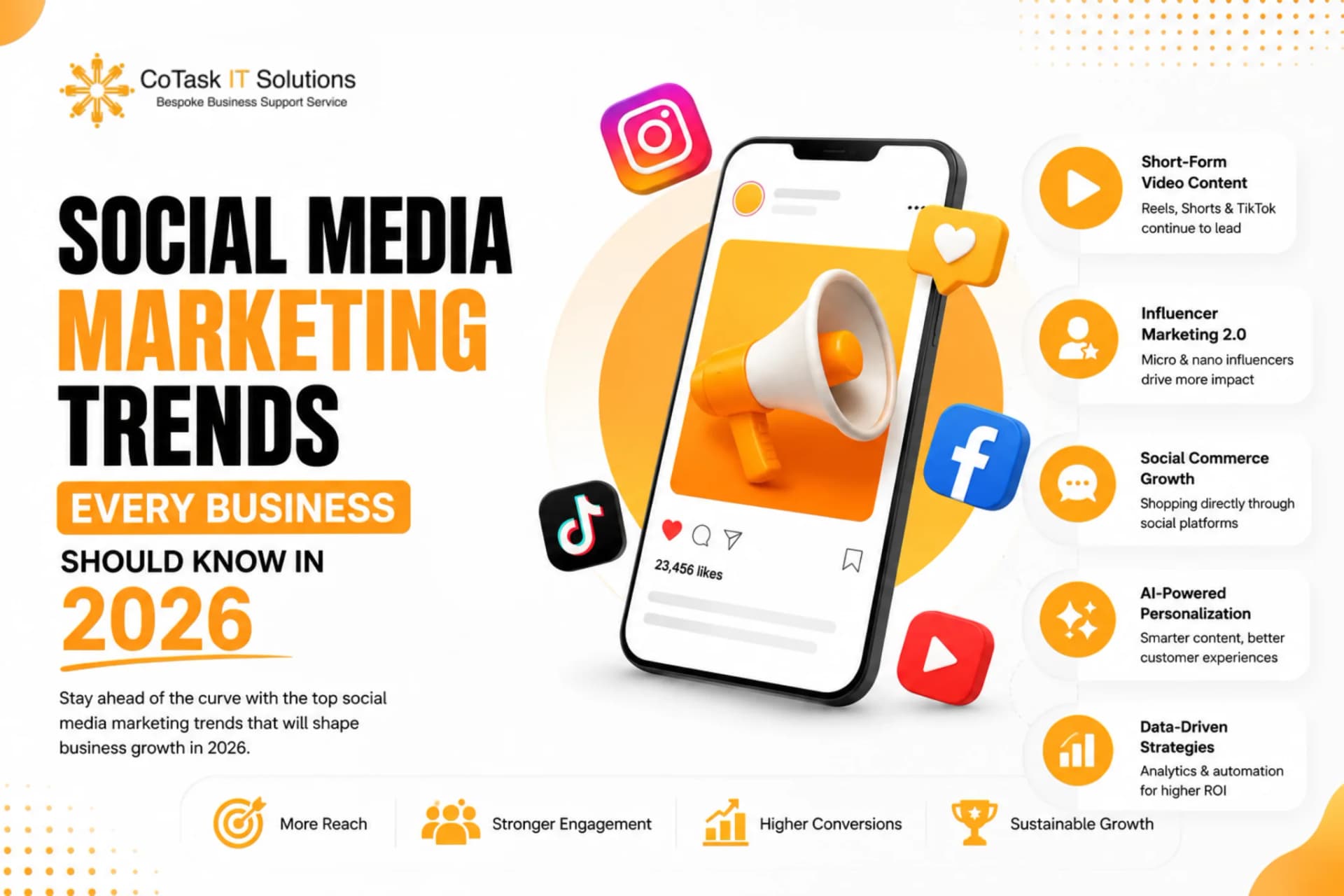
Social media stopped being a "nice to have" marketing channel a long time ago. In 2026, it's where people discover brands, compare products, ask questions, and increasingly, complete the entire purchase — all without leaving the app. If your strategy still looks like it did in 2023, you're not just behind; you're invisible to a growing share of your audience.
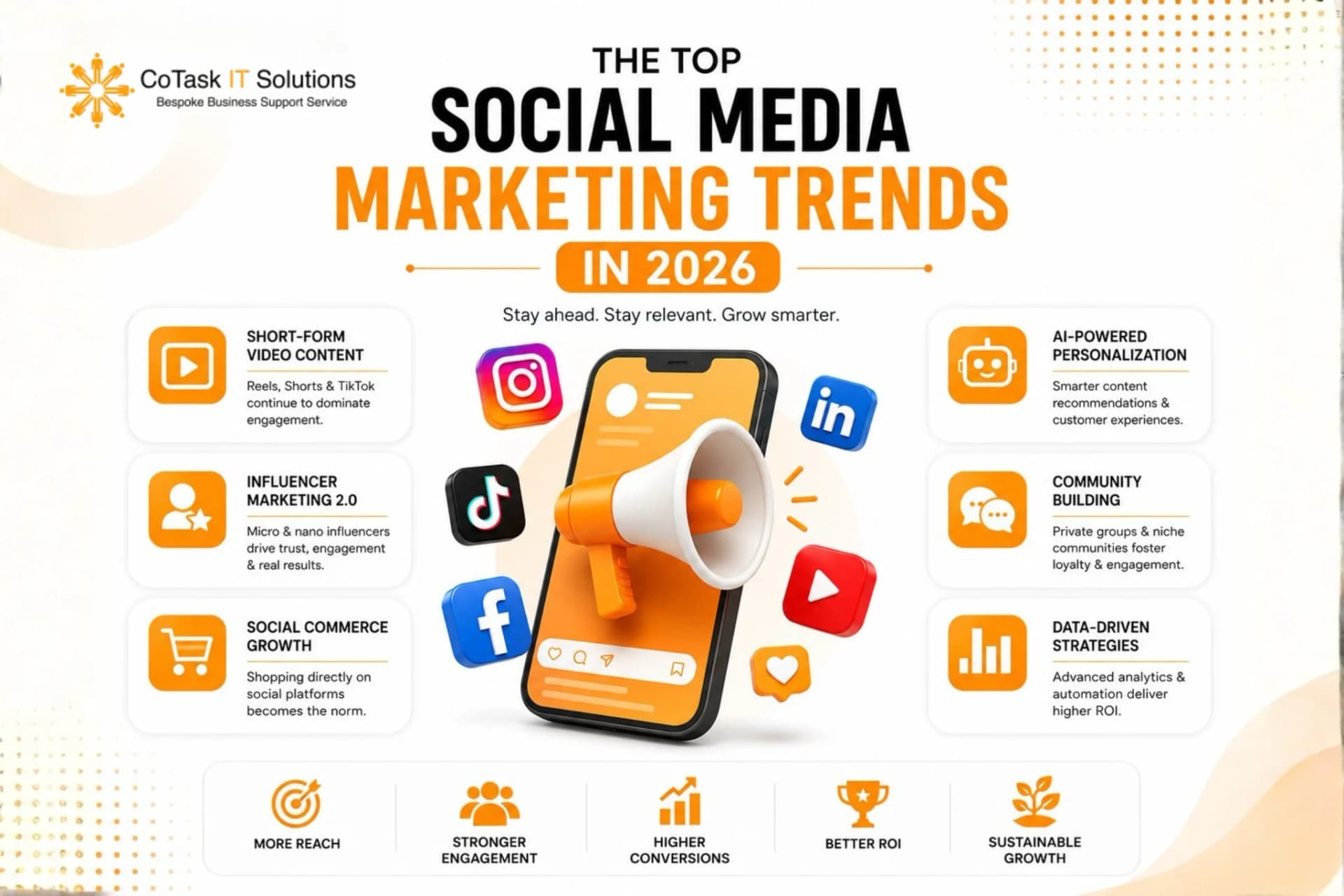
This guide breaks down the social media marketing trends actually shaping budgets, algorithms, and consumer behavior this year, and what your business can realistically do about each one.
Quick Answer: The Top Social Media Marketing Trends in 2026
If you only have thirty seconds, here's the summary:
- AI is now embedded in everyday social workflows — content ideation, visuals, optimization, and customer service — but brands that skip human review lose trust fast
- Social commerce has crossed $100 billion in the US alone, with short-form video driving the majority of in-app sales
- Community management is back as consumers prioritize genuine interaction over viral reach
- Social search behavior is mainstream — users are querying platforms like TikTok and Instagram the way they used to query Google
- Creator and influencer partnerships remain essential, despite a real trust gap that brands need to manage carefully
- ROI measurement is maturing, with CMOs demanding direct links between social spend and revenue outcomes
Now let's unpack each of these in more depth.
1. AI Is the Default, Not the Differentiator
AI is no longer a competitive edge in social media marketing — it's the baseline. From caption generation to audience segmentation, AI tools are woven into nearly every stage of the content pipeline. Many organizations are increasingly using AI in their social media marketing strategies, especially for content creation, optimization, analytics, and customer service.
But here's the catch that most "top trends" articles gloss over: consumers are watching how brands use AI, not just whether they use it. Concern about undisclosed AI-generated content is real and measurable among social users, even as comfort with AI-powered customer service is rising in parallel. That's not a contradiction — it's a signal. People are fine with AI doing the heavy lifting behind the scenes, but they want transparency and a human hand on anything that looks like it's speaking as the brand.
What this means for your business:
- Use AI to speed up ideation, first drafts, resizing, and A/B testing — not to replace your brand voice entirely
- Disclose AI-generated visuals or video where it's material to the viewer's trust
- Keep a human in the loop for anything customer-facing, especially replies to complaints or sensitive queries
2. Social Commerce Is No Longer Optional
This is the trend with the clearest dollar signs attached. In 2026, US social commerce is projected to cross $100 billion for the first time, growing close to 18% year-over-year. Zoom out globally, and the picture is even bigger — social commerce as a share of total ecommerce is climbing quickly, driven by in-app checkout, creator-led sales, and mobile-first buying habits.
Short-form video is the engine behind most of this growth. Across platforms, video-led formats now account for a large share of total social commerce activity, with live shopping and short-form clips consistently outperforming static posts for conversion. Smartphones account for the overwhelming majority of these transactions — social commerce is a mobile behavior first and everything else second.
That said, don't overestimate where the market actually is. In-platform purchasing in the US still hasn't hit critical mass compared to traditional ecommerce, and trust and checkout friction remain real barriers. This is a trend to build toward deliberately, not a switch you flip overnight.
What this means for your business:
- If you sell physical products, set up native storefronts on the platforms where your audience already spends time (Instagram Shop, TikTok Shop, Facebook Shops)
- Prioritize short-form product video over static product photography — it consistently converts better
- Don't assume social checkout will replace your website; treat it as a parallel, high-intent channel rather than your only funnel
3. Community Management Is Having a Comeback
For a few years, social strategy was almost entirely about reach — go viral, get seen, move on. That's shifting. Social media users in 2026 are increasingly looking for meaningful interaction, not just viral content, and brands that prioritize genuine engagement with their audience are outperforming those chasing one-off viral moments.
Industry voices describe this as community management "getting its moment again" — a return to actually replying to comments, engaging in DMs, and building recognizable, responsive brand personalities rather than treating social as a broadcast channel.
What this means for your business:
- Budget time (or a team member's role) specifically for community engagement, not just content publishing
- Respond to comments and DMs promptly — this is now a measurable trust signal, not just good manners
- Build recurring content formats (polls, AMAs, behind-the-scenes series) that invite two-way interaction instead of passive scrolling
4. Social Search Is the New Search Engine — For a Growing Segment of Users
A meaningful and growing share of your audience is skipping Google entirely for certain kinds of queries — "best coffee shop near me," "is this product worth it," "how to style this" — in favor of searching directly on TikTok, Instagram, or Pinterest. This is what industry analysts call "social as search," and it's becoming a defining trend for 2026 alongside AI-assisted marketing and embedded social commerce.
This has a direct implication for how you write captions, alt text, and video hooks: they need to answer real questions, not just look good. This is also where AEO (Answer Engine Optimization) and GEO (Generative Engine Optimization) intersect with social strategy — the same clear, direct-answer content that works for AI chatbots and Google's AI Overviews also works when someone searches your niche directly inside a social app. If you're wondering how this shift fits into the bigger picture, we've broken it down in more detail in Is SEO Dead in 2026? — the short answer is no, but where and how people search has changed.
What this means for your business:
- Front-load captions with the actual question your audience is asking, then answer it in the first line
- Use searchable, specific language in captions and on-screen text — not just clever wordplay
- Treat your Reels and TikToks like mini answer pages: clear hook, clear answer, clear next step
5. Creator Partnerships Remain Powerful, But the Trust Gap Is Real
Influencer and creator marketing hasn't slowed down — creator-led commerce revenue continues to grow at a healthy double-digit rate year-over-year, and a majority of adults report having purchased something because of an influencer endorsement at some point. But there's a tension brands need to manage: a meaningful share of consumers say they don't trust influencer marketing generally, and distrust rises sharply for creators who don't disclose brand relationships.
In other words, people are buying through creators while simultaneously being skeptical of the format. The brands winning here aren't the ones chasing the biggest follower count — they're the ones choosing creators whose audience overlap and authenticity are genuine, and who disclose partnerships clearly.
What this means for your business:
- Prioritize micro and niche creators with engaged, relevant audiences over sheer follower count
- Require clear, upfront disclosure in every sponsored post — it protects both your brand and the creator's credibility
- Track performance by conversion and engagement quality, not impressions alone
6. Long-Form Content Is Making a Quiet Return
While short-form video isn't going anywhere, there's a noticeable shift back toward longer-form video on platforms like YouTube and even LinkedIn, as audiences look for more depth and creators look for better monetization and retention metrics than the endless short-form treadmill offers. Platforms themselves are pushing this — LinkedIn's expanding video features and increasingly younger user base make it a platform worth testing in 2026, alongside newer entrants like Substack for long-form, subscriber-based content.
What this means for your business:
- Don't abandon long-form content just because short-form gets more immediate views — the two serve different stages of the funnel
- If you're on LinkedIn, video is currently underused by most competitors, which means an early-mover advantage
- Repurpose long-form content (webinars, podcasts, interviews) into short-form clips instead of creating everything from scratch twice
7. ROI Measurement Is Growing Up
Social budgets are under more scrutiny than ever, and "we got a lot of likes" no longer justifies spend to leadership. CMOs and heads of digital are increasingly expected to connect social strategy, content, and ad spend directly to measurable business outcomes — not just engagement metrics.
This is pushing marketing teams toward more sophisticated attribution models, tighter integration between social listening tools and campaign planning, and a more defensive posture around proving value per platform, per format, and per campaign. This same pressure to prove ROI is playing out across paid channels too — see our comparison of Google Ads vs SEO for how that budget conversation is evolving beyond social.
What this means for your business:
- Set up conversion tracking (not just engagement tracking) for every paid social campaign
- Report on cost-per-acquisition and revenue-influenced metrics alongside vanity metrics, especially if you're pitching budget internally
- Use social listening data to inform product and messaging decisions, not just crisis response
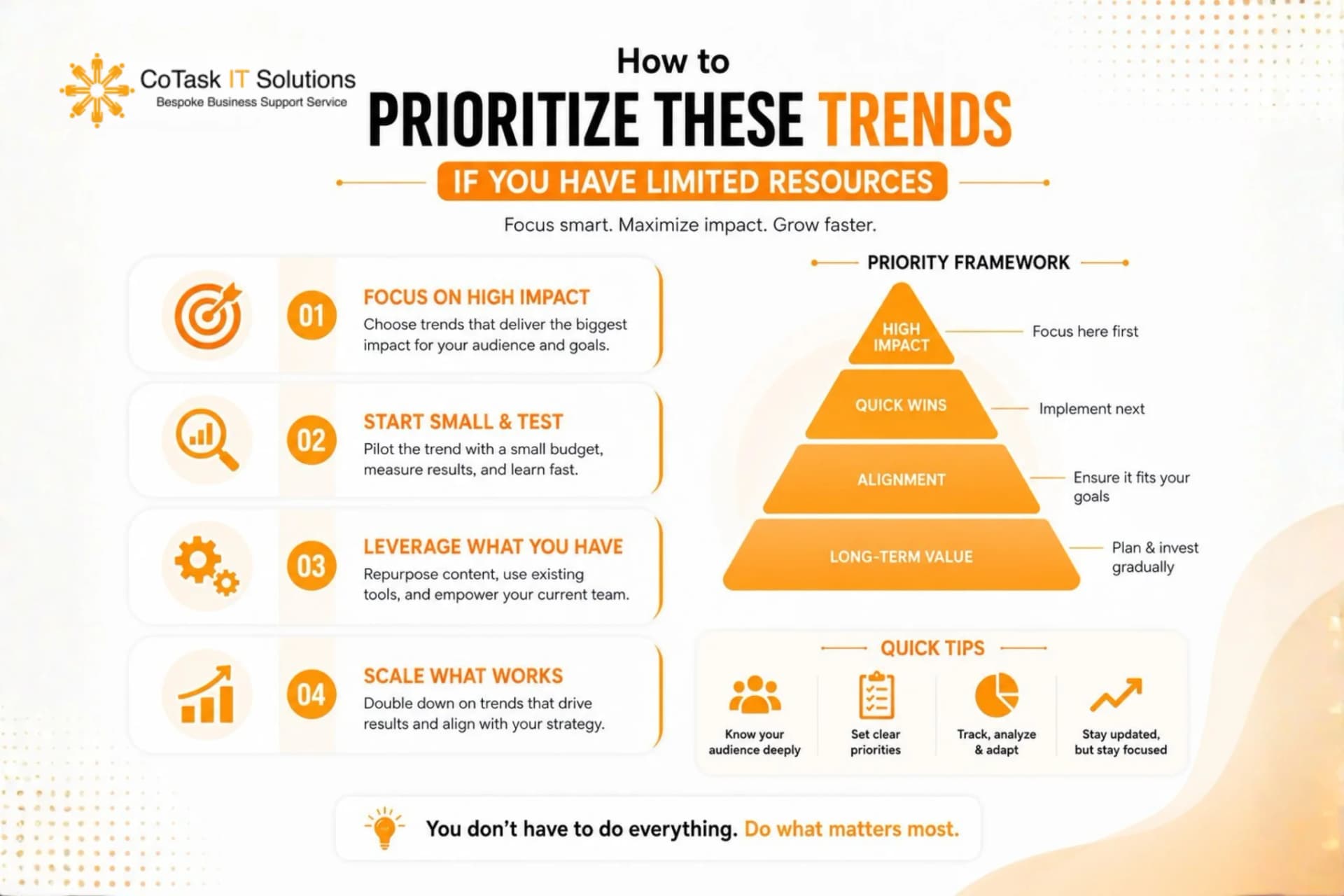
How to Prioritize These Trends If You Have Limited Resources
Not every business needs to chase all seven trends at once. If you're a small or mid-sized business with a lean team, here's a realistic order of operations:
- Start with community management — it costs time, not budget, and directly builds trust
- Layer in AEO-style captions — rewrite your captions to answer real questions your audience is searching for
- Test one short-form commerce format — a single well-made product video series before committing to full storefront builds
- Add AI tools for efficiency, not replacement — speed up your workflow without losing your brand voice
- Revisit creator partnerships last — this requires the most vetting and the most budget, so get your foundational content right first
Frequently Asked Questions
Final Thoughts
The businesses that will win on social media in 2026 aren't necessarily the ones with the biggest budgets — they're the ones paying attention to where consumer behavior is actually moving: toward AI-assisted but human-verified content, toward buying without leaving the app, and toward genuine two-way engagement instead of one-way broadcasting. Pick two or three of these trends that fit your resources and audience, execute them well, and you'll be ahead of most of your competitors who are still running a 2023 playbook.
Want to see where digital marketing as a whole is headed beyond social? Check out our take on the future of SEO for the bigger cross-channel picture.
Visit Us: cotasks.com