
Amazon PPC Campaign Structure: The Complete Guide
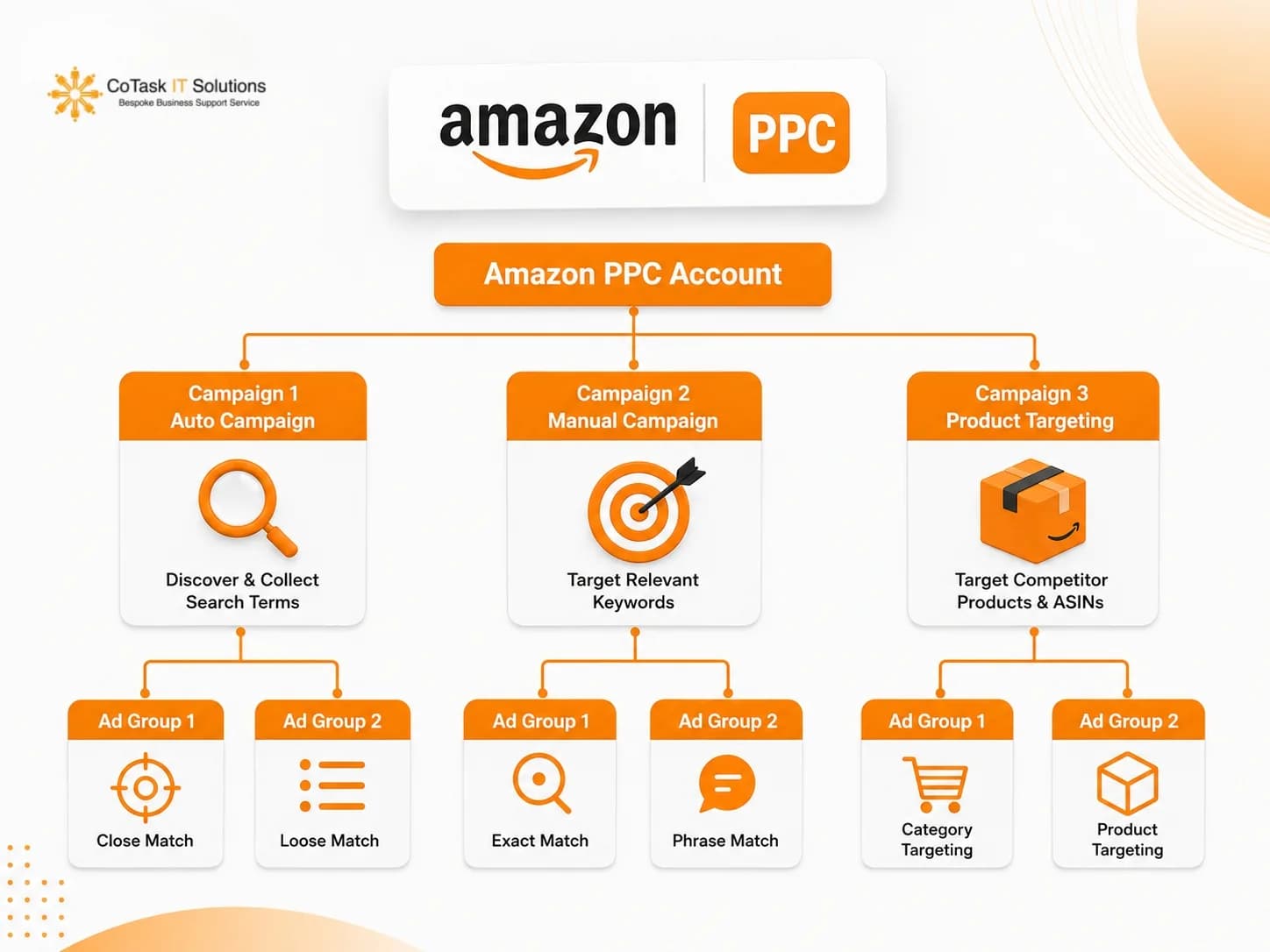
Quick answer: A well-structured Amazon PPC account separates campaigns by match type and funnel stage — typically Auto, Broad, Phrase, and Exact campaigns per product or product group — with each ad group built around a single, tightly related set of keywords or ASINs. This structure isolates performance data by keyword intent, lets you control bids precisely, and stops high-intent "Exact" budgets from being diluted by broad, exploratory traffic. Most professionally managed accounts in 2026 run a median ACoS around 30-34% and a TACoS between 10-15%, though both vary heavily by product category.
If you've ever opened an Amazon Ads account and found ten keywords, three match types, and a single budget all crammed into one campaign, you're not alone — and you're also not seeing anywhere close to what that account could do. Campaign structure is the single most common reason Amazon PPC underperforms, and it's almost never about bid amounts.
This guide breaks down exactly how a properly structured account is organized, why each layer exists, and how to benchmark your own account against 2026 industry data.
Why Campaign Structure Matters More Than Bids
Amazon's ad auction rewards accounts that give it clean, isolated performance data. When one campaign mixes match types, keyword intent, and products, Amazon's algorithm — and you — can't tell which specific keyword, product, or audience is actually driving profitable sales. The result is wasted spend on broad, low-intent clicks that never should have shared a budget with your best-converting exact-match terms.
A clean structure fixes this by isolating variables. Once each ad group contains only one type of intent, the data becomes readable, bid adjustments become precise, and negative keyword management becomes far easier to execute correctly. This is the foundation every professionally managed Amazon PPC campaign structure is built on before any bid strategy gets layered on top.
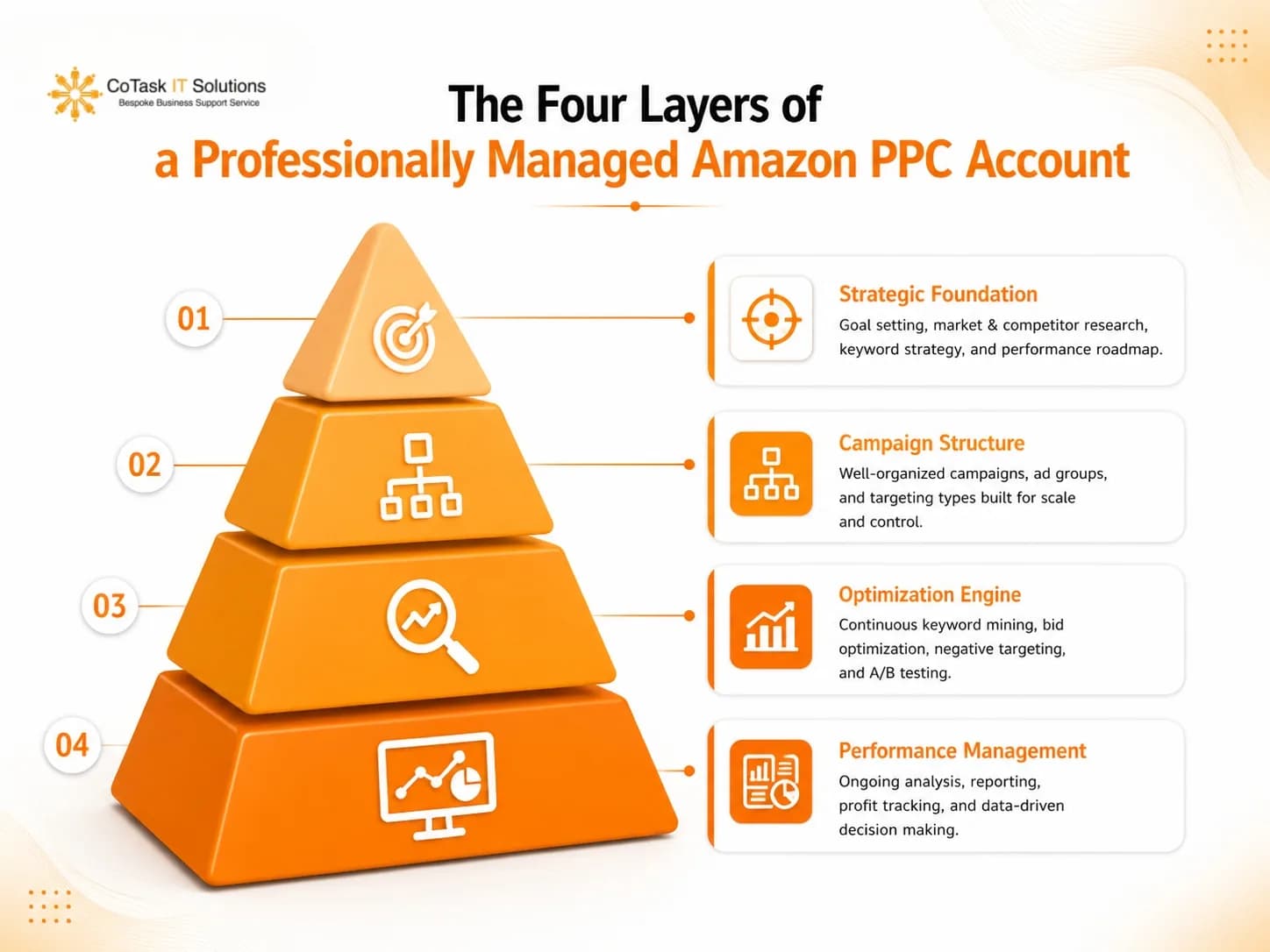
The Four Layers of a Professionally Managed Amazon PPC Account
1. Campaign Type Layer
At the top level, campaigns are typically separated by objective, not by product:
- Sponsored Products — the core layer, driving the majority of ad-attributed sales for most sellers
- Sponsored Brands — used for brand awareness and multi-product showcase, usually mid-to-upper funnel
- Sponsored Display — used for retargeting shoppers who viewed your listing (or a competitor's) without purchasing
- Amazon DSP — reserved for larger catalogs running full-funnel, cross-channel campaigns
Most small-to-mid sellers should have Sponsored Products fully optimized before layering in Sponsored Brands or DSP.
2. Match Type Layer
Within Sponsored Products, campaigns are split by match type, each serving a different strategic job:
- Auto — Purpose: Keyword discovery — Amazon finds search terms for you. Typical Role: Research engine, not a profit engine.
- Broad — Purpose: Tests keyword variations and related terms at low bids. Typical Role: Top-of-funnel discovery.
- Phrase — Purpose: Captures a middle ground of intent and relevance. Typical Role: Mid-funnel refinement.
- Exact — Purpose: Targets only your highest-intent, proven-converting terms. Typical Role: Bottom-funnel, highest ROAS.
The Auto campaign isn't there to convert efficiently — it exists to feed your search term report, which is where you harvest new Phrase and Exact keywords and build your negative keyword list.
3. Ad Group Layer
Inside each campaign, ad groups should be built around a single, tightly related theme — either one product, one keyword cluster, or one closely related group of ASINs. A common structural mistake is putting unrelated keywords (or unrelated products) in the same ad group, which forces every keyword in that group to share a single default bid, even though their actual value to your business is completely different.
4. Keyword / Target Tiering
Within each ad group, keywords are tiered by performance, typically into three buckets:
- Winners — proven converters, moved to their own Exact campaign with higher bids
- Testing — moderate performers still gathering data
- Negatives — irrelevant or non-converting terms, added as negative exact or negative phrase to stop wasted spend
This tiering is ongoing. A keyword doesn't get set once — it moves between these buckets as the data accumulates, usually reviewed weekly in an actively managed account.
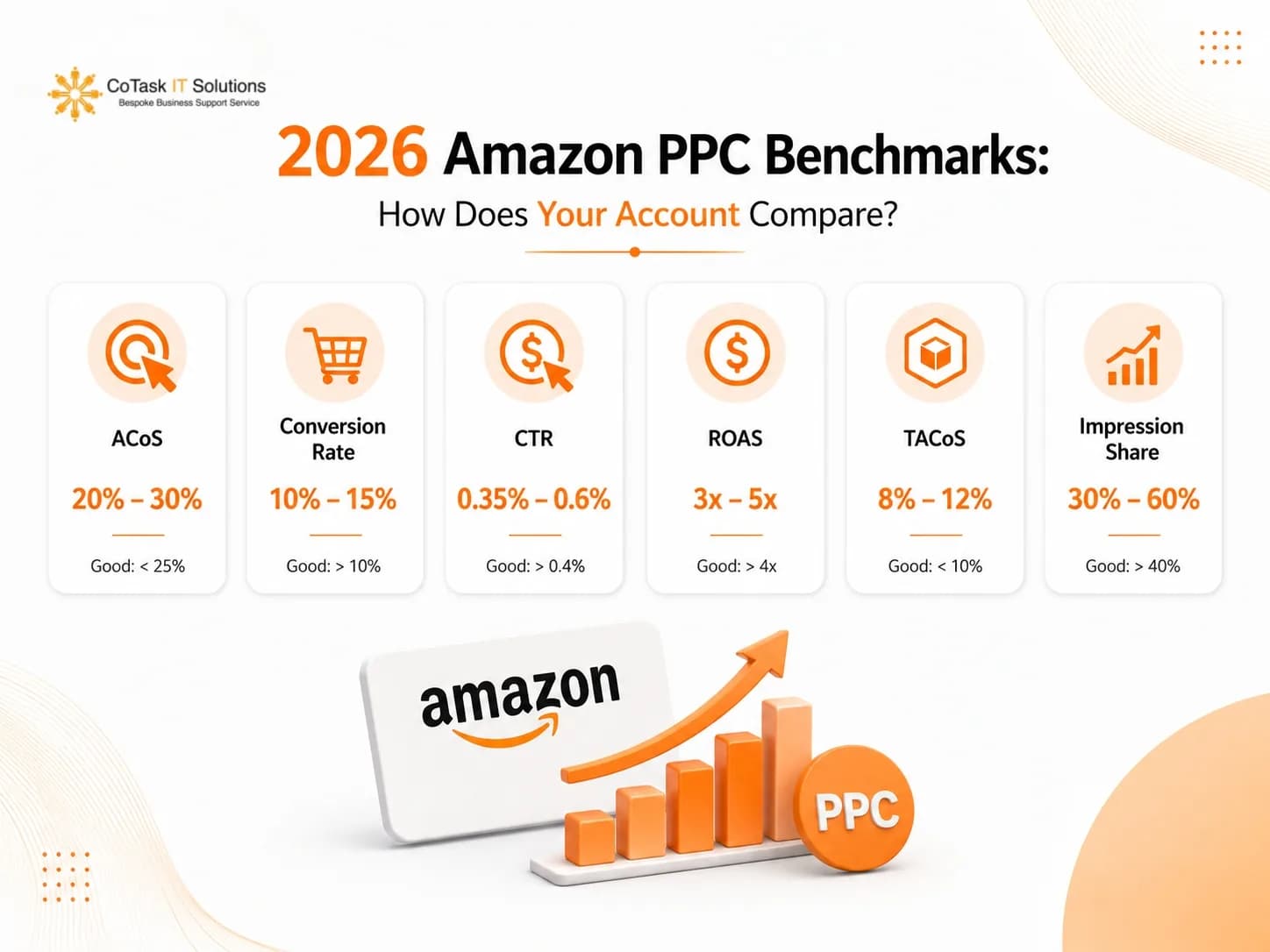
2026 Amazon PPC Benchmarks: How Does Your Account Compare?
Structure only matters if you can measure whether it's working. Based on Ad Badger's 2026 Amazon advertising benchmark data and Autron's 2026 category benchmarks, compiled across Sponsored Products accounts, here's what a healthy account with a well-managed Amazon PPC campaign structure typically looks like:
- ACoS — 2026 Typical Range: 25%–40% (category median ~30–34%). What It Tells You: Ad spend efficiency relative to ad-driven sales.
- TACoS — 2026 Typical Range: 10%–15%. What It Tells You: How much of total sales ads are driving overall.
- CPC — 2026 Typical Range: ~$1.10–$1.20 (higher in competitive categories). What It Tells You: Cost per click, rising steadily year over year.
- CTR — 2026 Typical Range: 0.4%–0.6%. What It Tells You: How compelling your ad creative and listing images are.
- Conversion Rate — 2026 Typical Range: 10%–12%. What It Tells You: Listing quality, pricing, and review strength.
These figures vary significantly by category — Clothing & Apparel typically runs a much higher ACoS than Books or Food & Grocery, so the honest benchmark is always your own category median, not the blended cross-category average. If your account structure is clean but your ACoS still sits well above your category's typical range, the issue is usually listing quality (images, reviews, pricing) rather than the campaigns themselves.
Common Structural Mistakes That Inflate ACoS
- Mixing match types in one campaign — makes it impossible to bid Exact and Broad terms differently, even though they deserve very different bids
- Running Auto campaigns indefinitely without harvesting — you pay to discover keywords and then never act on what you learned
- One giant ad group for an entire catalog — a bid that works for your best-seller crushes a slower-moving product's visibility
- No negative keyword cadence — irrelevant search terms keep draining budget month after month
- Ignoring Sponsored Brands and Display entirely — leaves upper-funnel and retargeting opportunity untouched, even when Sponsored Products alone is profitable
FAQ: Amazon PPC Campaign Structure
How many campaigns should a new Amazon PPC account have?
A new account typically starts with one Auto and one Broad campaign per core product to begin gathering search term data, then expands into Phrase and Exact campaigns once 2–4 weeks of data reveal which keywords are converting.
Should Auto and Manual campaigns share a budget?
No. Auto and Manual campaigns should always have separate budgets, since Auto is a discovery tool with lower expected efficiency, and sharing a budget lets it consume spend that should go to your proven Exact-match keywords.
How often should Amazon PPC campaign structure be reviewed?
An actively managed account is typically reviewed weekly for search term harvesting and negative keywords, with a full structural audit — checking ad group organization, match type splits, and campaign objectives — every 60–90 days.
What's the difference between ACoS and TACoS?
ACoS measures ad spend against ad-attributed sales only, while TACoS measures total ad spend against your total sales (organic and paid combined) — making TACoS a better long-term indicator of whether ads are actually growing the business, not just buying sales that would have happened anyway.
When Your Account Has Outgrown DIY Management
Campaign structure is straightforward to explain but time-intensive to execute correctly — search term harvesting, negative keyword additions, and bid tiering all need to happen on a consistent weekly cadence, not as a one-time setup. If your account structure hasn't been touched since launch, that's usually the fastest place to recover wasted ad spend.
Cotasks IT Solutions manages Amazon PPC accounts for sellers across the USA and UAE, building and maintaining the exact four-layer structure covered in this guide. Get a free Amazon PPC account review to see where your current structure is leaking.