
Namshi Seller Account: Is the Seller Partner Program Right for You?
Read time: 11 minutes · Category: E-commerce / Marketplace Selling · Last updated: August 2026
The UAE is one of the fastest-growing e-commerce markets on the planet — and fashion is its single biggest category. Online fashion sales in the UAE are worth roughly USD 2.1 billion in 2025 and are projected to cross USD 3.3 billion by 2032, growing at a CAGR of about 6.67%, according to The Report Cubes' UAE online fashion market report. Fashion already holds a 22% share of UAE e-commerce and generates nearly 38.7% of total online revenue, per Ramsha Home's UAE e-commerce statistics.
At the centre of that opportunity sits Namshi — the Middle East's homegrown online fashion giant, founded in Dubai in 2011 and now part of the Noon Group. For fashion brands wondering where to sell next, the Namshi Seller Partner Program is one of the most talked-about options in the region.
But is a Namshi seller account actually right for your brand?
The short answer: Yes, for most fashion-first brands targeting UAE, Saudi, and GCC shoppers — it offers a fashion-only audience, zero setup fees, weekly payouts, and market-leading delivery logistics. But it isn't for everyone. In this expert guide, we break down exactly how the Namshi partner program works, the full Namshi seller requirements, commission costs, a step-by-step application process, and a clear framework to help you decide.
Key Takeaways (2-Minute Summary)
- Namshi is a fashion-only marketplace owned by the Noon Group, serving the UAE, Saudi Arabia, Kuwait, Qatar, Oman, Bahrain, and Egypt.
- No setup fees, no monthly fees — Namshi charges a commission per sale of roughly 4–27%, depending on the product category (most fashion categories land between 10–25%).
- Payouts are weekly, in local currency — a major cash-flow advantage over marketplaces that pay monthly.
- You need a registered business (trade license), VAT registration, and a valid bank account to apply. Sellers in the US, Turkey, and India get cross-border exemptions.
- Approval is selective — Namshi curates its catalog, so strong documentation and product quality matter.
- Fashion category leadership + Noon logistics make Namshi a strong second (or third) channel next to Amazon.ae and Noon.
What Is the Namshi Seller Partner Program?
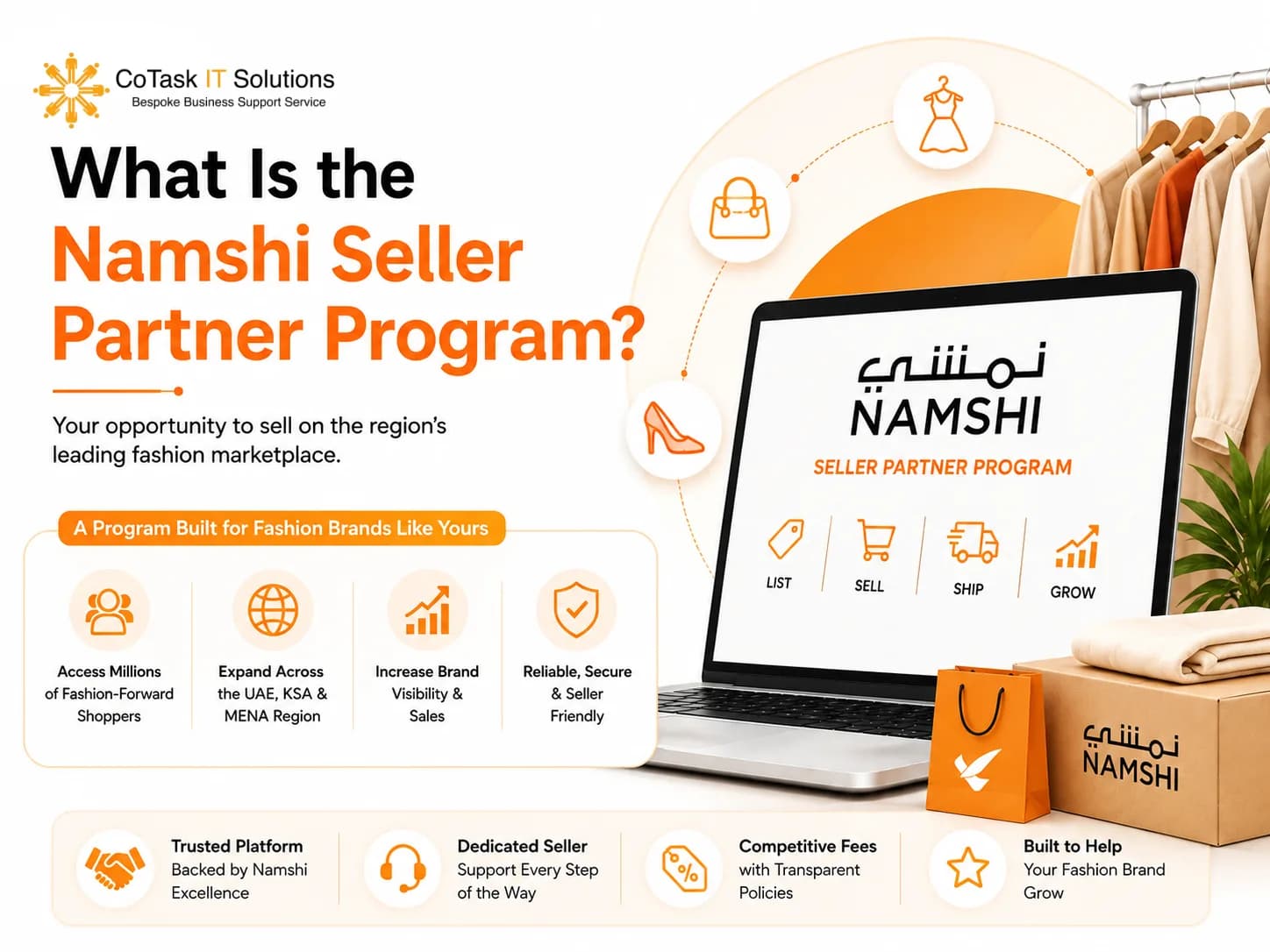
The Namshi Seller Partner Program is the marketplace arm of namshi.com. In simple terms: third-party fashion brands list their products on Namshi, Namshi handles the storefront, payments, marketing, and (in most cases) fulfilment, and the seller pays a commission on every sale. The seller keeps control of catalog, pricing, and inventory — while piggybacking on Namshi's traffic, brand trust, and delivery network.
To understand what you're signing up for, it helps to know the entity behind it:
- Founded: 2011, in Dubai, as part of the Rocket Internet / Global Fashion Group ecosystem.
- Acquired by Emaar Malls: 51% stake in 2017, full ownership by 2019.
- Acquired by Noon Group: announced August 2022, completed in early 2023, for USD 335.2 million, per MERetailNews' coverage of the Saudi Competition Authority approval.
Today Namshi describes itself as the Middle East's largest online fashion destination for women, men, and kids, spanning apparel, footwear, accessories, beauty, and homeware. It serves shoppers across the UAE, Saudi Arabia, Kuwait, Qatar, Oman, Bahrain, and Egypt, and industry trackers estimate the platform attracts on the order of 1.75 million monthly visits, according to ChannelEngine's Namshi marketplace guide.
That positioning matters for a fashion brand: Namshi isn't a "sell-everything" marketplace. Its shoppers arrive with fashion intent — the exact audience conversion gold is made of.
Why Sell Fashion Online in the UAE in 2026?
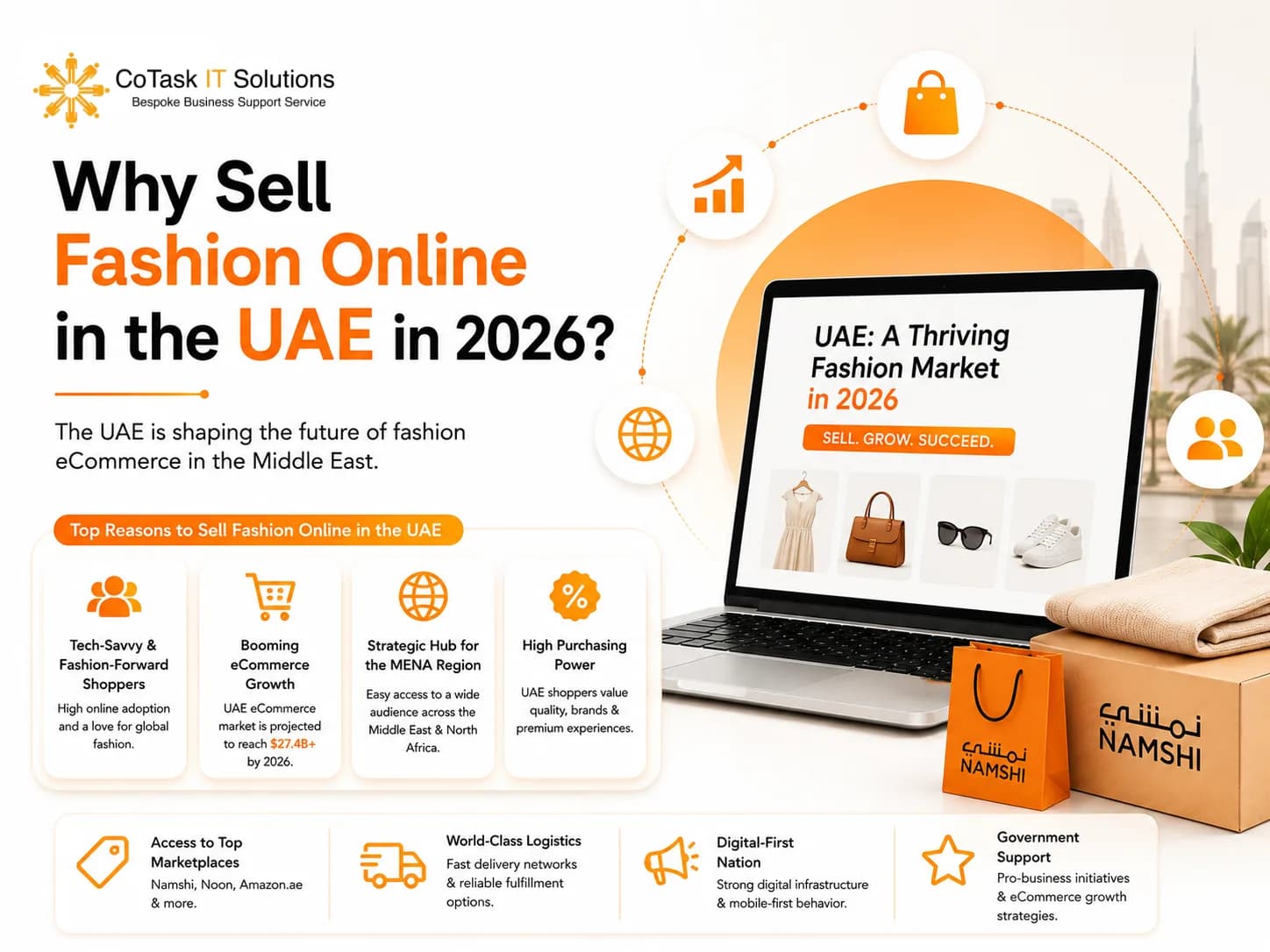
Before we dig into the Namshi seller requirements, it's worth zooming out. The regional tailwinds for a Namshi seller account are strong:
- Fashion leads UAE e-commerce. As noted, fashion is the #1 online category in the country, with the largest store count (roughly 17.7% of all UAE online stores are apparel) and the highest revenue share.
- Mobile-first shoppers. Nearly 79% of UAE e-commerce transactions happen on smartphones — and Namshi's app is one of the most-installed shopping apps in the region.
- Demand for both western and modest fashion. UAE shoppers buy everything from streetwear and athleisure to luxury modest wear — a breadth few markets offer.
- Same-day delivery expectations. Dubai consumers expect fast, reliable fulfilment, which is exactly what Namshi's logistics are built for.
In short, if you want to sell fashion online in UAE, the two questions every brand asks are: "Which marketplace?" and "Can I get approved?" Namshi answers the first one strongly — and the second one is what the rest of this guide is about.
Namshi Seller Requirements: The Complete Checklist
Let's get this out of the way: Namshi does not accept individual sellers or unregistered freelancers. A Namshi seller account is available only to officially registered businesses. Here is the full checklist of Namshi seller requirements, based on Namshi's partner onboarding process and marketplace integration documentation from ChannelEngine's Namshi marketplace guide:
| Requirement | Details |
|---|---|
| Trade license / commercial registration | LLC, free-zone company, or sole proprietorship in a supported market |
| VAT registration | Resident VAT registration for local sellers; non-resident VAT registration for cross-border sellers |
| Valid business bank account | Bank details submitted via a cancelled cheque / bank statement, or a letter on bank letterhead |
| Brand & product documentation | Brand profile, product catalog, and categories aligned with Namshi's fashion focus |
| Product data standards | GTIN for each product, minimum 6-digit HS code, high-resolution images (2–8 per product), detailed English descriptions |
| Authenticity & quality standards | Namshi curates its catalog — genuine branded goods with professional imagery and packaging |
| Existing sales track record (preferred) | Past e-commerce performance improves approval odds, though new businesses can also apply |
Cross-border sellers: a big advantage
Here's a detail most guides miss: merchants from the United States, Turkey, and India are exempt from the trade license, VAT registration, and local bank account requirements when selling cross-border. If you're a fashion brand in one of those countries, your path to a Namshi seller account is significantly simpler. Sellers from other regions can request an exemption case-by-case.
Pro tip: Because Namshi's onboarding is partially invitation-based, many international brands work with a marketplace management partner to handle documentation, approval, and listing setup — more on that at the end of this guide.
How to Create a Namshi Seller Account (Step by Step)
Namshi doesn't offer a fully self-serve "create account and sell instantly" flow like Amazon — the process runs through Namshi's partner onboarding team. Here's how to create a Namshi seller account in five steps:
Step 1: Prepare your business documentation
Gather your trade license, VAT certificate, bank account proof, brand profile, and a product catalog with categories, GTINs, and HS codes. Incomplete documentation is the #1 reason applications stall.
Step 2: Apply via the Namshi partners portal
Visit Namshi's website, find the seller/partner section (or contact their seller support team), and submit the application form with your business details and product categories. Expect questions about your inventory size, sourcing reliability, and compliance with Namshi's quality standards.
Step 3: Get approved & onboarded
Once approved, you gain access to the Namshi seller portal, receive your partner/warehouse credentials, and sign the commercial agreement. This is also where fulfilment setup (Namshi Fulfilled vs. self-fulfilled) is decided.
Step 4: Build and upload your listings
Upload products with:
- High-resolution images (up to 8 per product) showcasing design, fabric, and fit
- Keyword-rich titles and long descriptions — include terms like "women's sneakers UAE" or "men's casual shirts" to boost search visibility on and off Namshi
- Accurate GTIN and HS codes for smooth customs and catalog matching
Step 5: Start selling — and get paid weekly
Namshi's fulfilment network handles delivery (including same-day options in Dubai and next-day across much of the UAE), and payouts run weekly in local currency — a meaningful cash-flow advantage.
Namshi Commission & Fees: What It Really Costs
Here's the cost structure in plain numbers:
| Fee | Amount |
|---|---|
| Setup fee | None |
| Monthly subscription | None |
| Commission per sale | ~4%–27% depending on product category (most fashion categories: 10–25%) |
| Payment frequency | Weekly, in local currency (AED, SAR, etc.) |
| Fulfilment | Namshi-managed (same-day Dubai, next-day UAE) with fast-return handling |
| Advertising tools | Available as optional paid promotions |
Example math: A AED 150 dress sold at a 15% commission means AED 22.50 goes to Namshi and AED 127.50 is yours before product cost and fulfilment. At a 25% commission (premium categories), that same dress leaves AED 112.50.
The commission range varies by category and market, so confirm exact rates for your category during onboarding. Two important nuances:
- No fixed costs — if you don't sell, you pay nothing. That makes a Namshi seller account unusually low-risk for testing a new market.
- Fashion's return problem — UAE fashion return rates run high (size and fit issues are the top reason), so factor reverse logistics into your margins. Strong size charts and accurate photography are your best defence.
Namshi vs. Other Channels for Selling Fashion in the UAE
A quick comparison to put the Namshi partner program in context:
| Channel | Best For | Commission | Notes |
|---|---|---|---|
| Namshi | Fashion-first brands in UAE/KSA/GCC | ~4–27% | Fashion-only audience, weekly payouts, no fixed fees, Noon logistics |
| Amazon.ae | Everything, maximum reach | 5–15% | Massive traffic but generic audience; fashion competes with everything |
| Noon | General marketplace, big sale events | 7–15% | Same group as Namshi; huge White Friday traffic |
| Ounass | Luxury / premium positioning | Negotiated | Invite-only, high-end curation |
| Own DTC store | Full margins & data | — | You build all traffic, trust, and logistics yourself |
The pattern is clear: Namshi occupies the "fashion-specialist" slot. Its shoppers have higher fashion intent, its app experience is style-first, and its brand equity in the region is built on fashion — not toasters and phone chargers. For a fashion label, that audience quality often justifies the higher commission band compared to generalist marketplaces.
Pros and Cons of a Namshi Seller Account
The Upsides
- Fashion-only, high-intent traffic — no wasted impressions on non-buyers
- Zero fixed costs — pay only when you sell
- Weekly payouts — better cash flow than monthly-paying platforms
- Trusted delivery network — same-day Dubai, next-day UAE, managed returns
- Noon Group backing — financial stability, logistics muscle, and access to mega sale events
- Regional brand credibility — "Available on Namshi" is a trust signal for GCC shoppers
The Downsides
- Commission eats margins — 10–25% on fashion requires disciplined pricing
- Selective approval — Namshi curates; not every brand gets in
- Marketplace competition — you'll sit next to global brands and aggressive discounters
- Return rates — fashion's inherent size/fit returns cut into net revenue
- Less control — pricing, promotions, and customer data are governed by Namshi's rules
- Region-specific compliance — VAT, customs, and cross-border rules add admin overhead
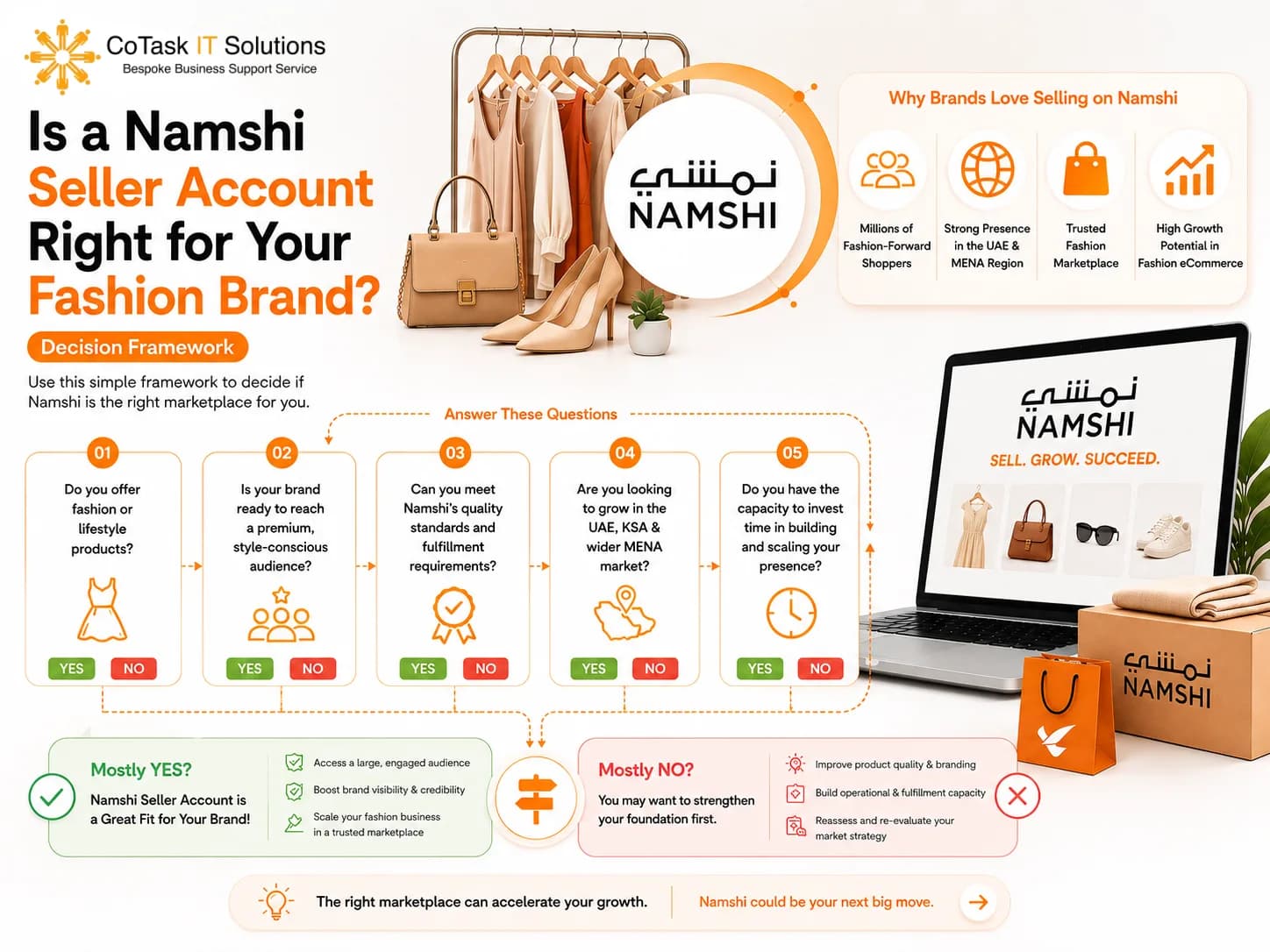
Is a Namshi Seller Account Right for Your Fashion Brand? (Decision Framework)
Ask yourself these six questions:
- Do you sell fashion? Apparel, footwear, accessories, beauty, or homeware? If yes, Namshi is a natural fit. If you sell electronics or groceries, it isn't.
- Are your margins 40%+? After a 10–25% commission plus fulfilment, thin-margin brands struggle. Premium and mid-premium brands thrive.
- Do you target UAE/KSA/GCC customers? That's Namshi's core market. Brands targeting only the US or Europe will find little overlap.
- Is your brand authentic and documented? Registered trademark, genuine products, professional imagery — these are non-negotiable for approval.
- Can you keep inventory in stock? Namshi's algorithm and shoppers reward availability. Out-of-stock listings lose ranking and trust fast.
- Are you ready for marketplace rules? If you need full control over pricing and customer data, a DTC store stays essential — Namshi should be an additional channel, not your only one.
Choose Namshi if: you're a fashion brand with healthy margins, a documented brand, and GCC ambitions — it's the region's most focused fashion marketplace, with the lowest fixed-cost entry point.
Think twice if: you sell non-fashion categories, you're a brand-new label with no catalog readiness, or your margins can't absorb 10–25% commission plus returns.
7 Expert Tips to Win on Namshi Once You're In
- Optimize listings like you're writing for Google. Keyword-rich titles and descriptions (think: "women's abaya UAE", "men's sneakers Saudi Arabia") improve on-platform search AND off-platform discoverability.
- Invest in photography. 8 high-res images per product, on-model and flat-lay, dramatically cut returns and lift conversion.
- Publish accurate size charts. Fit-related returns are the #1 margin killer in online fashion — fix it before it costs you.
- Sync inventory daily. Use an integration or a management partner to prevent overselling and out-of-stock ranking drops.
- Join the sale calendar. White Friday, Dubai Shopping Festival, Ramadan, and seasonal sales drive a huge share of GCC e-commerce revenue — plan stock and promotions around them.
- Use Namshi's ad tools. Promoted placements accelerate early sales velocity, which improves organic ranking.
- Collect reviews aggressively. Post-purchase follow-ups and quality control on every order build the social proof that converts.
Common Mistakes to Avoid as a Namshi Seller
- Submitting incomplete documentation — delays approval by weeks; prepare everything upfront
- Ignoring VAT obligations — UAE and GCC VAT compliance is mandatory; get advice before you launch
- Uploading low-quality images — Namshi is a fashion-first platform; presentation is everything
- Mis-categorizing products — wrong categories hurt discoverability and can trigger listing removals
- Running out of stock during sales — nothing kills marketplace ranking faster
- Copy-pasting Amazon listings — Namshi's audience and format need tailored, regionalized content
Frequently Asked Questions
Ready to Open Your Namshi Seller Account? Let Cotasks Handle the Heavy Lifting
Getting approved on Namshi — and staying profitable once you're in — is a specialized skill. Documentation, category mapping, listing optimization, inventory sync, and compliance all have to be right from day one, and mistakes cost you weeks of momentum.
That's exactly what Cotasks does. As a dedicated marketplace management and e-commerce services provider, Cotasks helps fashion brands across the region:
- Namshi seller account setup & approval — complete registration, brand approval, and documentation handling
- Listing creation & optimization — keyword-rich, conversion-focused product content that ranks on and off Namshi
- Catalog & inventory management — day-to-day listing upkeep, stock sync, and pricing support
- Performance monitoring — sales analytics, competitor tracking, and promotion planning for sale seasons
- Multi-marketplace strategy — Namshi, Noon, Amazon.ae, and DTC, managed as one channel ecosystem
If you'd rather launch fast and skip the trial-and-error, talk to the Cotasks team about getting your fashion brand live on Namshi within weeks, not months.
Final Verdict: Should Your Fashion Brand Sell on Namshi?
The Namshi Seller Partner Program is one of the smartest, lowest-risk marketplaces for fashion brands targeting the UAE and the wider GCC. The economics are transparent (commission-only, weekly payouts), the audience is fashion-focused, and the Noon Group's logistics and scale give you infrastructure you couldn't build alone.
It's not a silver bullet — approval is selective, commissions bite into thin margins, and fashion returns are an unavoidable reality of the category. But for a brand with strong margins, authentic products, and GCC ambitions, a Namshi seller account is not just "right" — in 2026, it's close to essential for anyone serious about how to sell fashion online in UAE.
Your next step: prepare the documentation checklist above, and if you want expert help getting approved and profitable, Cotasks is one conversation away.